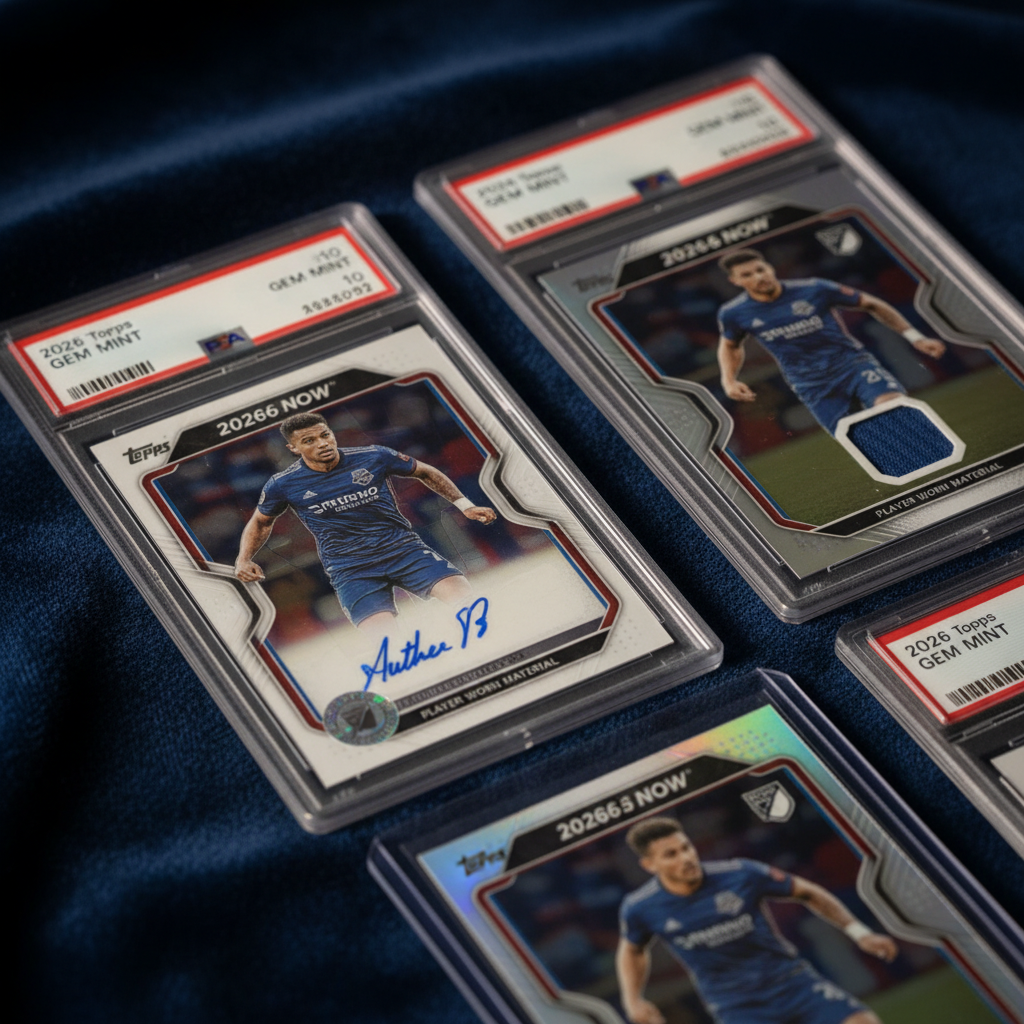
Topps Now MLS is back for 2026, and the on-demand format that turned World Cup moments into instant cardboard is now rolling through the domestic soccer calendar with a fresh checklist built around the league's biggest names and milestone moments.
The program operates on the same mechanics that have defined Topps Now since its 2016 launch: cards are available for a limited window — typically 24 to 72 hours — after which the print run locks and the order closes. No overproduction, no warehouse surplus. Whatever sold during the window is what exists. That scarcity model has driven some genuinely impressive secondary market action on prior MLS Topps Now releases, particularly cards tied to Lionel Messi's Inter Miami appearances, which routinely cleared $50–$150 raw on eBay in the weeks following their release windows.
What's on the Checklist
The 2026 checklist spans the full MLS season and includes standard base cards alongside the harder-to-pull premium tiers that serious collectors are actually chasing. The key insert categories include:
- Autographs — on-card signatures tied to featured players, with print runs varying by window demand
- Relics — jersey and equipment swatches embedded in card stock, typically numbered to 99 or below
- Short Prints — parallel variants with dramatically reduced print runs relative to the base card from the same window
- Parallel tiers — color-coded editions (Gold, Blue, Red) numbered at various thresholds, with 1-of-1 SuperFractors anchoring the top of the stack
Exact print runs won't be known until each window closes — that's the nature of the format — but historical MLS Topps Now data gives a reasonable baseline. Non-Messi base cards from 2024 typically printed between 200 and 800 copies, while Messi-adjacent cards regularly exceeded 2,000 units per window. The 2026 checklist will almost certainly follow that same gravitational pull toward whatever Inter Miami content appears.
The MLS Moment and What It Means for Demand
The timing here matters. The 2026 FIFA World Cup is being co-hosted by the United States, Canada, and Mexico, and MLS has spent the better part of three years positioning itself as a legitimate top-flight product — not just a retirement league — ahead of that spotlight. The league's television deals, expansion franchises, and high-profile international signings have pushed casual soccer interest in North America to levels that didn't exist five years ago.
That cultural momentum translates directly to on-demand card demand. Topps Now thrives when there's a reason to care about a specific moment, and the 2026 MLS season runs parallel to World Cup qualifying drama, roster construction decisions, and a domestic fanbase that's more engaged than it's ever been. Collectors who ignored MLS Topps Now in 2022 and 2023 paid a premium to catch up on Messi cards when his Inter Miami arrival turned a sleepy checklist into a genuine market event.
The relic and autograph cards are where the real secondary market action concentrates. A Messi auto from the 2023 Topps Now MLS run — numbered to 10 — moved through private sales in the $3,000–$5,000 range depending on condition and timing. That's not a comp you can apply universally across the checklist, but it illustrates the ceiling when the right player meets the right scarcity tier.
How to Play the On-Demand Format
For collectors approaching this as an investment vehicle rather than a pure hobby purchase, the calculus on Topps Now is specific. Base cards with print runs above 500 rarely hold meaningful secondary market premiums beyond the first 30 days unless the featured player has a significant moment post-release — a championship, a transfer, an international breakthrough. The short prints and numbered parallels are a different story.
The window-based model also creates a patience premium. Collectors who wait for the window to close, assess the final print run, and then buy on the secondary market often find better value than those who order at retail during the window — unless the card ends up printing under 300 copies, at which point retail was the obvious play in hindsight.
Grading these cards adds another layer. PSA and BGS both process Topps Now submissions, and the card stock on modern Topps Now product tends to grade well — centering is the primary variable. A PSA 10 on a numbered relic or auto card from a sub-100 print run is a genuinely scarce object. Population reports on these cards are often in the single digits simply because most collectors don't submit them.
The 2026 MLS season is shaping up to be the most commercially significant in the league's history. Topps Now will be there for every moment worth commemorating — and given the World Cup backdrop, there should be plenty of them.