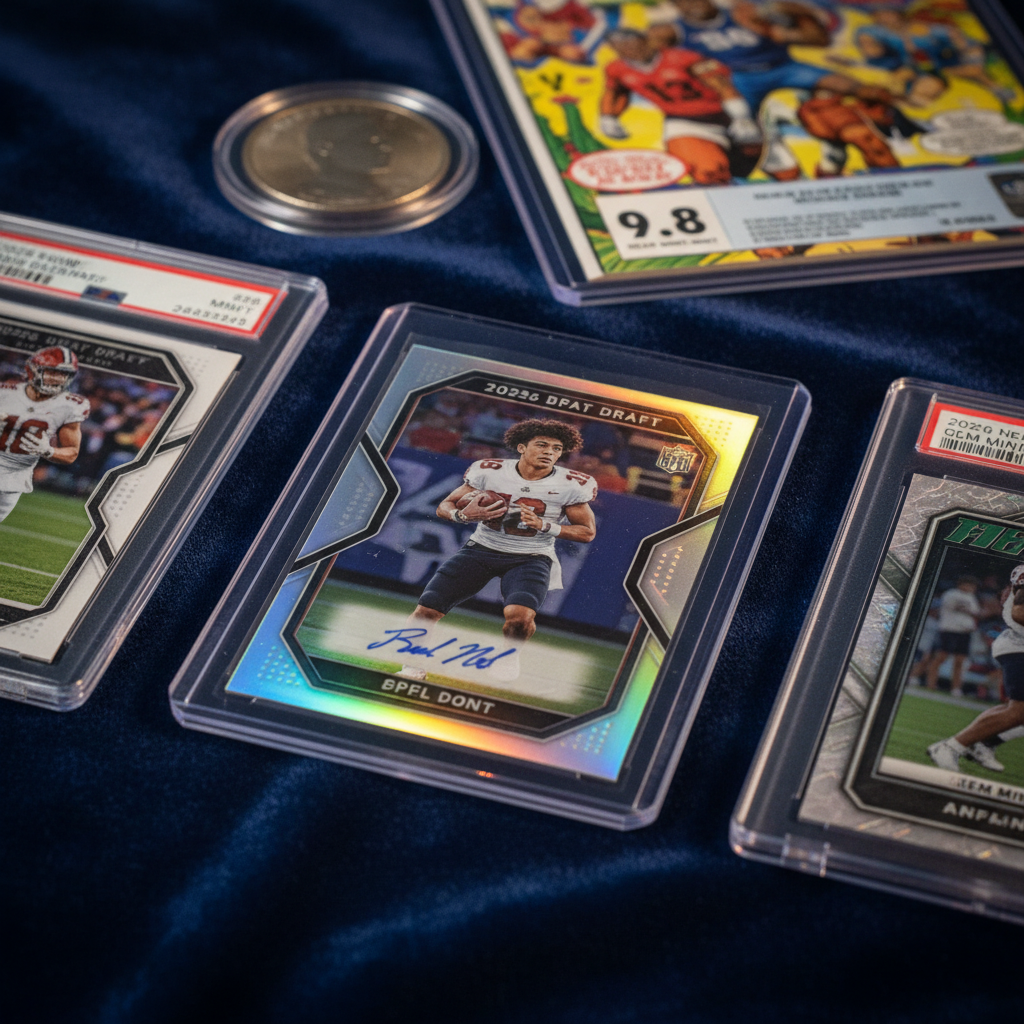
Topps Now's NFL Draft cards have become one of the most reliable early-market indicators for rookie card demand, and the 2026 edition is arriving with a structure that serious collectors should map out before the first pick is announced. Print-on-demand windows close fast, populations stay low, and the autograph parallels from this set have a track record of punching well above their issue price at auction.
The format is familiar: cards go on sale for a limited window — typically 48 to 72 hours — immediately following the NFL Draft, with print runs determined entirely by orders placed during that window. No artificial scarcity, no hobby box lottery. What you see is what gets printed. That transparency is a feature, not a bug, and it's why Topps Now NFL Draft cards have carved out a legitimate secondary market niche distinct from flagship rookie products.
What's in the 2026 Checklist
The 2026 checklist follows the tiered architecture Topps has refined over the past several cycles. Base cards cover first-round picks, with parallel structure running through Blue, Gold, Red, and SuperFractor tiers — the latter numbered to 1. Autograph versions are available at multiple levels, and the Chrome Autograph parallels represent the set's most coveted chase cards.
Chrome integration has been the single biggest value driver in recent Topps Now NFL Draft releases. The 2024 cycle demonstrated this clearly: base autos from top-five picks were moving at modest premiums within days of delivery, but Chrome Auto versions of the same players — with print runs often in the single or low double digits — were clearing multiples of that at Heritage Auctions and Goldin within the first 30 days. The lesson for 2026 is straightforward. If you're treating this set as an investment rather than a collecting exercise, the Chrome tier is where the leverage lives.
Parallels beyond Chrome include:
- Blue Parallel — numbered to 49
- Gold Parallel — numbered to 25
- Red Parallel — numbered to 10
- SuperFractor — 1/1
- Chrome Autograph — numbered to 10
- Chrome Auto SuperFractor — 1/1
Population context matters here. Because print runs are order-driven, a hyped prospect in a strong draft class can generate a base card with several thousand copies while a mid-round sleeper might land at under 200. That variance is exactly what creates grading arbitrage — a PSA 10 on a 175-copy print run is a fundamentally different asset than a PSA 10 on a 3,000-copy run, even if the catalog entry looks identical.
The Draft Class Factor
The 2026 NFL Draft class is headlined by quarterback prospects who have been generating legitimate pre-draft buzz, and quarterback cards have historically dominated Topps Now NFL Draft secondary market activity. The 2021 cycle — featuring Trevor Lawrence and Zach Wilson at the top — remains the high-water mark for the product line, with Lawrence Chrome Autos reaching four-figure territory within weeks of delivery. The 2023 class, led by Bryce Young and C.J. Stroud, showed that even a two-QB race at the top of the board is enough to sustain elevated demand across the entire first-round checklist.
A deep, quarterback-heavy draft class in 2026 would be the most favorable demand scenario for this product. Skill position players — particularly wide receivers with name recognition coming out of college — have also shown strong Topps Now performance, especially when their NFL landing spot is a high-profile market.
The print-on-demand model means collectors are essentially pre-ordering against draft-night excitement, which introduces timing risk that traditional hobby products don't carry. A player who slides out of the first round or lands in an unfavorable situation can see demand evaporate before cards even ship. That's the volatility premium baked into this format, and it cuts both ways.
Grading and the Secondary Market Window
Topps Now cards grade well when handled correctly — the card stock is consistent and the print quality has improved meaningfully since the early years of the product. PSA and BGS both handle these submissions routinely, and the turnaround math matters: cards typically ship four to six weeks after the order window closes, which means graded copies don't hit the secondary market until late summer at the earliest.
That delay creates a window. Raw copies of high-profile autos often trade immediately on eBay and through private dealer networks, sometimes at significant premiums to issue price. Collectors who can identify the breakout players early — before graded populations establish a ceiling — have historically captured the best returns in this format.
The 2026 Topps Now NFL Draft order window opens in conjunction with the draft itself. Given what the last three cycles have demonstrated about Chrome Auto scarcity and the outsized impact of quarterback class depth, this is a product that rewards preparation over impulse. Know your targets before the picks are announced. The window doesn't wait.