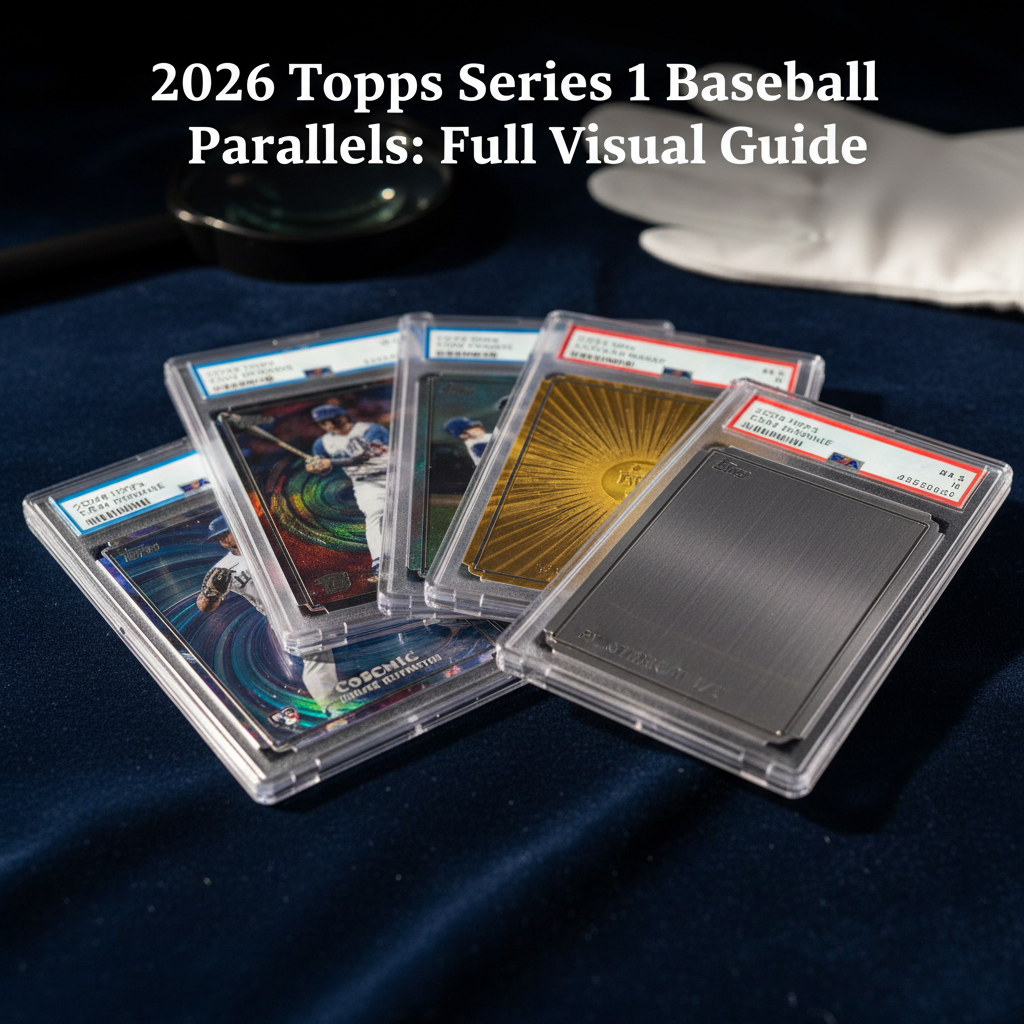
Topps has never made parallel hunting simple, and 2026 Series 1 is no exception. With the product hitting hobby shops and online breaks in the coming weeks, collectors are already mapping out which foil patterns, color borders, and short-print tiers are worth chasing — and which ones exist primarily to inflate pack counts. This guide breaks down what's in the set, what it looks like, and what the market history of Series 1 parallels tells us about where value is likely to land.
The Parallel Ladder: What Topps Built for 2026
Series 1 has always run a tiered parallel structure, and 2026 follows the established framework with enough visual variation to keep things interesting. At the base level, you're looking at the standard foilboard parallels — Gold, Silver, and Rainbow Foil — that fall at relatively accessible rates and function more as filler than as genuine chase cards for most collectors.
The mid-tier is where things get more competitive. Gold parallels, numbered to /2026 in a nod to the product year, sit in that sweet spot where they're scarce enough to carry real secondary market weight but common enough that set builders can realistically acquire them. Historically, Gold numbered parallels of star rookies from Series 1 have opened strong and cooled within 60–90 days of release as supply catches up to initial demand. The 2024 Topps Series 1 Gold of Jackson Holliday is instructive here — it peaked around $85–$110 in the first month before settling into the $40–$60 range by midsummer.
Above that, the print-run compression gets serious. Black parallels (numbered /67) and Platinum Ice (numbered /10) are the formats that drive real money in the hobby. A PSA 10 Black parallel of a top-tier rookie can command multiples of the base card — sometimes 20x or more — and the population counts stay low enough that graded examples hold their premium. One-of-one Superfractors, as always, sit at the apex. They're less investments than they are trophies, and pricing is almost entirely driven by the player and the timing of the sale.
- Rainbow Foil — High-volume, no print run, accessible price point
- Gold — Numbered /2026, the workhorse of the parallel ladder
- Independence Day — Numbered /76, seasonal flag-pattern design
- Black — Numbered /67, strong collector demand, grading-friendly
- Platinum Ice — Numbered /10, low pop, meaningful secondary market
- Superfractor — 1/1, the ceiling of the chase
Pattern Differences and Why They Matter to Graders
One underappreciated aspect of Series 1 parallels is how dramatically the foil texture and border treatment vary across tiers — and how that variation affects grading outcomes. Rainbow Foil cards, with their holographic surface, are notoriously prone to surface scratches that tank PSA and BGS grades. Collectors pulling Rainbow Foils for submission should handle them with gloves immediately out of the pack. BGS has historically been slightly more forgiving on Rainbow Foil surface assessments, but neither service gives them a free pass.
Black parallels, by contrast, have a matte-adjacent finish that tends to photograph well under grading lights and holds up better in transit. That's part of why Black parallel PSA 10s consistently command a premium over their raw counterparts at a higher multiplier than you'd see on the base card. The grade is more achievable, which paradoxically makes the graded population more competitive — but it also means a PSA 10 Black of a superstar rookie is a realistic target, not a pipe dream.
The Independence Day parallel — numbered to /76 and featuring a flag-pattern foil treatment — has developed a genuine collector following over the past several years. It's not just a novelty. The design is distinctive enough that it photographs well for social media, which drives visibility and, ultimately, auction results. Heritage Auctions and Goldin have both seen Independence Day parallels of key rookies clear $200–$400 in PSA 10 for high-demand players in recent years.
Where to Focus in 2026
The 2026 rookie class will shape the value ceiling for this entire product. Without confirmed breakout names yet, the smart play at release is to focus on the mid-tier parallels — Gold and Independence Day — of players with strong prospect pedigree and hold for the first month of the season. The market for Series 1 parallels is almost always reactive to on-field performance, and early-season hot streaks can move prices faster than almost any other catalyst in the baseball card market.
For investors rather than collectors, the Platinum Ice tier deserves attention. With only 10 copies of each card in existence, a single strong auction result can reset the comp for every remaining raw and graded copy. That asymmetry — low supply, price-sensitive comps — makes it one of the more interesting speculative plays in a flagship release.
Series 1 has been Topps' most reliable annual product for decades, and the parallel structure is refined enough at this point that the real variable is always the players. In 2026, that uncertainty is the entire story.