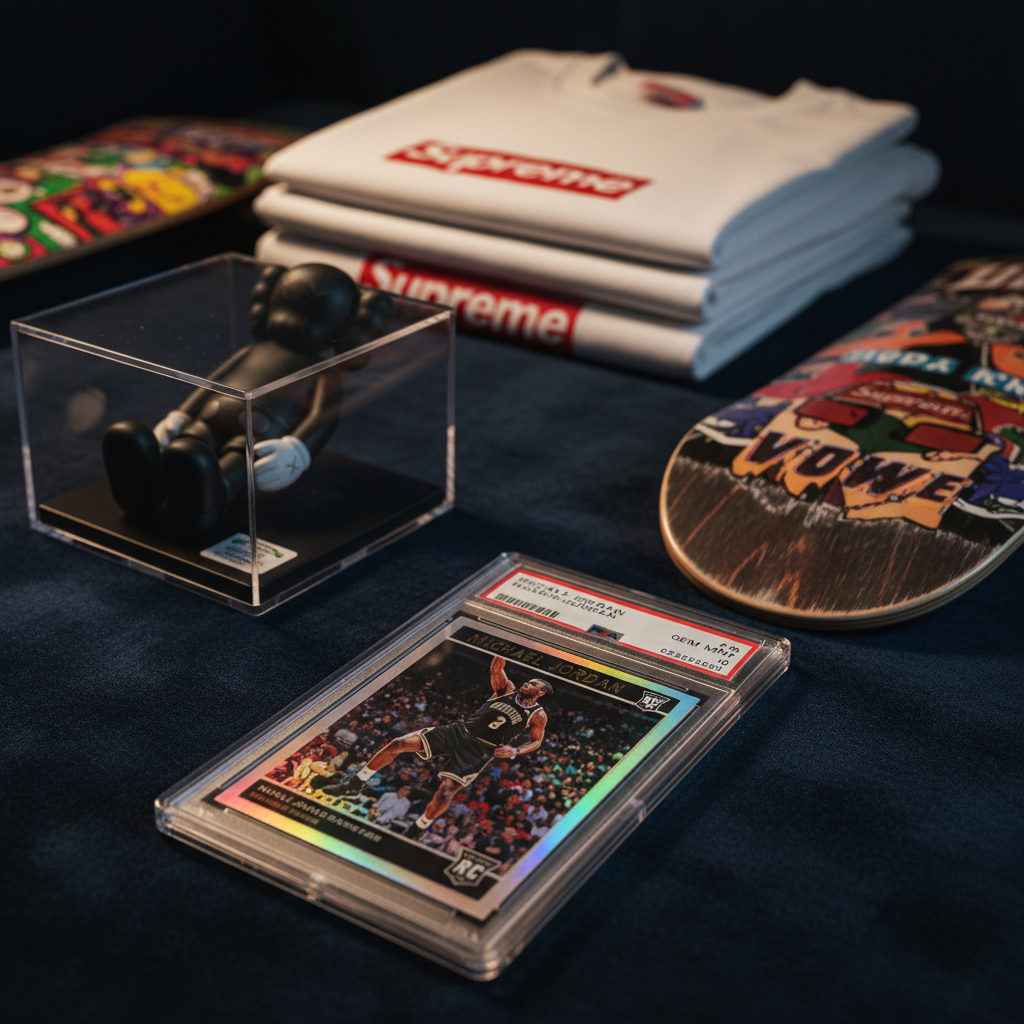
Someone rolled the dice on a $5,000 abandoned storage unit and walked away with what may be the most culturally loaded blind-buy haul of the year — Supreme skate decks, Takashi Murakami and KAWS designer toys, and a collection of Air Jordans that would make any sneakerhead's pulse quicken.
Storage unit auctions have always attracted a certain breed of gambler-collector, but finds of this caliber are genuinely rare. Most units yield furniture and forgotten appliances. This one apparently belonged to someone deeply embedded in the streetwear and designer toy ecosystem — and then, for whatever reason, stopped paying rent.
What Was Inside
The haul breaks down across three of the most liquid categories in the alternative collectibles market right now. Supreme skate decks — particularly older box logo releases and artist collaboration decks — have held serious secondary market value for years. A pristine, unridden Supreme x Damien Hirst deck in original shrink can fetch north of $3,000 on StockX or at auction. A Supreme x KAWS deck from the early 2000s in comparable condition has cleared $8,000 at Heritage. Condition is everything here; any wall-mounting hardware holes or edge chips crater the value immediately.
The designer toy component is where things get genuinely interesting from an investment standpoint. KAWS Companion figures — especially the original 1999 edition and early OriginalFake runs — have appreciated dramatically over the past decade. A KAWS Companion (Passing Through) in sealed condition sold for over $10,000 at Sotheby's in 2021. Murakami's Kaikai Kiki figures, particularly the early Superflat Museum exclusives, are harder to find in sealed condition and command premiums accordingly. The secondary market for both artists has cooled somewhat from the 2020-2021 peak frenzy, but blue-chip pieces remain firmly in demand among serious collectors.
Then there are the Jordans. The Air Jordan market has matured significantly — casual hype has faded, but deadstock pairs in original boxes with authenticated provenance continue to move. A Jordan 1 Retro High OG Chicago (2015) in unworn DS condition with box recently cleared $1,200 to $1,800 depending on size, with mid-sizes commanding the highest premiums. Earlier OG pairs from the 1985 run, if present, would be in a different conversation entirely — a DS pair of original 1985 Jordan 1s in a common size grades well and can push past $20,000.
The Storage Auction Market as Collector Pipeline
The storage auction industry has quietly become one of the more unpredictable sourcing channels in the collectibles world. Platforms like StorageTreasures and CubeSmart's auction arm have digitized the bidding process, pulling in buyers nationally rather than just locally. That competition has driven up average winning bids — gone are the days of $200 units that yielded $5,000 in resale. A $5,000 entry point for a unit is on the higher end, suggesting either visible merchandise through the door gap or a competitive bidding war among buyers who sensed the contents were worth chasing.
The economics of a find like this are straightforward but unforgiving. If the Supreme decks include even two or three high-demand collaboration pieces in unplayed condition, the deck haul alone could recoup the entry cost. Add a handful of sealed KAWS or Murakami figures and several DS Jordan pairs, and the gross resale value could plausibly land between $30,000 and $80,000 — a wide range that hinges entirely on which specific pieces were inside and what condition they're in.
Grading will matter here. PSA now grades trading cards and select memorabilia, but for sneakers, GOAT Authentication and Sneaker Con's authentication service are the floor-level checks buyers expect on higher-value pairs. Designer toys don't have a formal third-party grading infrastructure the way cards do — condition is largely self-reported and photographic, which means sealed, factory-fresh pieces carry an outsized premium over anything opened or displayed.
The Uncomfortable Truth About Provenance
There's a wrinkle in every storage unit story that serious collectors shouldn't ignore: provenance is nonexistent. You know what you have, but not where it came from, how it was stored, or whether any of it was reported stolen. That's not an accusation — it's a structural reality of the format. For lower-value items, it's a non-issue. For a KAWS piece pushing five figures or a pair of OG Jordan 1s, a buyer doing due diligence will ask questions that the storage auction winner simply cannot answer.
That gap matters at auction. Heritage and Goldin both require consignors to warrant clear title. A piece with no paper trail isn't automatically unsellable, but it may be better suited to peer-to-peer platforms or dealer networks where provenance expectations are less rigorous.
Still — a $5,000 bet that potentially yields a six-figure haul is the kind of story that keeps the storage auction circuit alive. Someone out there is already calculating their next bid.