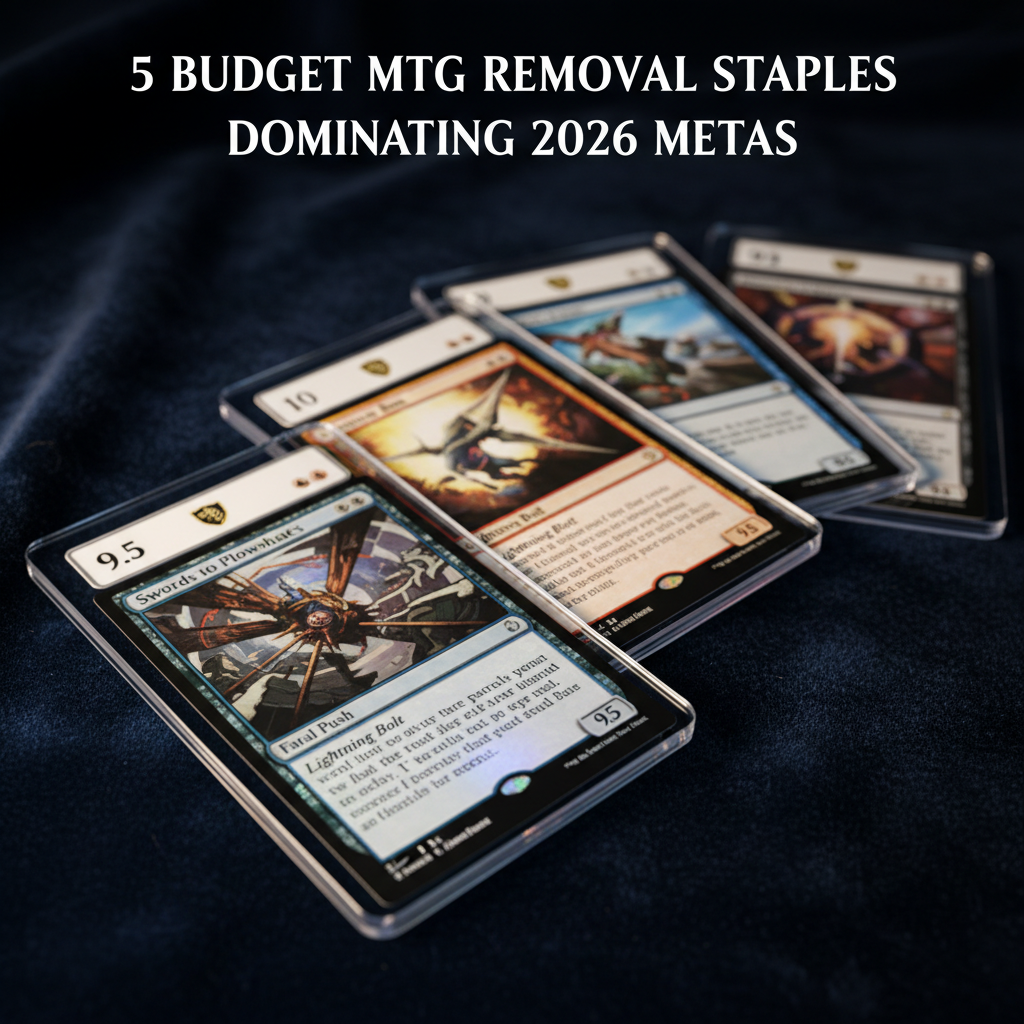
Efficient removal has always separated competitive Magic: The Gathering decks from casual ones. In 2026, with high-velocity sets like Lorwyn Eclipsed and the Teenage Mutant Ninja Turtles crossover flooding the market with complex new mechanics and increasingly aggressive board states, the demand for cheap, reliable interaction has never been more acute — or more financially relevant for collectors tracking the secondary market.
Budget removal cards occupy a peculiar corner of MTG collectibility. They're simultaneously evergreen staples and price-suppressed workhorses, kept affordable by consistent reprints yet perpetually in demand. Understanding which five cards currently represent the best utility-per-dollar is as much a market question as a gameplay one.
The Anchors: White and Black's Timeless Workhorses
Swords to Plowshares remains the undisputed benchmark for targeted creature removal in the game's history. Printed first in Alpha (1993), it has been reprinted dozens of times across Commander precons, Masters sets, and Secret Lairs — each wave suppressing its price ceiling while broadening its collector footprint. A raw Unlimited copy trades for under $3 in most markets. A PSA 9 Alpha copy, by contrast, cleared $1,200 at Heritage Auctions in late 2024, illustrating the vast spectrum this single card occupies across collector tiers.
The gameplay case is simple: one mana, instant speed, unconditional exile. No other white spell at this cost comes close. For budget builders, the Commander precon printings and Mystery Booster versions keep entry well under $1.
Fatal Push is the modern counterpart — a 2017 Aether Revolt rare that briefly spiked above $12 at peak Modern demand before successive reprints in Double Masters 2022 and various Secret Lair drops pulled it back to the $1.50–$2.50 range. It's a card that rewards players who understand revolt triggers, and its price floor has proven remarkably stable despite the reprint pressure. The foil versions from original Aether Revolt still command $8–$10 among collectors who prize first-print aesthetics.
The Middle Tier: Value Cards Punching Above Their Price
Path to Exile mirrors Swords to Plowshares in function but introduces a meaningful tradeoff — the opponent fetches a basic land — making it the slightly weaker but still essential option in formats where Swords is banned or unavailable. Modern Horizons reprints have kept it under $2 for non-foil copies. The original Conflux printing (2009) in near-mint condition still fetches $6–$8 from collectors who track set-specific print runs.
Doom Blade and its functional cousin Go for the Throat represent the budget tier's workhorses for black removal. Neither is flashy. Both get the job done at two mana with minimal deckbuilding friction. Go for the Throat, originally from Mirrodin Besieged (2011), has seen enough reprints — including a high-profile reprint in Commander Legends — that copies sit comfortably at $0.50–$1.00. It's the kind of card that never spikes dramatically but never truly bottoms out either.
Rounding out the five is Generous Gift, white's answer to permanent-type versatility. At three mana it's slower than the format's elite options, but its ability to exile any permanent — enchantments, artifacts, planeswalkers, lands — gives it a flexibility that justifies the cost in Commander and casual formats. First printed in Modern Horizons (2019), it trades between $1–$3 depending on printing, with the original MH1 version retaining a modest premium.
The Collector Angle: Reprints, Foils, and the Budget Card Market
Budget removal cards are an underappreciated segment of MTG collecting. Because their gameplay utility is undeniable, their reprint history creates layered price tiers that reward collectors who track print runs carefully. An Alpha Swords to Plowshares and a 2024 Commander precon copy of the same card are functionally identical on the table — but they exist in entirely different markets.
The foil premium on older removal staples has compressed significantly since the introduction of surge foils and special treatments in recent sets. A foil Fatal Push from Aether Revolt that once commanded 3x the non-foil price now competes with textured foil versions, borderless treatments, and Secret Lair exclusives, fragmenting collector demand across more SKUs than the market can cleanly absorb.
For investors, the takeaway is straightforward: first-print foils of format-defining removal retain value better than subsequent reprints, but the ceiling is capped by the card's perpetual reprint eligibility. The real upside in this segment has always been in the oldest, highest-grade copies — not in chasing the latest premium treatment.
In a set environment as crowded as 2026's, the cards that remove problems cheaply and reliably don't go out of style. They just get reprinted again.