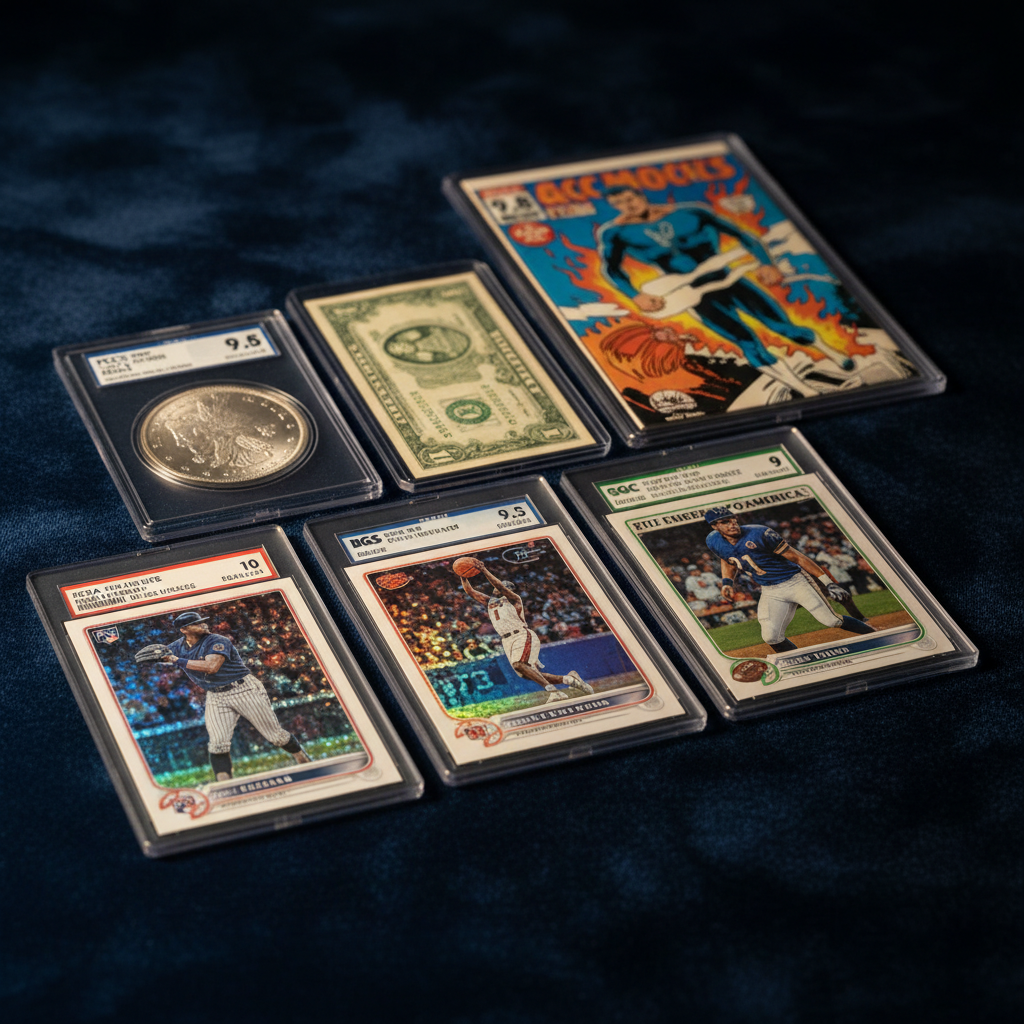
Last November, a 1952 Topps Mickey Mantle PSA 5 hammered at $360,000 at Goldin. Two weeks later, a raw copy of the same card — creased, off-center, unmistakably authentic — sold on eBay for $4,200. The gap between those two numbers tells you everything about where the smart money moves when the market cools: it migrates toward asymmetry. Toward things priced like yesterday's news that are quietly becoming tomorrow's story.
The collectibles market in 2025 is a tale of two economies. Blue-chip slabs — Mantle rookies, LeBron Logomans, pre-1933 Morgan dollars in MS-65 — remain stubbornly elevated, propped up by institutional buyers and the gravitational pull of headline auction results. But one tier down, in the space where dedicated collectors actually live, there are genuine pricing dislocations happening right now. Items whose comps don't reflect their scarcity. Whose pop reports are tighter than anyone is paying attention to. Whose cultural moment is approaching, not receding.
These are six of them. A mix of cards, coins, memorabilia, and antiques — budget entries and serious investment-grade plays. Each one has a specific reason it's undervalued, a specific risk to acknowledge, and a clear editorial rating. Let's get into it.
The Sleepers Nobody's Talking About
Budget picks in the collectibles world get dismissed as hobbyist territory. That's a mistake. Some of the best percentage gains in this market's history started at under a hundred dollars — PSA 10 common-era rookies, raw copper coins, regional sports memorabilia that hit a cultural nerve. The three items below cost less than a dinner for two and carry meaningful upside if you're patient.
Pick #1 — 1984 Topps John Elway Rookie Card, PSA 8 | ~$55
Here's the math that doesn't make sense: a PSA 8 Elway rookie currently trades between $50 and $65 on PWCC and eBay. A PSA 8 Dan Marino rookie from the same 1984 Topps set — same era, same design, same production run — trades at $140 to $180. Marino has a slight population advantage in high grades, but not nearly enough to justify a 2.5x price gap for the same numerical grade on a comparable Hall of Famer from an identical set.
The PSA population report as of early 2025 shows roughly 4,200 Elway rookies graded across all tiers, with PSA 8s representing the sweet spot of the distribution. Marino has a similar total pop. What Marino has that Elway currently lacks is a documentary — and Elway's cultural rehabilitation, driven by his front-office legacy in Denver and the ongoing nostalgia cycle for 1980s NFL, is overdue for a catalyst. When that catalyst arrives (a 40th-anniversary set tribute, a streaming documentary, another Super Bowl cycle featuring Denver), the spread between these two cards will compress fast.
Risk/Reward: Low downside — PSA 8 Elway rookies have a well-established floor. The upside is convergence toward Marino pricing, which represents roughly 150–200% gain from current levels. The main risk is timeline: this is a 2–4 year hold, not a flip.
Rating: BUY
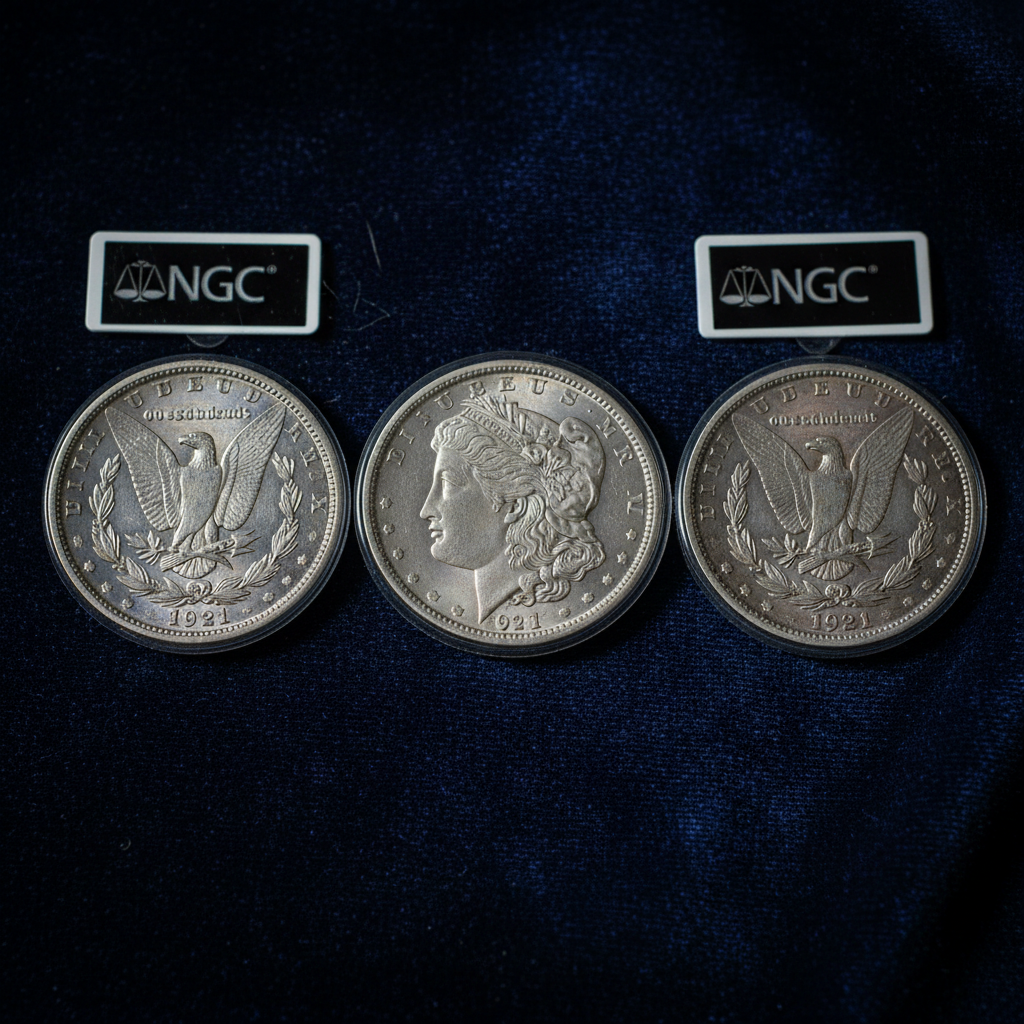
Pick #2 — 1921 Morgan Silver Dollar, NGC MS-62 | ~$75–90
The 1921 Morgan is the final year of the original Morgan dollar series, and it gets chronically overlooked because it's the most common date in the run — mintage of over 44 million pieces across Philadelphia, Denver, and San Francisco. Coin collectors know this, so they move toward the scarcer dates. But here's what they're missing: in NGC MS-62, you are holding a 100-year-old silver coin in a certified slab, with genuine numismatic provenance, for under a hundred dollars. No other legitimate investment-grade numismatic item offers that entry point.
Compare it to a 1922 Peace Dollar in NGC MS-62, which trades at $60–75. The 1921 Morgan carries a slight premium because the design is more celebrated and the collector base is larger, but the gap should be wider, not narrower. Morgan dollars as a category have been on a quiet upswing through 2024 — Stack's Bowers reported stronger-than-expected results across their Morgan dollar lots in their August 2024 ANA sale, with MS-62 and MS-63 examples outperforming estimates by 15–20% across multiple dates.
At $75–90, you're not getting rich. But you're buying a century-old American artifact at a price that makes almost no logical sense given the collector demand and the silver content floor beneath it.
Risk/Reward: The silver spot price provides a hard floor — melt value alone on a Morgan dollar runs roughly $25–28 at current silver prices. The numismatic premium on a certified MS-62 is modest but durable. Downside is minimal. Upside is steady appreciation, not explosive gains.
Rating: BUY
Pick #3 — 2003-04 Topps Chrome LeBron James Rookie Refractor, PSA 7 | ~$85–100
Before you close this tab: hear me out on the PSA 7.
The 2003-04 Topps Chrome LeBron refractor in PSA 10 is a $20,000+ card. In PSA 9, it's $1,800–2,200. In PSA 8, it's roughly $300–400. And in PSA 7? You can buy one right now for $85–100. That is a verified LeBron James rookie refractor — one of the most iconic modern basketball cards in existence — in a legitimate PSA slab, for less than a pair of sneakers.
The PSA 7 gets no respect because the grading community has developed a cultural allergy to anything below an 8. That bias creates opportunity. The card is real. The population is finite. The collector who just wants a LeBron refractor rookie in a slab — not the investment-grade version, just the genuine article — has an entry point here that didn't exist five years ago. As LeBron's career winds toward its conclusion and the retrospective nostalgia cycle accelerates, the floor on every grade of this card moves up. PSA 7s will benefit proportionally.
Risk/Reward: Higher risk than the Elway or Morgan plays. The PSA 7 market is thinner and less liquid. But the absolute dollar downside is low, and the upside — if LeBron's retirement triggers the kind of market response Jordan's did — is substantial even at this grade.
Rating: WATCH (Buy on dips below $80)
The Mid-Range Plays With Real Upside
The $150–500 range is where the most interesting pricing dislocations live right now. These are items with enough market history to establish genuine comps, enough collector demand to ensure liquidity, but not enough mainstream attention to have been bid up to fair value. Two picks here.
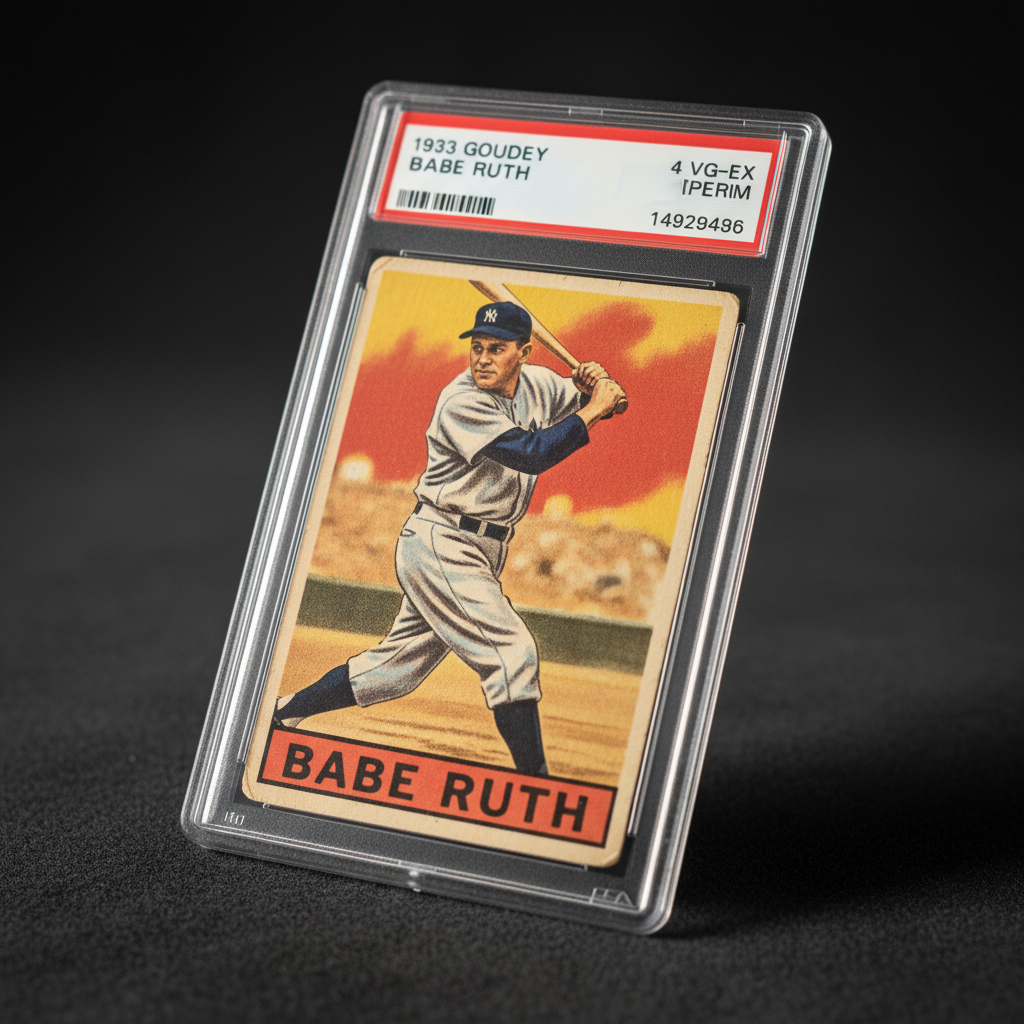
Pick #4 — 1933 Goudey Babe Ruth #144, PSA 2 | ~$350–450
The 1933 Goudey set is one of the foundational documents of American sports card collecting. Ruth appears four times in the set — cards #53, #144, #149, and #181 — and all four are legitimate pre-war icons. The #144 specifically is the least-discussed of the four, which is precisely why it's the buy.
A PSA 2 Goudey Ruth #144 trades at roughly $400. A PSA 2 of the more popular #53 trades at $600–700. Both are authentic 1933 Babe Ruth cards. Both carry identical centering challenges and age-related wear at low grades. The #144 has a slightly lower total population — the PSA pop report shows roughly 890 copies graded across all grades for #144 versus just over 1,100 for #53 — yet it trades at a persistent 35–40% discount. That's purely a collector preference artifact, not a scarcity-justified spread.
Heritage Auctions has consistently moved low-grade pre-war Ruth material at or above estimate through 2023 and 2024. The appetite for authenticated vintage Ruth is not diminishing. It's growing, driven by a new generation of collectors who understand that owning a genuine pre-war card at PSA 2 is more meaningful than owning a modern reprint at any grade.
Risk/Reward: Pre-war cards at low grades carry condition sensitivity risk — a PSA 2 can look very different from another PSA 2. Buy with photos in hand. The upside is convergence toward #53 pricing, which represents a 40–50% gain from current levels on a genuinely scarce piece of American sports history.
Rating: BUY
Pick #5 — Vintage 1950s–60s Cast Iron Mechanical Bank, Unrestored Original | ~$200–400
Antiques are the forgotten category in the collectibles conversation, and that's the entire thesis here.
American cast iron mechanical banks from the 1870s through the 1920s are among the most documented, most studied, and most auction-proven antique collectibles in existence. The top examples — a Freedman's Bank, a Tammany Hall bank in excellent original paint — have sold at Bertoia Auctions for six figures. But the mid-tier examples, particularly 1950s and 1960s reproduction mechanical banks made by companies like Book of Knowledge and Shepard Hardware, occupy a strange market purgatory.
These aren't originals. Serious bank collectors know that immediately. But they are 50–70 years old, genuinely cast iron, mechanically functional, and increasingly scarce in unrestored original condition. At $200–400 at regional antique shows and estate sales, they are priced as curiosities rather than collectibles — which is exactly the mispricing to exploit.
The antiques market has been quietly bifurcating: documented provenance pieces are surging while undocumented mid-century items stagnate. But the mechanical bank category has a devoted collector base through the Mechanical Bank Collectors of America, a published reference guide (the Penny Lane catalog), and a consistent auction record at Bertoia that provides real price anchors. The 50-year threshold — when items formally enter antique status — is approaching for many 1970s pieces, which will push collector attention back toward 1950s–60s examples as the legitimate early tier.
Risk/Reward: Authenticity research is essential — reproductions of reproductions exist. The risk is buying something represented as original that isn't. With proper due diligence, the downside is modest and the upside is a category re-rating as antique collecting regains mainstream attention through platforms like Chairish and 1stDibs driving new collector discovery.
Rating: WATCH (Buy only with provenance documentation)
Investment-Grade Picks Priced Like Afterthoughts
One pick in the serious money tier. This is the play I'd make today if I had $1,500–2,500 to deploy in a single collectible.
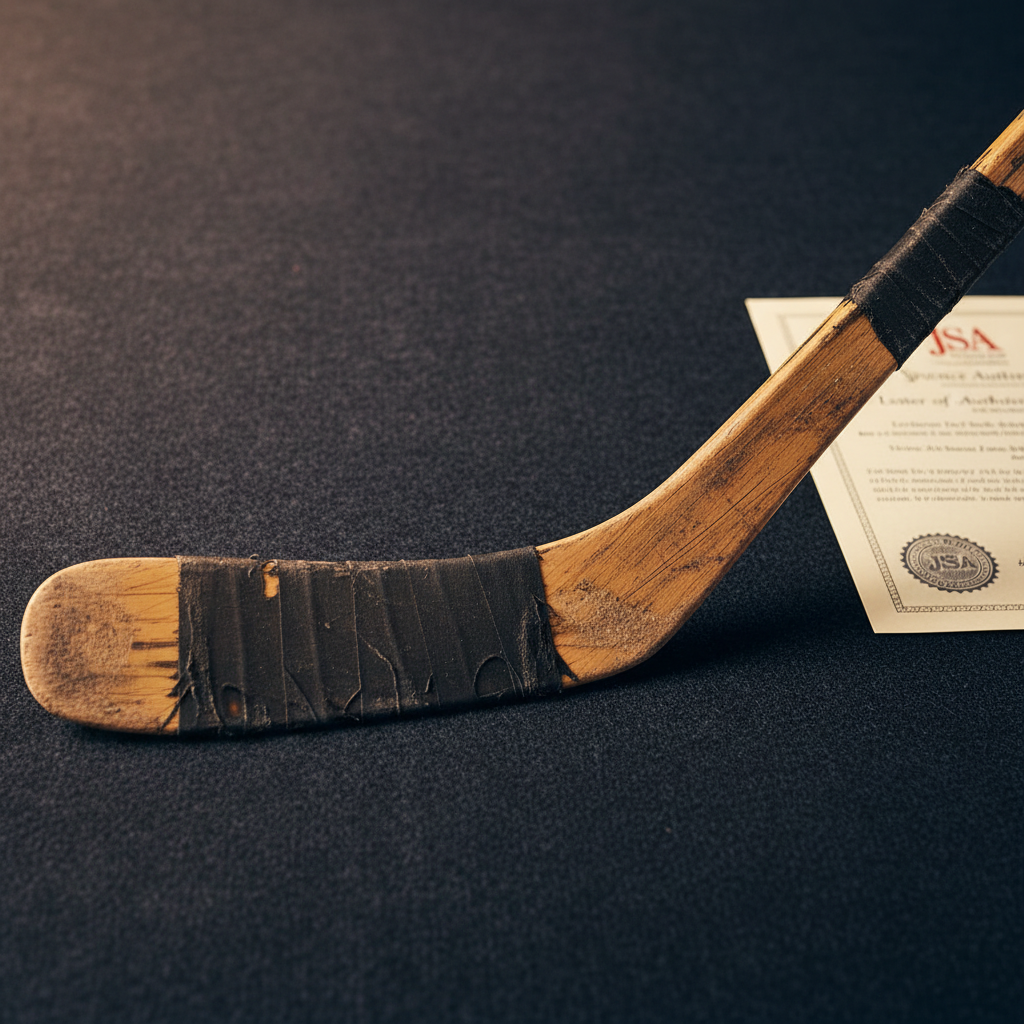
Pick #6 — Wayne Gretzky Autographed Game-Used Stick, Full JSA LOA | ~$1,200–1,800
The autograph memorabilia market has a hockey problem: it chronically undervalues Gretzky relative to his actual historical standing. A Wayne Gretzky game-used stick with full JSA Letter of Authenticity currently moves at $1,200–1,800 depending on the season, the provenance documentation, and the auction venue. A Michael Jordan game-used basketball with comparable documentation trades at $8,000–15,000. A Babe Ruth game-used bat with PSA/DNA authentication trades at $25,000 and up.
Now consider this: Wayne Gretzky holds or shares 61 NHL records. He scored more assists than any other player scored total points. His statistical dominance over his sport is, by any objective measure, greater than Jordan's dominance over basketball. Yet the game-used memorabilia market prices him at a fraction of comparable legends from other sports.
The gap is cultural, not logical. Hockey has historically had a smaller American collector base than basketball or baseball, which suppresses prices. But that's changing. The NHL's expansion into non-traditional markets — Vegas, Seattle, Salt Lake City — is building new fan bases. The Upper Deck Gretzky auto card market has been strengthening since 2022, with authenticated on-card autos in PSA 10 holders now regularly clearing $800–1,200 at Goldin and PWCC. Game-used stick prices have not moved in proportion.
The JSA full LOA is critical here — not a sticker, not a COA card, but the full letter with photo-matching where available. At $1,500, you are buying a piece of equipment actually held by the greatest player in the history of his sport, authenticated by the industry's most rigorous third-party service. The comparable in baseball would cost you ten times that.
Risk/Reward: The primary risk is authentication — the Gretzky memorabilia market has had forgery issues historically, which is precisely why JSA full LOA documentation is non-negotiable. With proper authentication, the downside is limited and the upside is significant as hockey's collector market matures and the sport-agnostic case for Gretzky's historical standing becomes more broadly understood.
Rating: BUY
Key Takeaways
- 1984 Topps Elway Rookie, PSA 8 (~$55): Trades at a 60% discount to comparable Marino. Cultural catalyst approaching. BUY.
- 1921 Morgan Dollar, NGC MS-62 (~$80): A century-old certified coin with a silver floor and growing numismatic demand for under $100. BUY.
- 2003-04 Topps Chrome LeBron Refractor, PSA 7 (~$90): The market's grade bias creates a genuine entry point on an iconic card. WATCH — buy below $80.
- 1933 Goudey Babe Ruth #144, PSA 2 (~$400): Lower population than the #53 yet trades at a persistent 35–40% discount. Pre-war Ruth demand is durable. BUY.
- 1950s–60s Cast Iron Mechanical Bank (~$200–400): Antiques' forgotten middle tier. Requires provenance diligence but offers category re-rating upside. WATCH.
- Gretzky Game-Used Stick, Full JSA LOA (~$1,500): The most undervalued game-used memorabilia play in any major sport relative to the player's historical standing. Authentication is everything. BUY.
- The pattern across all six picks: mispricing driven by collector habit, not market fundamentals. When the habit changes, the price changes.
Editorial disclaimer: All prices are approximate market estimates based on recent auction results and active listings as of early 2025. This article represents editorial opinion only and should not be construed as financial or investment advice. Collectibles markets are illiquid and volatile. Do your own research before purchasing.
The market doesn't misprice things forever. It misprice things until someone notices — and then, very quickly, it doesn't anymore. The window on several of these picks is measured in months, not years. The Gretzky stick especially. When the hockey collector market catches up to where the basketball and baseball markets already are, the people who bought at $1,500 will look like geniuses. The people who waited for confirmation will be paying $5,000 for the same stick and wondering why they hesitated.
That's always how it works. That's why we're here.