Last October, a 1957 Topps Frank Robinson rookie card in PSA 7 sold on Heritage Auctions for $1,320. The comparable Mickey Mantle from the same set, same grade, fetched over $18,000. Robinson was a first-ballot Hall of Famer, a Triple Crown winner, the only player to win MVP in both leagues. And yet the market prices him like a footnote. That gap — between what a collectible is and what the market currently pays — is where the real opportunity lives.
This week's Vault Weekly is a hunting guide. Seven specific items across cards, coins, memorabilia, and antiques that are priced below where they deserve to be. Some because of category-wide neglect. Some because a comparable piece gets all the attention. Some because the population data tells a story the market hasn't caught up to yet. Not every pick will moon. But every pick here has a clear, articulable reason to be worth more than it currently is — and that's a better starting point than most.
Seven Collectibles the Market Is Mispricing
The criteria here are simple: each item has a documented comparable that commands significantly more money, a population or supply dynamic that supports appreciation, and a plausible catalyst — a record sale, anniversary, anniversary set release, or cultural moment — that could close the gap. These aren't moonshots. They're mispricings.
Budget Tier: Under $150
Pick 1 — 1909-11 T206 Common Player, SGC 2 (~$35–$60)
Everyone knows the T206 Honus Wagner. Fewer people talk about the fact that you can own a card from the exact same set — printed the same year, distributed the same way, surviving the same 115 years — for less than a tank of gas. Commons like Rube Marquard, Chief Bender, or Fred Clarke in SGC 2 (Good) trade on eBay completed listings in the $35–$60 range most weeks.
The value proposition here isn't that these will 5x. It's that the floor is essentially the paper and ink — authentic pre-war tobacco cards with more than a century of survival behind them. SGC has been aggressively grading vintage tobacco cards and their population reports show T206 commons in grades 1–3 as by far the most accessible entry point. For new collectors, a T206 common in a slab is a $50 history lesson with upside. The set has never lost cultural relevance, and as the Wagner continues to set records — the SGC 3 example sold by Rob Gough fetched $7.25 million in 2021 — curiosity about the broader set only grows.
Risk/Reward: Low ceiling, but near-zero downside on authentic slabbed examples. The risk is overpaying for a trimmed or altered card that slips through without a grade — which is why the slab matters here.
Rating: BUY
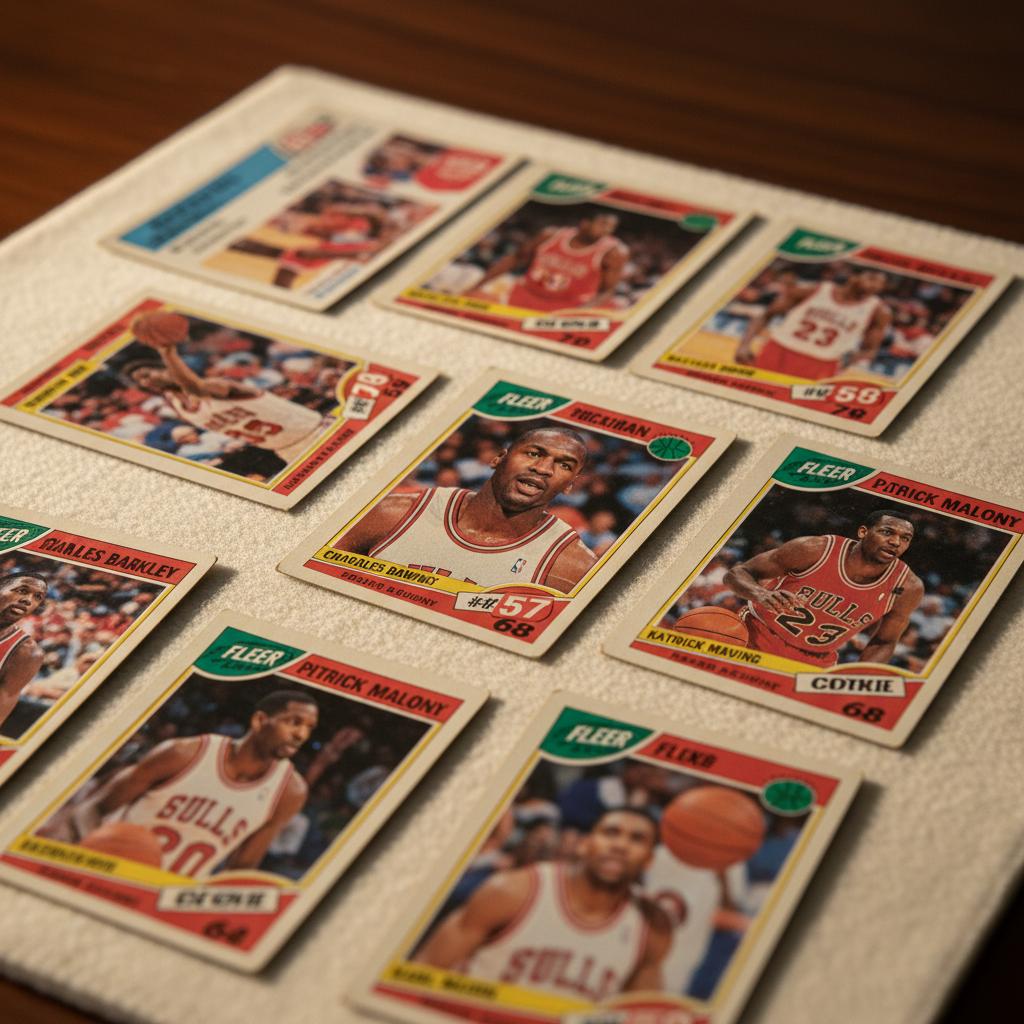
Pick 2 — 1986 Fleer Basketball Complete Set, Raw (~$80–$120)
The 1986-87 Fleer Michael Jordan rookie gets all the oxygen. Rightfully so. But the complete 132-card set — Jordan included, raw — is currently moving in the $80–$120 range on PWCC's marketplace and eBay when the Jordan grades out at VG or lower. Here's the thing: that set also contains the Charles Barkley rookie, Patrick Ewing rookie, Karl Malone rookie, Hakeem Olajuwon rookie, and Clyde Drexler rookie. Seven Hall of Famers in one 132-card set, and the market prices the whole thing based almost entirely on Jordan's condition.
A raw Barkley from this set in decent shape trades around $15–$25 on its own. A PSA 8 Barkley is $200+. The arbitrage for someone willing to crack the set, cherry-pick the best cards, and submit to PSA is real. Even without Jordan paying off, the supporting cast has been quietly appreciating since 2020.
Risk/Reward: Moderate. The Jordan needs to grade well to make the math sing. If it comes back PSA 4, the economics change. But even a PSA 6 Jordan from a $100 set purchase has historically sold in the $400–$600 range on Goldin, making this a strong expected-value play.
Rating: BUY
Mid-Tier: $150–$500
Pick 3 — 1972 Eisenhower Dollar, MS65 PCGS (~$150–$200)
Modern coin collectors largely ignore the Eisenhower dollar. It's too recent to be vintage, too common to feel rare, and too large for most people's albums. The market agrees: a PCGS MS65 1972 Eisenhower dollar — the Type 2 reverse, the scarce variety — trades in the $150–$200 range, a number that has barely moved in three years.
Here's what the market is missing. The 1972 Type 2 reverse was a production error — the Earth on the reverse shows three islands in the Gulf of Mexico that shouldn't be there. PCGS identifies it as a distinct variety, and the population at MS65 is thin: fewer than 400 examples certified across both PCGS and NGC combined as of their most recent population reports. Compare that to a 1971 Ike dollar at MS65, which has populations in the thousands and still commands similar prices. The 1972 Type 2 is genuinely scarce at gem mint. It's priced like it isn't.
The catalyst here is generational. Eisenhower dollar collectors skew older. When that collection eventually hits the market — through estate sales, Stack's Bowers auctions, Heritage's coin catalog — the population data will be front and center, and buyers will notice the scarcity.
Risk/Reward: Patient money. This isn't a 12-month flip. But for a collector willing to hold 5–7 years, the combination of genuine variety scarcity and low current pricing makes this a quiet compounder.
Rating: BUY
Pick 4 — 1993 SP Derek Jeter Rookie, PSA 7 (~$280–$350)
The 1993 Upper Deck SP Derek Jeter is one of the most iconic modern rookies in the hobby. PSA 10 examples have cleared $100,000. PSA 9s routinely trade above $10,000. And then there's a cliff. A PSA 7 — still a sharp, presentable card — moves in the $280–$350 range currently on PWCC and eBay completed sales.
The grade gap between a 7 and a 9 on this card is enormous by dollar value. But here's the population reality: PSA has graded over 14,000 copies of the Jeter SP, and fewer than 400 have come back PSA 9 or better. The 7s and 8s are where the actual supply lives. For a collector who wants a legitimate Jeter SP in a slab — authenticated, graded, displayable — at a price that won't require a second mortgage, the PSA 7 is drastically undervalued relative to what the card is.
Jeter's cultural relevance is perennial. His Hall of Fame induction in 2020 moved the market. A Monument Park ceremony, documentary, or anniversary moment could do it again. The PSA 7 captures that upside at a fraction of the cost.
Risk/Reward: The main risk is grade compression — if PSA 8s start trading lower due to market softness, 7s follow. But the floor on an authenticated Jeter SP at any grade has historically been durable. Strong risk/reward at current levels.
Rating: BUY
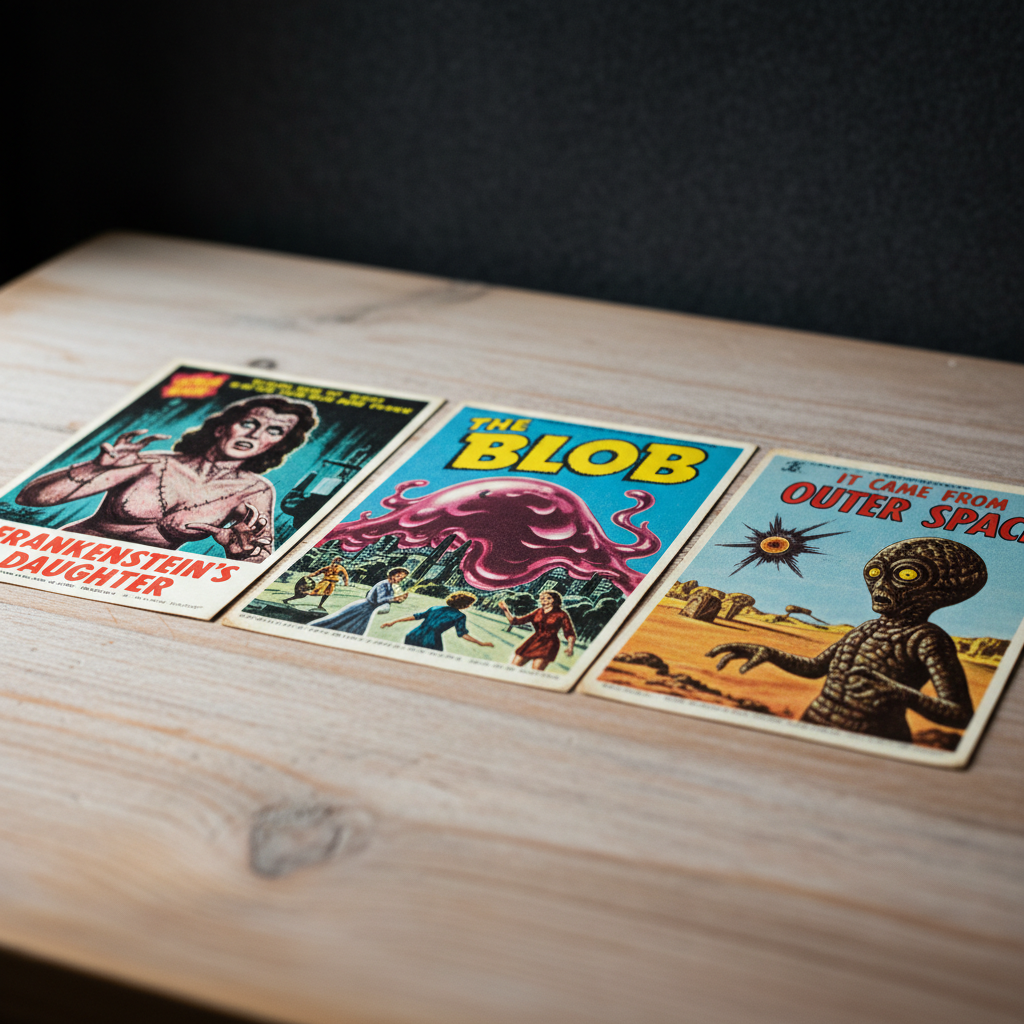
Pick 5 — Original Vintage Movie Lobby Card, 1940s–1950s Horror (~$75–$200 each)
Film memorabilia gets priced by star power and poster format. A one-sheet from Casablanca in Fine condition can fetch $50,000+ at Heritage. But the lobby cards from the same era — the 11x14 display cards that theaters used to advertise films in their lobbies — are the orphaned sibling. Original 1940s and 1950s horror and science fiction lobby cards in solid condition trade in the $75–$200 range depending on title, scene, and condition.
These are original printed artifacts from Hollywood's golden age. They're not reproductions. They're not posters that got folded and refolded. Many are in better structural condition than contemporary one-sheets because they were displayed flat. CGC has started certifying vintage movie posters and paper ephemera, and as that grading infrastructure grows, the price discovery process for lobby cards will accelerate. Right now, the market for them is thin and inefficient — which means opportunity for collectors who know what they're looking at.
Titles to target: anything featuring Boris Karloff, Bela Lugosi, or early Universal Monsters. The Creature from the Black Lagoon lobby card set has already started moving. The second tier — The Mole People, Tarantula, It Came from Outer Space — remains underpriced.
Risk/Reward: Condition and authenticity are everything here. Fakes and reproductions exist. Buy from established dealers or auction houses with provenance documentation. The reward for getting it right is meaningful; the cost of getting it wrong is a worthless piece of paper.
Rating: WATCH (buy only with provenance documentation)
Investment Grade: $500+
Pick 6 — 1952 Topps High Number Series, Mid-Grade Commons (~$500–$800 each)
The 1952 Topps Mickey Mantle is the most famous baseball card in existence. The high-number series it belongs to — cards #311 through #407 — is where Topps dumped unsold inventory into the Hudson River in 1960, creating artificial scarcity that defines the entire run. Everyone knows the Mantle. Almost nobody talks about the commons from that same high-number series.
A mid-grade common from cards #311–#407 — think Bobby Thomson, Archie Wilson, or Dick Brodowski in PSA 4 or 5 — trades in the $500–$800 range. The populations are legitimately thin. PSA has graded fewer than 50 examples of many of these cards across all grades. They survived the same Hudson River purge that makes the Mantle worth millions. The set's scarcity is real and documented, and the high-number commons are priced as if the survival story only applies to the stars.
Heritage and Goldin have both seen increased bidder activity on 1952 Topps high-number commons over the past 18 months. The collectors who built complete sets of this series are a dying breed, and when those collections break up, the individual card prices will reset based on actual population data rather than historical inertia.
Risk/Reward: This is patient, informed capital. The liquidity is thin — you may wait months for the right buyer. But the fundamental scarcity is real and the price-to-scarcity ratio is wildly favorable compared to the stars from the same series.
Rating: BUY for patient collectors
Pick 7 — 1986 Fleer Larry Bird, BGS 9.5 (~$600–$900)
Here's a number that should stop you cold: a BGS 9.5 1986-87 Fleer Larry Bird — a Gem Mint slab from Beckett with a black label — is currently trading in the $600–$900 range on PWCC and recent Goldin sales. The PSA 10 version of the same card trades above $6,000. The PSA 9 trades above $1,500.
The BGS 9.5 is, by any objective grading standard, a gem mint card. Beckett's subgrades — centering, corners, edges, surface — all have to hit 9 or better to get a 9.5. It is a more rigorous grade than PSA 10 in terms of documented criteria. And yet the market discounts it by 85% relative to the PSA 10. Some of that discount is registry-driven — PSA's Set Registry creates demand for PSA-specific grades. But 85% is an extraordinary premium to pay for a holder preference.
BGS 9.5s have historically been the most undervalued tier in the Beckett grading system, and the Bird is a perfect example. The card's cultural relevance is bulletproof — Bird vs. Magic is the defining rivalry of the NBA's modern era, and the 1986 Fleer set is the hobby's most important basketball issue. At $600–$900, you're buying a legitimate gem mint example of a generational card at a fraction of its PSA equivalent. The market will not ignore this gap forever.
Risk/Reward: The risk is that the PSA premium persists indefinitely — it has for longer than most people expected. The reward is that even partial convergence represents a 2–3x return from current levels. This is the highest-conviction pick on this list.
Rating: STRONG BUY
Risk Matrix & Final Ratings
Quick Reference
T206 Common, SGC 2 (~$35–$60) — BUY
1986 Fleer Complete Set, Raw (~$80–$120) — BUY
1972 Eisenhower Dollar Type 2, PCGS MS65 (~$150–$200) — BUY
1993 SP Jeter Rookie, PSA 7 (~$280–$350) — BUY
Vintage Horror Lobby Cards, 1940s–50s (~$75–$200) — WATCH
1952 Topps High-Number Commons, PSA 4–5 (~$500–$800) — BUY (patient capital)
1986 Fleer Larry Bird, BGS 9.5 (~$600–$900) — STRONG BUY
The through-line connecting all seven picks is the same: the market is pricing them relative to a more famous neighbor rather than on their own merits. The T206 common gets priced like it isn't a 115-year-old artifact. The BGS 9.5 Bird gets priced like it isn't gem mint. The 1952 high-number commons get priced like the scarcity story only applies to Mantle. Identifying those mispricings, understanding why they exist, and having the patience to wait for the correction — that's the work.
The lobby cards carry the most execution risk and deserve the most caution. Everything else on this list is a straightforward bet on rational price discovery eventually doing its job.
- BGS 9.5 vs. PSA 10 discounts on iconic cards like the 1986 Fleer Bird represent some of the most durable mispricings in the modern hobby — the gap rarely justifies the price difference.
- Population data is your edge. The 1972 Ike Dollar Type 2 and 1952 Topps high-number commons both look common until you check the actual PCGS/NGC and PSA population reports.
- Set arbitrage — buying complete sets and cracking them for individual submission — remains one of the most reliable strategies for budget collectors in the card market.
- Paper ephemera like vintage lobby cards is one of the last genuinely inefficient corners of the collectibles market, but authentication infrastructure is improving fast.
- The 1986 Fleer set's supporting cast — Barkley, Ewing, Malone — is chronically undervalued relative to Jordan from the same issue. That gap has been closing for three years and likely continues.
- Every pick here has a specific, articulable reason for the mispricing. If you can't explain why something is cheap, it might just be cheap.
- These are editorial opinions, not financial advice. Collectibles markets are illiquid and speculative. Never allocate capital you cannot afford to hold long-term.
The best time to buy a Larry Bird BGS 9.5 was three years ago. The second-best time is before the rest of the market does the math.