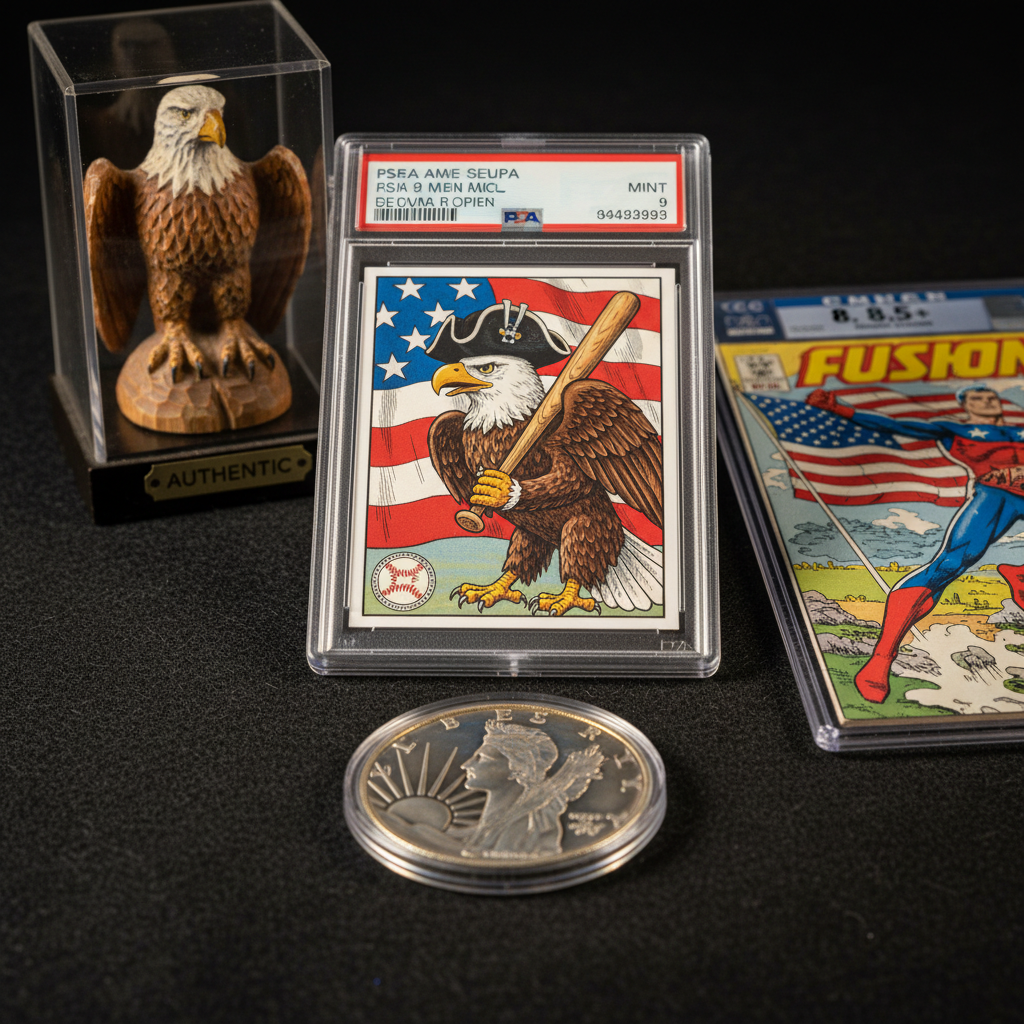
There is a particular kind of American object that defies easy categorization — hand-carved eagles with asymmetrical wings, painted wooden Uncle Sams with mismatched eyes, flag-draped trade signs weathered to near-illegibility. Folk art made in the name of patriotism. For decades, this category lived in the shadow of fine art and blue-chip Americana collectibles. That era is quietly ending.
The market for American patriotic folk art has been building a serious collector base, driven partly by nostalgia, partly by a broader appetite for objects with authentic handmade provenance. Unlike mass-produced memorabilia, these pieces carry the fingerprints — sometimes literally — of their makers. That singularity is exactly what the current market rewards.
What the Category Actually Covers
Patriotic folk art is not a monolith. At one end, you have carved and painted eagles, the workhorses of the genre — pieces that range from crude 19th-century shop carvings worth a few hundred dollars to museum-quality examples by documented makers that have cleared $50,000 at Heritage Auctions and Skinner. At the other end sit painted game boards, hooked rugs with flag motifs, whirligigs, and trade figures — objects that straddle decorative art and functional craft.
The most coveted pieces share a few traits: strong graphic impact, clear age indicators like original paint surface and tool marks, and ideally some provenance linking them to a specific region or tradition. New England and Pennsylvania remain the dominant production regions in the historical record, and pieces from those areas command premiums accordingly.
Condition grading in folk art is more subjective than in cards or coins, but the market has developed its own informal standards. Original paint — meaning untouched, unrestored surface — is the equivalent of a PSA 10 in this world. A carved eagle with 80 percent original paint and honest wear will consistently outperform a cleaner example that has been touched up. Dealers who specialize in this category are rigorous about this distinction, and serious buyers have learned to ask the right questions.
Auction Performance and the Current Pricing Landscape
The last several years have produced some instructive data points. A carved and painted American eagle attributed to the mid-19th century — the kind of piece that might have hung above a post office or civic building — brought $28,750 at a New England regional house in 2023, well above its $12,000–$18,000 estimate. Painted wooden figures in patriotic dress, the Uncle Sam and Lady Liberty archetypes, have seen similar enthusiasm, with strong examples regularly finding buyers in the $8,000–$25,000 range depending on scale, condition, and graphic intensity.
At the more accessible end, hooked rugs with eagle or flag compositions have become entry points for newer collectors. Good examples in the $1,500–$4,000 range appear regularly at regional auction houses and through dealers specializing in American country antiques. These are not speculative flips — they are pieces that hold value because the supply of authentic 19th and early 20th-century examples is genuinely finite.
That finite supply is a key structural fact about this market. Unlike sports cards, where the population of a given issue is knowable and trackable, folk art inventory is whatever survived attics, barn fires, and estate clearances. New discoveries do surface — a carved figure emerging from a rural Pennsylvania estate, a painted game board at a small-town auction — but the pipeline is inherently unpredictable. Scarcity is baked in.
The Collector Profile Is Shifting
Traditionally, patriotic folk art attracted a specific kind of buyer: older, regionally rooted, often connected to the antiques trade. That profile is broadening. Younger collectors drawn to Americana aesthetics — the same demographic fueling the market for vintage workwear, early American ceramics, and primitive furniture — are discovering folk art as an extension of a broader design sensibility. These buyers are not necessarily coming through traditional auction channels. They are finding pieces through Instagram dealers, specialized fairs like the Antiques Week events in New Hampshire and the Brimfield Antique Flea Markets, and a growing number of curated online platforms.
This demographic shift matters because it introduces new capital and new tastes into a category that had grown somewhat static. Pieces that appeal visually — bold graphics, strong silhouettes, immediate presence on a wall — are outperforming more historically significant but visually quieter examples. The market is, in this sense, behaving like every other collectibles market: aesthetics and emotional resonance drive premiums as much as provenance and age.
For established collectors, that dynamic creates both opportunity and frustration. The opportunity is that deep knowledge still confers real advantage — understanding regional traditions, identifying authentic tool marks, recognizing period paint chemistry separates serious buyers from decorators writing checks. The frustration is that prices on the most visually arresting pieces have moved sharply, compressing the margin for patient, research-driven acquisition.
American patriotic folk art has never been a get-rich-quick category. It rewards the collector who does the work — reads the scholarship, handles enough pieces to develop an eye, builds relationships with the right dealers. What's changed is that the rest of the market is finally paying attention.