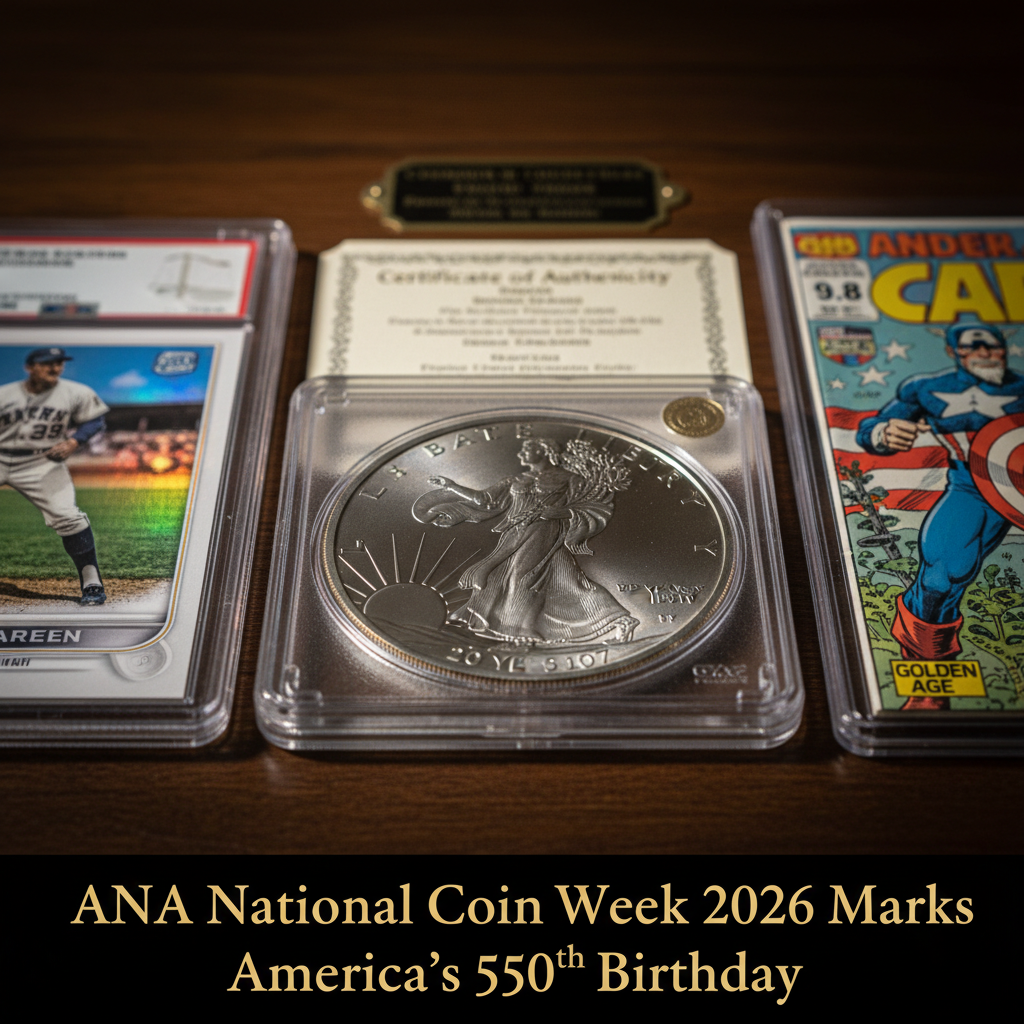
The American Numismatic Association is turning the nation's semiquincentennial into a numismatic event. National Coin Week 2026, running April 19–25, frames the United States' 250th anniversary not through monuments or textbooks, but through the coins and currency that changed hands across two and a half centuries of American commerce, conflict, and culture.
The timing couldn't be more deliberate. The ANA has organized National Coin Week annually since 1924 — itself a century-old tradition — but the 2026 edition carries unusual weight. The Semiquincentennial is already reshaping the U.S. Mint's production calendar, with commemorative programs and special releases scheduled throughout the year. For collectors, that means National Coin Week lands at the precise intersection of peak public interest and peak mint output. A rare alignment.
Why 1776 Still Sells in 2026
The numismatic market has a long memory for round numbers. The U.S. Bicentennial in 1976 produced the dual-dated 1776–1976 Washington Quarter, Eisenhower Dollar, and Kennedy Half Dollar — coins that remain among the most recognized issues in modern American numismatics. Circulated examples trade for face value, but top-tier specimens tell a different story. A 1976-S Eisenhower Dollar graded NGC MS-68 can fetch several hundred dollars at auction, and Bicentennial proof sets in original government packaging still move briskly at shows and on Heritage's weekly internet auctions.
The 250th anniversary market is already building on that precedent. The U.S. Mint's America the Beautiful and American Innovation programs have conditioned a generation of collectors to treat commemorative coinage as both accessible entry points and legitimate investment vehicles. If the Mint's 2026 commemorative lineup delivers strong designs — not a guarantee, given the agency's uneven track record on that front — demand from both casual buyers and registry-set builders could be substantial.
PCGS and NGC population reports will be the scorecards. Early submissions on any 2026-dated commemorative will establish the grade curve, and the collectors who move fastest on high-mintage issues with low pop counts at the top end historically see the strongest returns.
Education as the Engine
National Coin Week has always been as much outreach as celebration. The ANA uses the week to push numismatic education into schools, libraries, and community centers — an effort that matters more than it might seem for the long-term health of the hobby. The average age of active coin collectors skews older, a demographic reality the ANA has been working against for years. Events like National Coin Week, with their emphasis on everyday coins as historical artifacts, are among the more effective tools for pulling younger audiences in.
The 2026 theme is particularly well-suited to that goal. Framing American history through the physical objects that funded a revolution, survived a Civil War, and navigated the Great Depression is genuinely compelling storytelling. A 1793 Chain Cent — the first coin struck by the United States Mint — is a more visceral connection to the founding era than most museum exhibits. That narrative hook works on a ten-year-old and a seasoned collector alike.
Local coin clubs affiliated with the ANA typically organize shows, presentations, and trading events during the week. For dealers, it's a reliable traffic driver. For newer collectors, it's often the first structured exposure to grading, authentication, and the basics of building a focused collection rather than a random accumulation.
The Bigger Picture for Coin Collectors in 2026
The U.S. coin market has shown resilience through broader collectibles volatility. While trading cards and sports memorabilia experienced sharp corrections from their 2021 peaks, rare coins — particularly pre-1933 gold, key-date Morgans, and early American copper — held value with more stability. The PCGS 3000 index, which tracks rare coin prices across major categories, has reflected that steadiness, even as speculative corners of the market cooled.
A national anniversary year historically lifts all numismatic boats, at least temporarily. Increased media coverage of the Semiquincentennial will introduce new buyers to the category. Some will stay. The ANA's job during National Coin Week is to make sure they have somewhere to land when they do.
Two hundred and fifty years of American monetary history is an extraordinary collection in itself — from hand-struck colonial coppers to clad statehood quarters to digital payment systems that may eventually render physical currency ceremonial. That arc is the story National Coin Week 2026 is trying to tell. Whether the coins themselves get the audience they deserve depends largely on how well the hobby shows up for the moment.