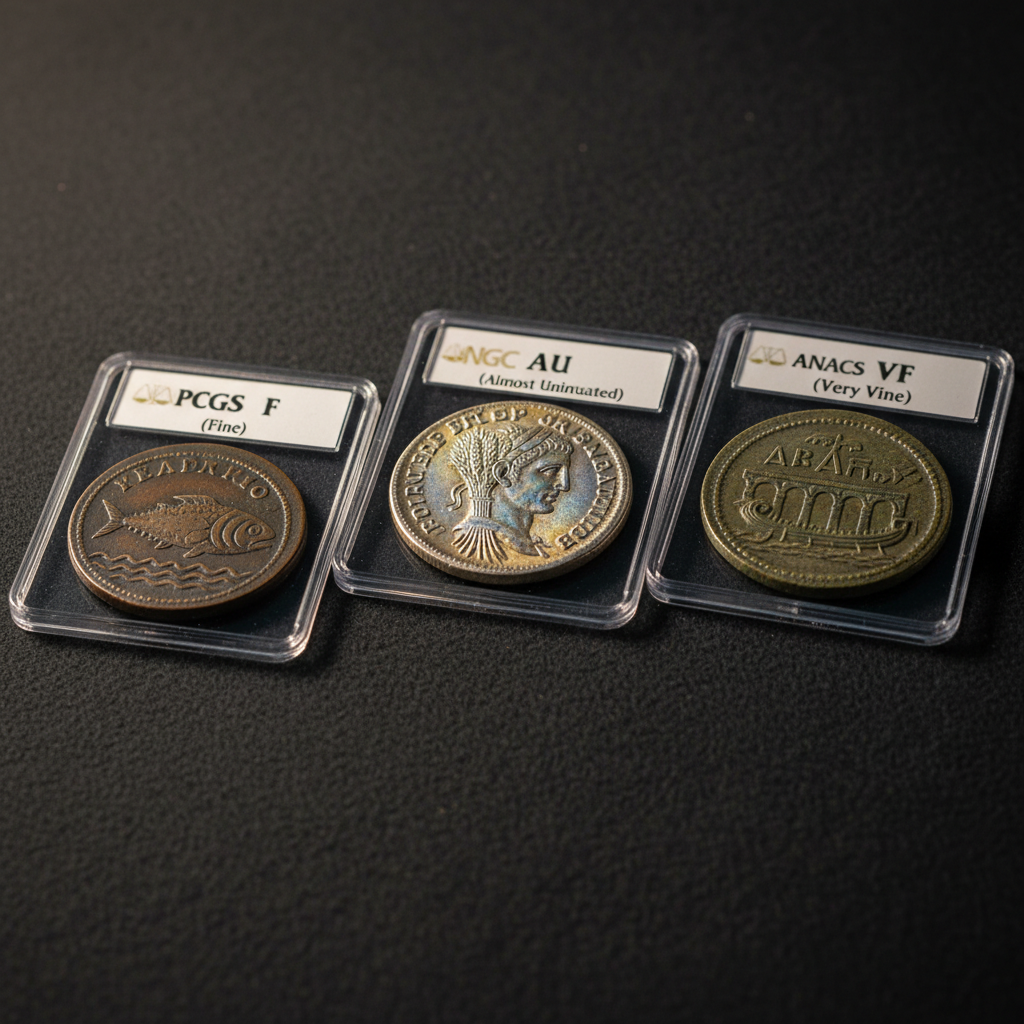
Before paper money, before banking, before futures markets — there were coins stamped with wheat ears, grape clusters, and fish. The ancient world's anxiety about food supply didn't live only in granaries and tax records. It lived on money. And for collectors of ancient coinage, that iconography is one of the most underappreciated entry points into a market that has quietly outperformed many modern collectible categories over the past decade.
Mike Markowitz's deep-dive for CoinWeek into food imagery on ancient Greek and Roman coins is a reminder that numismatic scholarship and market opportunity are rarely far apart. The coins he examines aren't curiosities. They're primary sources — struck in silver and bronze by rulers who understood that controlling the food supply and controlling the money supply were the same political act.
What the Dies Actually Show
Grain ears appear on coinage from Metapontum, the Greek colony in southern Italy, as early as the sixth century BCE — some of the earliest and most visually striking examples of agricultural iconography in the Western numismatic tradition. Metapontum's fertile plains made it a grain powerhouse, and the city wasn't shy about advertising that fact on its silver staters. A well-preserved Metapontum stater in NGC Choice Fine condition can move for $400–$800 at auction; finer examples with full grain-ear reverses and sharp obverse portraits have cleared $3,000–$5,000 at Heritage and Stack's Bowers in recent years.
Grapes and wine appear across the Aegean world — on coins from Naxos, Thasos, and Mende — reflecting the economic centrality of viticulture to those island and coastal economies. Fish, particularly tuna and dolphin, dominate the coinage of maritime cities like Cyzicus and Syracuse. The Syracuse dekadrachm, featuring the sea-nymph Arethusa surrounded by dolphins, is one of the most coveted coins in all of ancient numismatics. A NGC MS 5/5 4/5 example sold for over $120,000 at Stack's Bowers in 2022 — and that's a coin where the dolphins are almost secondary to the artistry of the obverse.
Roman coinage brought a different political logic to food imagery. The annona — Rome's grain dole — became a recurring reverse type on Imperial bronzes, with personifications of grain supply holding ears of wheat and a ship's prow. These aren't decorative choices. They're policy statements, struck in metal and circulated to a population that understood exactly what they meant.
The Collector Market for Food-Themed Ancients
Ancient coins remain one of the few collectible categories where a serious, historically significant piece can still be acquired for under $500. That's not a small thing. A PSA 10 1986 Fleer Michael Jordan rookie will cost you north of $700,000. A genuine silver drachm from a Greek city-state that used grain imagery — 2,400 years old, authenticated and graded by NGC Ancients — can be had for a few hundred dollars on a slow auction day.
The NGC Ancients grading scale uses a descriptive system rather than a numeric one — Fine, Very Fine, Extremely Fine, Choice — combined with strike and surface scores on a 1–5 basis. Population data for ancient coins is thinner than modern numismatics, which cuts both ways: less transparency on rarity, but also less speculative premium baked into common types. For food-themed coins specifically, the Metapontum grain staters and the bronze coinage of Roman Egypt (which frequently depicted agricultural scenes tied to the Nile flood cycle) represent the most accessible price points with genuine historical depth.
Dealers specializing in ancients — CNG (Classical Numismatic Group), Nomos AG, and the ancient coin departments at Heritage and Stack's Bowers — have all reported sustained demand from crossover buyers: collectors who came up through U.S. coins or world coins and discovered that ancients offer more history per dollar than almost anything else in the hobby.
Why Iconography Drives Value
Not all food imagery is created equal. A generic wheat ear on a late Roman provincial bronze is a footnote. A fully struck, high-relief grain stater from Metapontum with provenance to a named collection is a centerpiece. The difference in value can be tenfold or more, and it tracks directly to the clarity and artistic quality of the food imagery itself — which is unusual in numismatics, where the obverse portrait typically dominates valuation.
For fish coins, condition of the reverse is everything. Tuna and dolphin types from Cyzicus and Acragas are frequently found with flat or worn reverses precisely because those high-relief aquatic designs struck unevenly. A sharply detailed fish reverse on an Acragas silver didrachm — the city's famous eagle-and-crab type notwithstanding — commands a meaningful premium over the same coin with a mushy reverse, even if the obverse is crisp.
Markowitz's scholarship points to something the market has already priced in: food iconography on ancient coins isn't a niche interest. It's a window into the economic and political architecture of the ancient world, struck by governments that understood money and food were inseparable instruments of power. Collectors who've figured that out are buying accordingly.