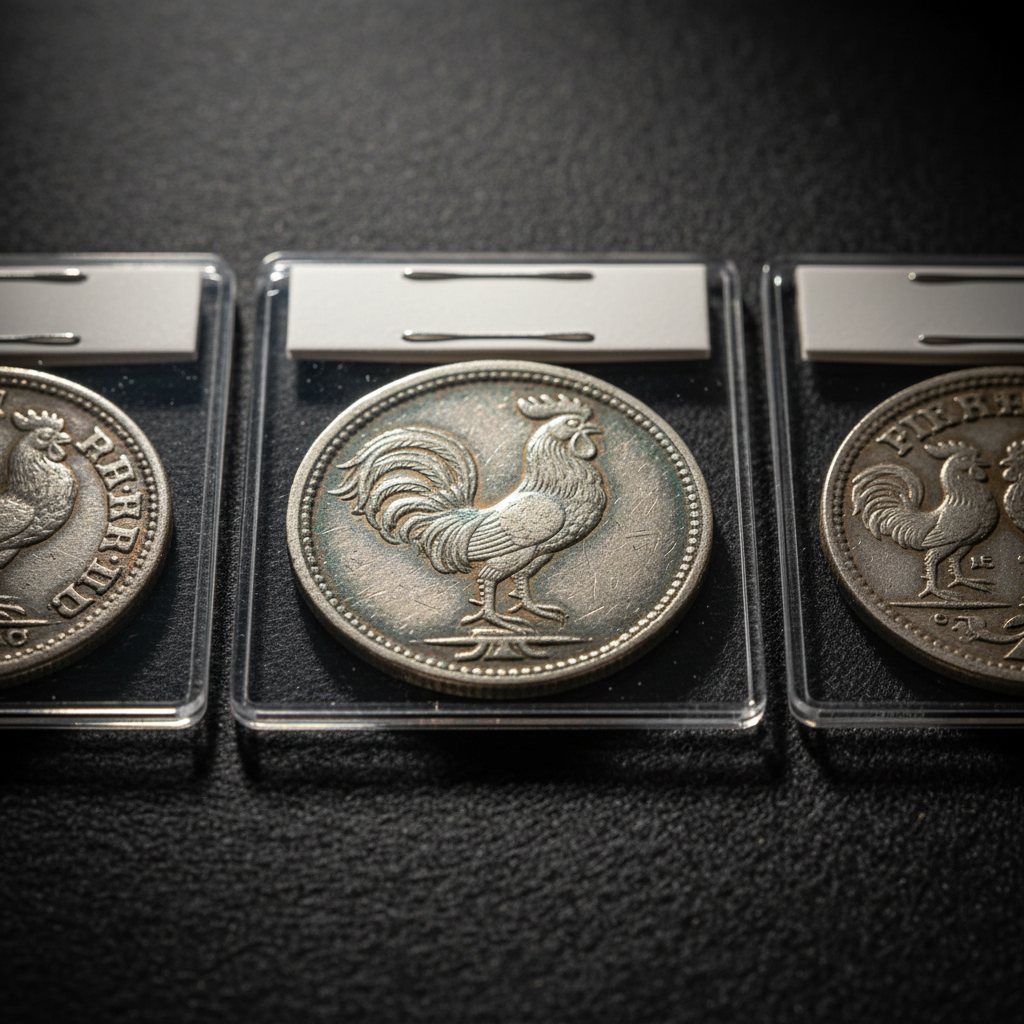
Before the chicken became a commodity, it was a god. Or close enough. In the ancient Mediterranean world, the rooster crowed at dawn and was understood to summon the sun — a creature of divine punctuality that commanded genuine religious awe. That cultural weight translated directly onto coinage, and for collectors of ancient numismatics, the bird's appearances across Greek, Roman, and provincial issues represent one of the most underappreciated iconographic threads in the entire field.
Mike Markowitz, writing for CoinWeek, has traced this lineage from its origins in Southeast Asian jungle fowl through the Phoenician trade networks that introduced domesticated chickens to the Mediterranean around 2000 BCE. What followed was a millennia-long process of symbolic elevation — from livestock to sacred omen to civic emblem — and ancient mints documented nearly every stage of it.
Sacred Bird, Silver Coin
The rooster's earliest and most persistent association in Greek religion was with Asclepius, the god of medicine. Plato's Phaedo records Socrates' final words as a request to sacrifice a rooster to Asclepius — a detail that has fascinated classicists for centuries and that gives rooster-type coins from Epidaurus, the god's primary sanctuary, an extraordinary literary resonance. A collector holding an Epidaurian bronze with a rooster reverse isn't just holding metal; they're holding an artifact from the same devotional economy Socrates died inside.
Hermes, the messenger god, also claimed the rooster as a sacred animal, which explains its appearance on coins from cities under his patronage. The bird's association with dawn, transitions, and thresholds mapped neatly onto Hermes' role as a psychopomp — a guide of souls between worlds. These weren't arbitrary design choices. Ancient die engravers worked within a visual vocabulary their audiences understood immediately.
The practical military dimension matters too. Roman commanders relied on sacred chickens — the pullarii — as battlefield divination tools. If the birds ate eagerly before an engagement, the omens were favorable. If they refused, commanders were expected to delay. The consul Publius Claudius Pulcher famously ignored an unfavorable omen in 249 BCE, reportedly throwing the reluctant birds overboard with the line that if they wouldn't eat, they could drink — then lost the Battle of Drepana and most of his fleet. Roman coins referencing this avian augury tradition carry the full weight of that institutional belief system.
The Market for Rooster-Type Ancients
For collectors, the good news is that rooster-type ancient coins span an enormous price range — from accessible to genuinely rare. Small Greek bronzes from minor city-states featuring a rooster as the primary type can be acquired through dealers like CNG (Classical Numismatic Group) or at Heritage Auctions for under $200 in circulated grades. These are legitimate ancient coins, 2,400 years old, available at the price of a decent modern graded card.
At the upper end, silver issues are a different conversation entirely. A well-struck hemidrachm from Himera — the Sicilian city whose coins famously featured a rooster on the obverse during the 5th century BCE — in NGC Choice Fine condition has traded in the $800–$2,500 range at recent auction, depending on strike quality and centering. Himera's rooster types are among the most recognizable in all of Greek numismatics, and population is genuinely limited; NGC's ancient coin census, while less granular than its modern counterparts, reflects consistent scarcity in the higher grades.
- Himera hemidrachms (5th century BCE): Rooster obverse, crab reverse — one of the canonical Greek civic types
- Delos bronzes: Rooster associated with Apollo's sacred island, modest size but strong iconographic pedigree
- Corinthian issues: Pegasus obverse, rooster in various reverse positions on fractional silver
- Roman Republican bronzes: Augural symbolism, rooster appearing alongside other priestly implements
NGC and PCGS both grade ancient coins, with NGC holding the dominant market position in the ancient segment. A rooster-type coin in an NGC slab carries meaningful liquidity advantages over raw examples at auction — Heritage and Stack's Bowers both report stronger hammer prices on slabbed ancients versus equivalent raw pieces, typically in the 15–30% range depending on the type.
Why Iconography Drives Value Here
Ancient coin collecting has always rewarded iconographic literacy. A buyer who understands that a rooster on a Himerean coin isn't decorative — that it signals the city's identity, its religious affiliations, its place in the broader Greek world — is a buyer who can identify undervalued inventory. The market for ancient coins remains less efficient than modern numismatics precisely because the knowledge barrier is higher.
That inefficiency is a feature, not a bug. Collectors who do the work — reading Markowitz, working through standard references like Sear's Greek Coins and Their Values, building relationships with specialist dealers — consistently find coins priced below what their historical significance warrants. The rooster types are a textbook example: common enough to be acquirable, rare enough in high grades to reward patience, and rich enough in historical context to hold collector interest across generations.
The chicken changed the ancient world, as Markowitz argues. It also left a paper trail — struck in silver and bronze, circulated across trade routes, and now sitting in dealer cases and auction lots waiting for someone who knows what they're looking at.