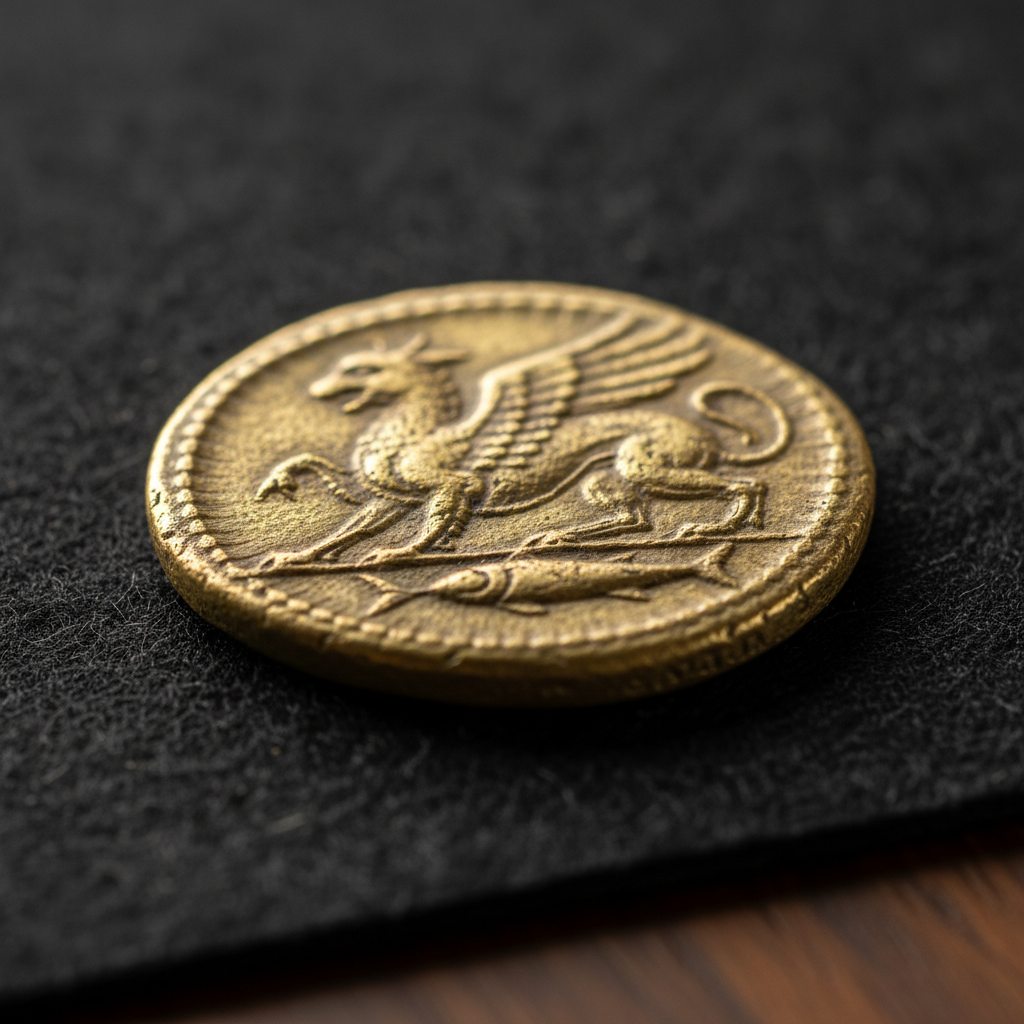
Some coins are historical artifacts first and collectibles second. The electrum stater from ancient Cyzicus consigned to GreatCollections' April 12 auction falls squarely into that category — a 2,400-year-old monetary relic that fuses maritime dominance, mystery cult iconography, and the ancient world's most sophisticated monetary technology into a single, palm-sized object.
The coin originates from Cyzicus, Mysia — a city-state on the southern shore of the Propontis (modern-day Sea of Marmara) — and is dated to the 5th–4th centuries B.C. Its obverse features the Cabeirus, a deity associated with the mystery cults of the northern Aegean and a figure rarely depicted in ancient numismatics. That iconographic specificity alone elevates this piece above the typical Greek stater offering.
Why Cyzicus Staters Occupy a Singular Place in Ancient Numismatics
Cyzicus was not merely a prosperous port city. It was the de facto monetary engine of the pre-Hellenistic Aegean economy. From roughly 550 B.C. through the mid-4th century B.C., Cyzicene staters — struck in electrum, a naturally occurring gold-silver alloy — functioned as the dominant international trade currency across the Black Sea basin and eastern Mediterranean. Think of them as the ancient equivalent of a reserve currency, accepted far beyond the issuing state's political reach.
The city's control over electrum coinage was partly geographic. Positioned at the narrow passage between the Propontis and the Black Sea, Cyzicus taxed and facilitated trade between the Aegean world and the grain-rich Pontic steppe. That economic leverage translated directly into monetary authority. Cyzicene staters circulated in Athens, Sparta, Persia, and throughout the Thracian coast — their consistent weight standard and high electrum purity making them trusted instruments of commerce across rival political systems.
What makes the series visually distinctive — and what drives collector demand — is Cyzicus' practice of rotating obverse types with each issue. Rather than standardizing on a single deity or ruler portrait, the mint produced hundreds of distinct reverse and obverse combinations over two centuries. Scholars have catalogued well over 200 individual types. Each stater is, in effect, a unique artifact. Finding one with the Cabeirus depicted is particularly uncommon; the mystery cult deity appears far less frequently than the city's signature tunny fish, which typically anchors the reverse as a civic emblem.
The Cabeirus Connection — Sacred Iconography in Hard Currency
The Cabeiri were chthonic deities worshipped in mystery cults centered on the islands of Samothrace and Lemnos, as well as in coastal Thrace and northwestern Anatolia — precisely the cultural sphere Cyzicus occupied. Initiates into the Cabeiri mysteries were promised protection at sea, making the cult enormously popular among sailors and merchants. For a maritime trading hub like Cyzicus, embedding Cabeirus imagery into coinage was both a religious statement and a commercial signal.
That layered symbolism — civic identity, divine protection, trade network — compressed into a single electrum disc is exactly what serious ancient coin collectors pursue. These aren't decorative objects. They are primary historical documents.
Electrum staters in general command strong premiums over comparable silver issues from the same period, reflecting both their relative scarcity and the alloy's intrinsic complexity. Cyzicene electrum staters in particular have seen sustained auction interest over the past decade, with mid-grade examples from major houses like Heritage Auctions and Stack's Bowers regularly clearing the $3,000–$8,000 range, while exceptional specimens with sharp strike and clear iconography have pushed well past $15,000. The presence of a rare type like the Cabeirus — rather than the more common athlete or animal obverses — pushes any well-preserved example toward the upper end of that spectrum.
GreatCollections and the Democratization of Serious Ancient Coins
GreatCollections, best known in the modern coin community for its no-buyer's-premium model and strong graded coin volume, has steadily expanded its ancient coin offerings in recent years. Listing a piece of this historical and numismatic significance on April 12 signals continued ambition in that category.
For bidders, the calculus here is straightforward: Cyzicene electrum staters are finite. The mint closed in the mid-4th century B.C., production never resumed, and attrition over two millennia has thinned the surviving population considerably. Unlike modern collectibles where grading population reports give you precise scarcity data, ancient coin rarity is estimated through die studies and auction archives — and by that measure, a Cabeirus-type Cyzicene stater is not something that surfaces on a predictable schedule.
The April 12 sale is worth watching closely. Not every ancient coin auction offers a piece where the iconography, the issuing city's historical weight, and the monetary significance all converge this cleanly. This one does.