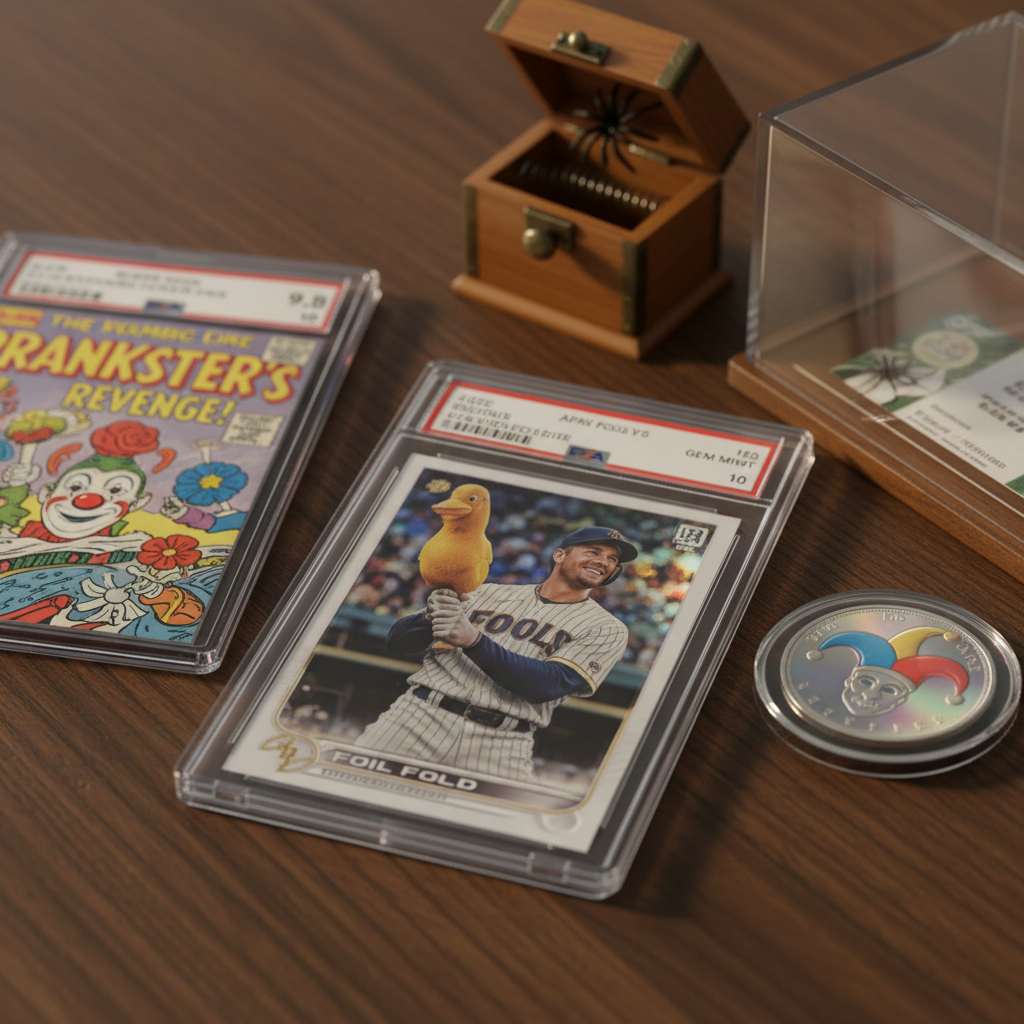
Every April 1st, the collectibles world gets a little chaotic. Fake auction listings. Staged grading reveals. Dealers trolling their regulars with absurd price tags on common items. The pranks are predictable. The history behind why humans decided one day a year should be devoted to deception, however, is anything but.
April Fool's Day sits in a strange corner of the antiques and collectibles market — it's one of the few cultural phenomena that has generated genuine, collectible ephemera across centuries without ever having an official origin story. That ambiguity is exactly what makes the category interesting.
A Holiday Without a Birth Certificate
The most widely cited theory traces April Fool's Day to 16th-century France, when the Gregorian calendar reform shifted the new year from late March to January 1. Those slow to adopt the change — or simply unaware of it — continued celebrating the new year around April 1 and became targets of jokes, often receiving fake gifts or invitations to nonexistent parties. The French called these victims poisson d'avril, or April fish, a term still used in France today.
But the historical record is murky. References to spring-time foolishness appear in Chaucer's Canterbury Tales as early as 1392, and some scholars connect the holiday to the Roman festival of Hilaria or the unpredictable weather of early spring. No single origin has ever been definitively proven. For collectors of historical ephemera, that ambiguity is a feature, not a bug — it means the paper trail is wide open.
Printed April Fool's ephemera began appearing in earnest in the 18th and 19th centuries. British and French printers produced novelty cards, fake newspaper front pages, and satirical broadsides tied to the holiday. These items now surface regularly at auction, typically through specialist ephemera dealers and occasionally through major houses like Heritage Auctions and Swann Auction Galleries, which handles paper Americana and printed ephemera with particular depth.
The Collectible Footprint of April 1st
Victorian-era April Fool's postcards represent the most accessible entry point for collectors today. Produced between roughly 1900 and 1920, these chromolithograph cards feature fish imagery, jesters, and elaborate visual gags. In Fine to Very Fine condition, common examples trade in the $15–$40 range. Rarer mechanical or hold-to-light variants — where the image changes when held up to a lamp — can push into the $200–$500 range depending on condition and publisher.
The German-printed postcard market of that era was particularly prolific, and April Fool's themes appeared alongside Christmas, Easter, and Valentine's Day cards in the major export catalogs. Collectors who specialize in holiday ephemera often treat April Fool's as an undervalued subcategory — the production numbers were lower than Christmas or Easter, and serious collector competition is relatively thin.
Beyond postcards, there's a legitimate category of April Fool's newspaper hoaxes that generated their own paper trail. The 1957 BBC broadcast about the Swiss spaghetti harvest — widely considered the most successful television hoax in history — spawned decades of documented media coverage, anniversary features, and archival reprints that serious broadcast history collectors actively pursue. Original BBC documentation from that broadcast has appeared at U.K. auction.
Why Ephemera Collectors Should Pay Attention
The broader ephemera market has been on a quiet but sustained run. Swann Auction Galleries reported strong results across its paper Americana categories throughout 2023 and into 2024, with vintage advertising, novelty cards, and satirical prints all outperforming pre-sale estimates at a higher rate than in previous cycles. Holiday ephemera, broadly, has benefited from the same nostalgia wave driving vintage toy and trading card prices — buyers want tangible connections to cultural memory.
April Fool's material sits at the intersection of humor history, print history, and holiday collecting. It doesn't have the institutional support of Christmas ephemera or the crossover appeal of Halloween, which commands serious premiums from costume and horror collectors. But that's precisely the opportunity. A focused collection of April Fool's postcards, novelty newspapers, and satirical broadsides from the 18th through mid-20th century could be assembled for well under $5,000 today — a figure that would buy you approximately nothing in the vintage sports card market.
The collectors who built serious Halloween ephemera collections in the 1990s, when the category was considered niche and slightly odd, are sitting on holdings worth multiples of their original investment. April Fool's won't replicate that trajectory overnight. But the category has the raw ingredients: genuine historical depth, limited collector competition, and a cultural hook that resonates across generations.
The joke, it turns out, might be on anyone who keeps ignoring it.