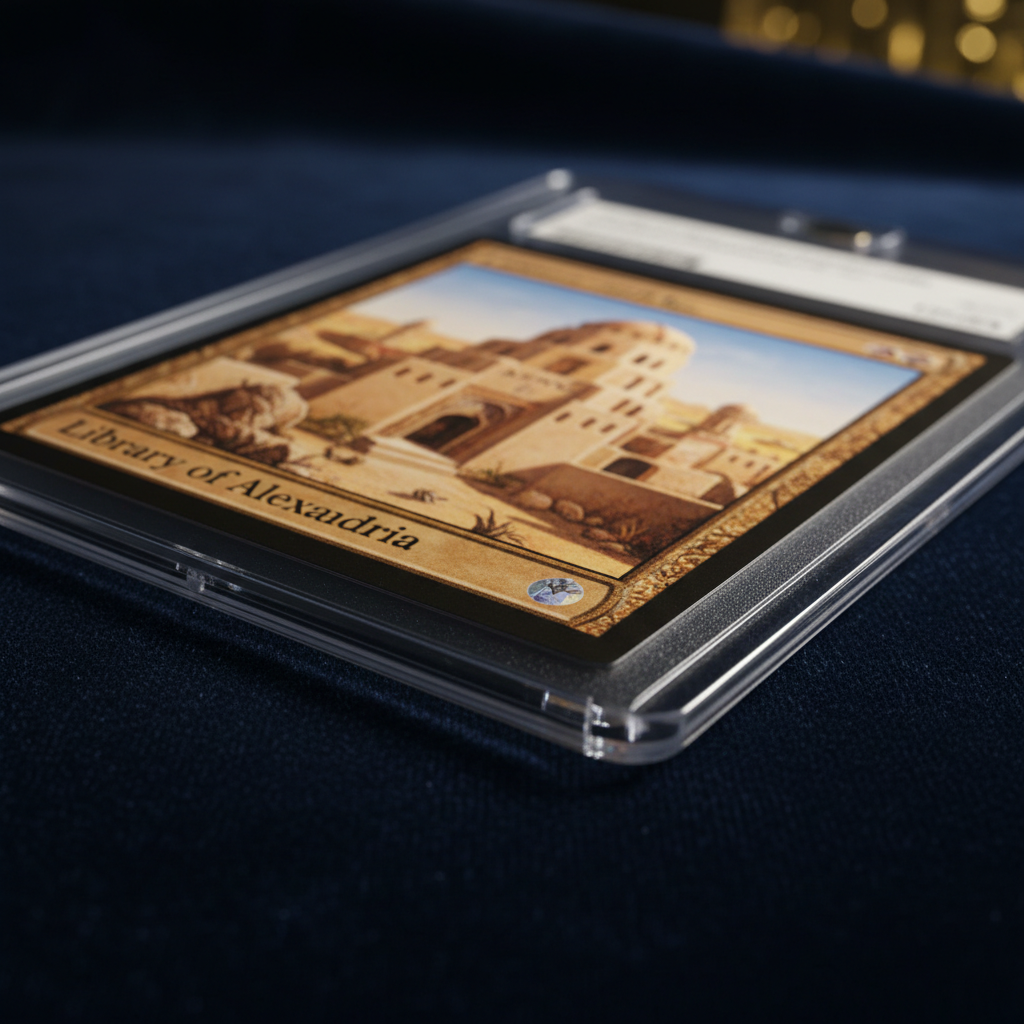
Thirty years on, the cards from Magic: The Gathering's first expansion set are still punishing collectors who slept on them. Arabian Nights, released in December 1993 — just four months after Alpha hit hobby shops — remains one of the most consequential 92-card sets ever printed, and its top-tier specimens are trading at prices that would have seemed absurd when booster packs retailed for pocket change.
The set's origin story is worth understanding before you touch the price guide. Wizards of the Coast was still finding its footing when Arabian Nights went to press. The company briefly considered producing the set with a distinct pink-and-purple card back, effectively making it a standalone product. They pulled back from that decision — a call that, in hindsight, preserved the set's compatibility with the base game and cemented its collectibility. What collectors ended up with was 92 cards drawn from the mythology of One Thousand and One Nights, pressed in a print run estimated at roughly five million cards total. For context, that's a fraction of what a modern Magic set ships in a single week.
The Cards Moving Real Money
At the top of the Arabian Nights value hierarchy sits Library of Alexandria, the set's undisputed crown jewel. A PSA 9 copy sold through Heritage Auctions for north of $16,000 in recent years, and even heavily played copies regularly clear four figures. The card's power level — drawing an extra card per turn under the right conditions — got it banned from virtually every competitive format, which somehow only enhanced its mystique as a collector's object.
Bazaar of Baghdad runs close behind. Another land card with a warped power-to-mana-cost ratio, it's a Legacy and Vintage staple that commands $2,000 to $6,000 depending on condition, with PSA 10 copies essentially nonexistent in the population report. The PSA pop for Gem Mint Arabian Nights cards across the board is brutally thin — the combination of 30-year-old card stock, black-bordered edges that show wear instantly, and a collector base that largely didn't sleeve cards in 1993 means high-grade copies are genuinely scarce, not just marketed as such.
Juzám Djinn occupies a different kind of prestige. It's not broken by modern standards, but it's an iconic beatdown creature from an era when a 5/5 for four mana felt game-warping. PSA 8 copies trade in the $800–$1,500 range, and the card carries enormous nostalgia weight among players who built black aggro decks in the mid-1990s. Nostalgia, as any serious collector knows, is a legitimate pricing variable.
Other cards worth tracking on the Arabian Nights checklist:
- Serendib Efreet — a misprint variant (with the wrong artist credit) adds a premium layer to an already desirable card
- City of Brass — reprinted dozens of times but the original Arabian Nights printing commands a significant premium over later versions
- Shahrazad — banned in most formats, which paradoxically makes it a conversation piece; NM copies trade around $200–$400
- Drop of Honey — a Reserved List enchantment with limited supply and steady demand from cube and Vintage collectors
Why Arabian Nights Holds Up as an Investment Thesis
The Reserved List is the structural argument here. Wizards of the Coast committed in 1996 to never reprinting certain cards in their original form, and Arabian Nights is heavily represented on that list. Supply is permanently capped. The only new copies entering the market are ones that have been sitting in collections for decades — often in conditions that won't impress a grader.
BGS grading has added another dimension for condition-sensitive buyers. Beckett's subgrades expose centering and surface issues that a raw card can hide, and Arabian Nights cards routinely struggle on centering — the 1993 printing process wasn't engineered for the tolerances that earn a BGS 9.5 Black Label. That makes high-subgrade BGS copies of Library of Alexandria or Bazaar of Baghdad genuinely rare assets, not just scarce ones.
The broader Old School Magic format — a community-driven competitive scene built around cards from 1993 and 1994 — has been a sustained demand driver that the mainstream hobby press undercoveres. Old School events run at major conventions and online leagues, and players actually use these cards. This isn't purely a display-case market. That dual-use demand profile, playable and collectible, is exactly what sustains price floors when the broader trading card market softens.
Five million cards sounds like a lot until you account for three decades of attrition — cards played to destruction, lost in moves, thrown away by parents, damaged by water. The surviving population of high-grade Arabian Nights cards is almost certainly smaller today than it was in 2010, and it will be smaller still in 2035. The set isn't getting younger, and neither is the supply.