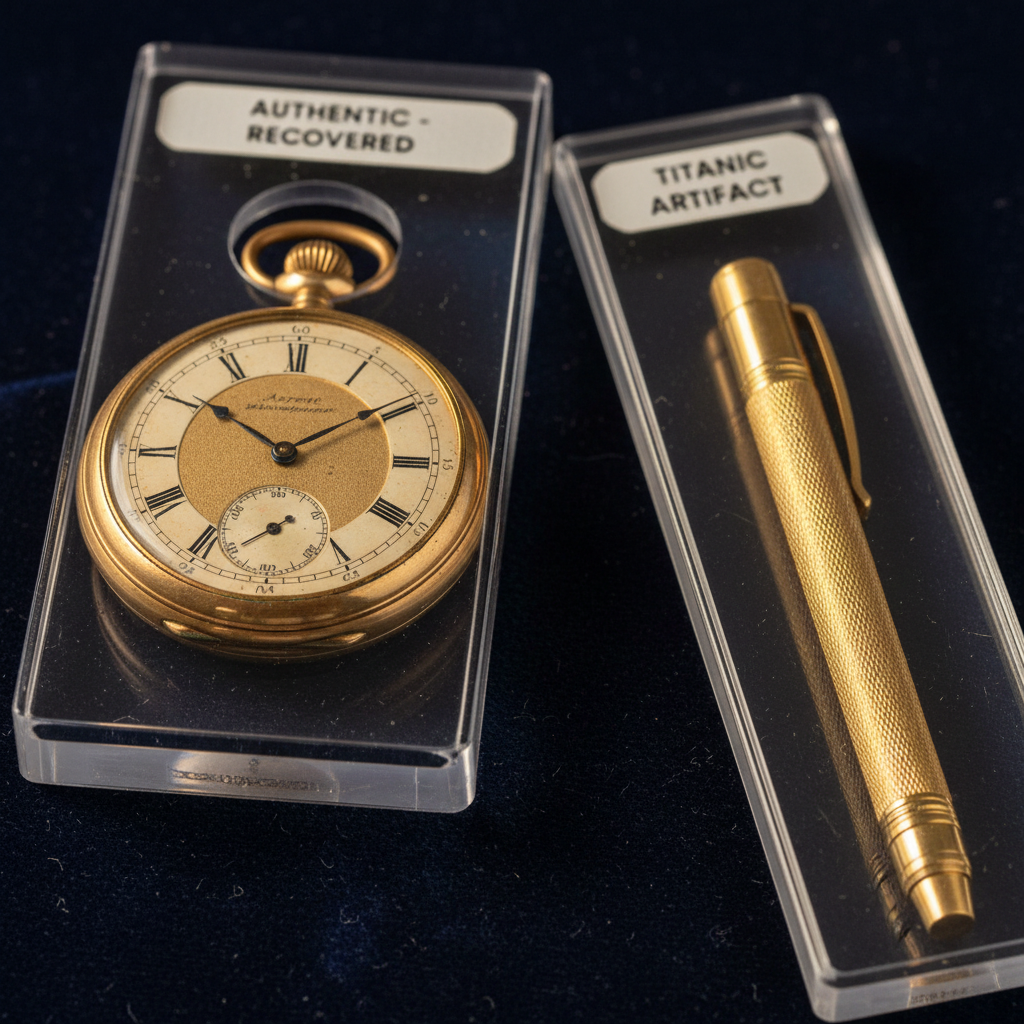
One of the most consequential pocket watches in American history is coming to auction. Freeman's will offer the personal effects of John Jacob Astor IV — recovered from his body after the Titanic sank on April 15, 1912 — including his pocket watch and a gold pencil that have remained in unbroken Astor family possession for more than 110 years.
Astor was the wealthiest passenger aboard the Titanic and, at the time of his death, one of the richest men in America. His fortune, built on Manhattan real estate and the Waldorf-Astoria hotel empire, was estimated at roughly $87 million — equivalent to well over $2 billion today. He did not survive the sinking. His body was recovered by the CS Mackay-Bennett, and the personal effects found on him were returned to his family. That chain of custody has never broken.
Why Provenance Here Is Everything
In the broader collectibles market, provenance is often a marketing term. Here, it is the entire story. These are not artifacts pulled from the ocean floor by a salvage operation — a category that carries its own legal and ethical complications — but objects that passed directly from the disaster site to the Astor family and stayed there. That distinction matters enormously, both legally and at auction.
Titanic-related material has always commanded serious premiums. A first-class dinner menu from the ship sold for $88,000 at Henry Aldridge & Son in 2015. A life jacket recovered from the wreck fetched $167,000 at the same house in 2016. Letters written by passengers during the voyage routinely breach five figures. But personal effects belonging to a named, historically significant victim — recovered from his body and held by his descendants — represent a category of provenance that almost never surfaces.
The last comparable sale that comes to mind is the pocket watch belonging to Wallace Hartley, the Titanic's bandmaster, which sold at Henry Aldridge & Son in 2013 for £1.175 million (approximately $1.5 million at the time). Hartley's watch had strong provenance and enormous romantic resonance. Astor's watch carries both of those qualities and adds the weight of one of the most famous names in Gilded Age America.
Freeman's and the Significance of the Consignment
Freeman's, the Philadelphia-based auction house founded in 1805 and widely considered the oldest auction house in the United States, is a natural home for this material. The house has deep expertise in American decorative arts and historical artifacts, and a consignment of this profile signals that the Astor family chose their platform deliberately. Freeman's doesn't typically compete with Heritage or Sotheby's for headline-grabbing sports memorabilia or contemporary art — but for a piece of American social history with this kind of institutional gravity, they are a credible and appropriate choice.
Exact pre-sale estimates have not been publicly released at the time of writing, but given the Hartley comp and the considerably higher name recognition of Astor in an American context, a seven-figure result for the pocket watch alone would not be surprising. The gold pencil is a secondary lot in terms of monetary expectation, but as a paired provenance item — also recovered from Astor's body, also held by the family — it adds texture and completeness to the offering.
Collectors and institutions considering a bid should also weigh the regulatory landscape around Titanic artifacts. The R.M.S. Titanic Maritime Memorial Act and ongoing international agreements govern objects recovered from the wreck site, but those restrictions do not apply to items that were never submerged as part of a salvage operation. Astor's effects fall cleanly outside that framework.
The Market for Disaster-Provenance Artifacts
There is a subset of the historical memorabilia market that tracks specifically what might be called disaster-provenance material — objects whose significance derives entirely from a catastrophic moment in history. This category includes items from the Hindenburg, the assassination of Abraham Lincoln, and both World Wars. The Titanic sits at the apex of that category, in part because the disaster has never left the cultural consciousness, and in part because the number of authentic, well-provenanced artifacts is finite and shrinking as estates are settled and collections dispersed.
The Astor family holding these objects for over a century and choosing to sell now — rather than donate to an institution — suggests they expect the market to recognize full value. They are almost certainly right.
When the gavel falls on this lot, it will not just be a price. It will be a data point that resets expectations for every piece of authenticated Titanic personal-effects material that comes to market afterward.