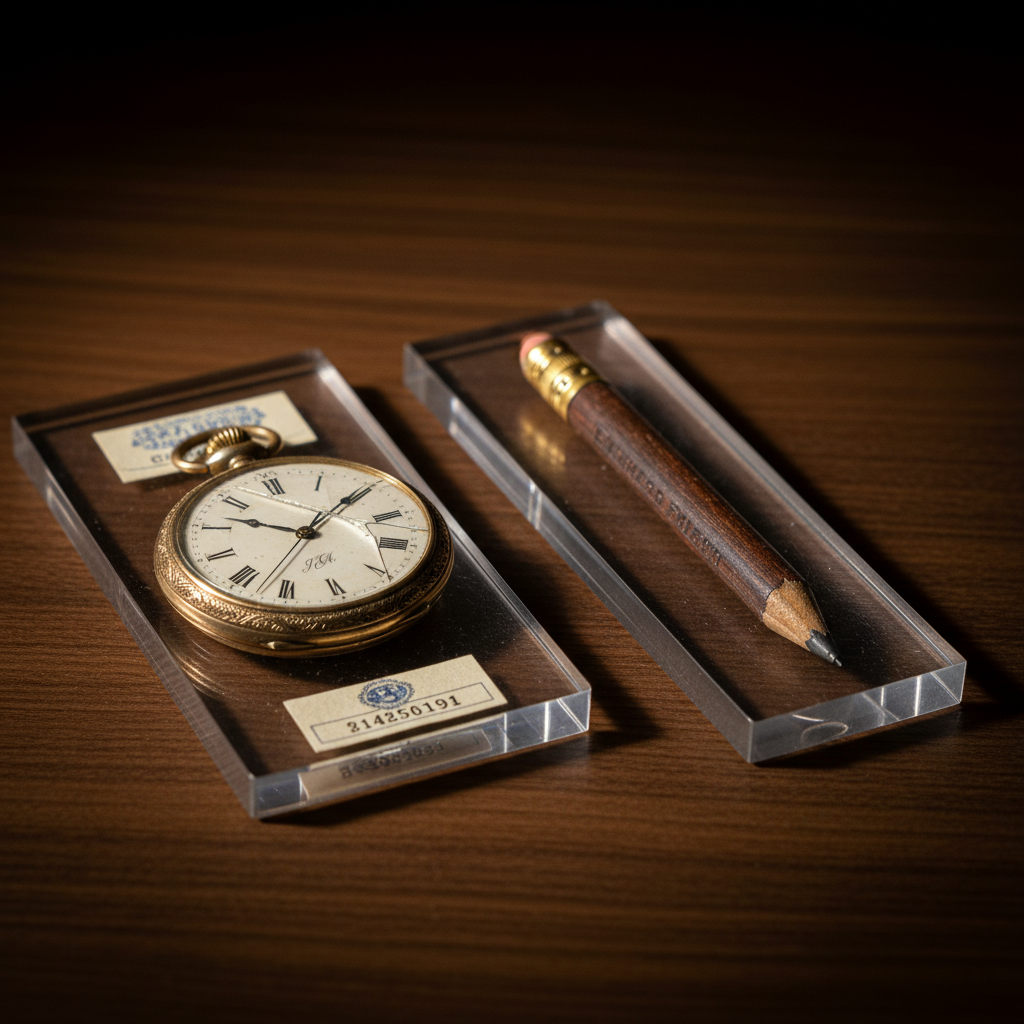
A Patek Philippe pocket watch and a gold pencil recovered from the body of John Jacob Astor IV — the wealthiest passenger aboard the RMS Titanic when it sank in April 1912 — surpassed $1.2 million combined at Freeman's auction house, delivering one of the most emotionally charged results the historical artifacts market has seen in years. These weren't decorative relics sitting in a museum vitrine. They were on his person when he drowned.
Astor, whose net worth at the time of his death was estimated at roughly $87 million — equivalent to several billion dollars today — was among the 1,517 people who perished when the ship went down. His body was recovered by the CS Mackay-Bennett. The watch and pencil were returned to his estate and have remained in family hands for over a century, which gives this sale a provenance chain that most historical artifact dealers can only dream about. Unbroken lineage from the original owner to the auction block is extraordinarily rare at this level.
The Lots That Drove the Room
The Patek Philippe was the clear headline piece. Patek's historical significance in the watch market needs no elaboration — the Geneva manufacture has long commanded the highest multiples of any brand at auction, and a piece with this kind of documented tragedy-linked provenance operates in a category almost entirely its own. No comparable Titanic-connected Patek has come to market in recent memory, making any direct comp essentially impossible. That scarcity is precisely what drives bidding into irrational territory, and Freeman's buyers obliged.
The gold pencil, which might seem like a footnote beside a Patek, is anything but. Personal effects recovered from disaster victims carry a specific, visceral weight that decorative antiques simply don't. The pencil was in his pocket. That detail matters enormously to collectors in this space, and the final price reflected it.
Freeman's, the Philadelphia-based auction house founded in 1805 and one of the oldest in the United States, has been steadily building its reputation in high-provenance historical property. This result cements that positioning. The $1.2 million figure comfortably exceeds most pre-sale estimates for Titanic-related material at this tier.
Titanic Artifacts in the Broader Market
The Titanic artifact market has a complicated history. For decades, legal disputes over salvage rights and ethical debates about commercializing disaster victims' belongings suppressed prices and chilled institutional interest. That has shifted considerably. Heritage Auctions and other major houses have handled Titanic-adjacent material with increasing frequency, and collector appetite — particularly from American and British buyers — has proven durable across economic cycles.
A few benchmarks worth knowing: a first-class Titanic menu sold for $83,000 at auction in 2012, and a life jacket recovered from the wreck fetched over $100,000 in a separate sale. Those figures underscore just how dramatically the Astor lots outperformed the broader Titanic artifact tier. The difference, of course, is attribution. Anonymous artifacts from the ship are interesting. Objects documented to the wealthiest man on board — with 112 years of family provenance — are something else entirely.
The watch market context adds another layer. Vintage Patek Philippe at auction has remained resilient even as broader luxury watch prices corrected sharply from their 2021-2022 peaks. Historically significant Pateks — particularly those with ironclad ownership histories — have held value better than almost any other category in horology. Combine that with the Titanic narrative and Astor's specific cultural footprint, and the $1.2 million result starts to look less like an outlier and more like a logical outcome.
What This Sale Signals
The collector base for material at this intersection — documented personal effects, celebrity provenance, and historical catastrophe — is small but extraordinarily motivated. These buyers aren't flipping. They're acquiring singular objects, and they know it. Freeman's ability to surface this collection and execute at this level suggests the house is increasingly competitive with Heritage and Sotheby's for top-tier historical Americana.
For dealers and collectors tracking the historical artifacts space, the Astor sale sets a new psychological benchmark. The next time a piece of Titanic material with named, documented provenance comes to market, this result will be the first comp cited in every pre-sale estimate conversation. At $1.2 million for a watch and a pencil, the floor just moved.