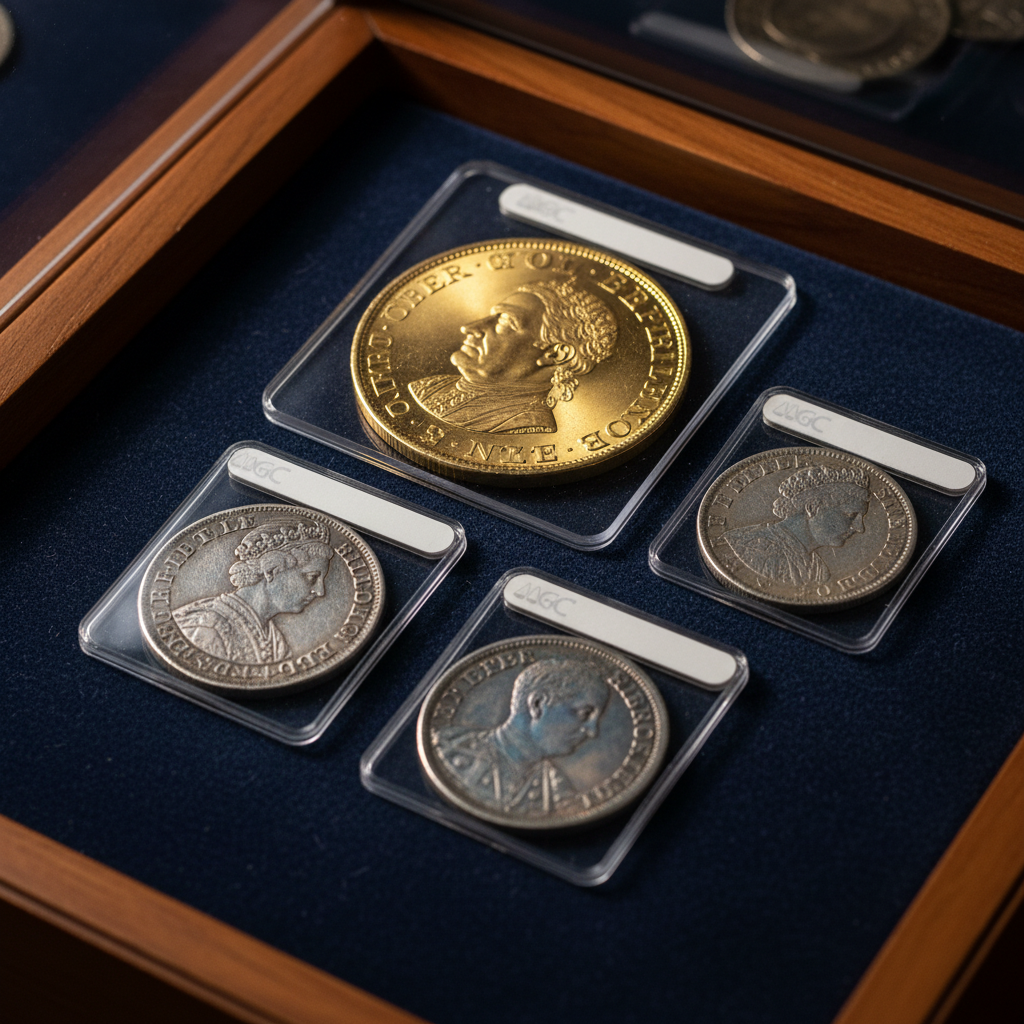
Baldwin's has assembled one of the more historically loaded British numismatic sales in recent memory, with its March 30 auction anchored by three lots that span five centuries of English power, tragedy, and naval glory. The headliners — an Oliver Cromwell gold broad, an Edward VI half sovereign, and a presentation medal honoring Admiral Earl St. Vincent — aren't just rare coins. They're primary documents of British history, struck in gold.
For serious collectors, that distinction matters. The numismatic market for historic British gold has remained stubbornly resilient even as broader collectibles categories have softened. Hammered and milled gold from the Tudor and Interregnum periods commands a premium that transcends pure metal value — provenance, historical context, and rarity compound into prices that consistently outperform pre-sale estimates at the major houses. Baldwin's, operating out of London and with a pedigree dating to 1872, knows this audience intimately.
Three Lots, Three Centuries of Consequence
The Cromwell gold broad is the marquee piece. Struck during the Interregnum — the period between Charles I's execution in 1649 and the Restoration of Charles II in 1660 — Cromwell coinage represents one of the most politically charged numismatic categories in British history. The Lord Protector's portrait appears on these pieces in the classical Roman tradition, a deliberate aesthetic choice that positioned Cromwell as a republican ruler of antiquity rather than a monarch. That tension between republican ideology and monarchical iconography is precisely what makes these coins so compelling to collectors and historians alike.
Gold broads from this period are genuinely scarce. Cromwell's coinage was never produced in large quantities, and surviving examples in collectible condition are rarer still. When one does surface at auction, the room tends to take notice.
The Edward VI half sovereign tells a different kind of story. Edward, the only legitimate son of Henry VIII, died in 1553 at just 15 years old after a reign marked by Protestant reform and political instability. His coinage reflects the monetary chaos of the mid-Tudor period — a time when the crown was actively debasing the currency to fund wars, and then attempting to restore confidence through recoinage. A half sovereign from this reign in strong condition is a survivor of extraordinary circumstance. Tudor gold, particularly from Edward's short reign, doesn't appear in major sales with any regularity.
Then there's the Admiral Earl St. Vincent presentation medal. John Jervis, 1st Earl St. Vincent, earned his title after defeating a Spanish fleet at the Battle of Cape St. Vincent in 1797 — a victory that made him a national hero and directly boosted the career of a young Commodore Horatio Nelson, who served under him that day. Presentation medals of this era were bespoke commissions, produced in small numbers for specific recipients. They sit at the intersection of numismatics and decorative arts, and the collector base for naval heroism pieces of this caliber is genuinely global.
Market Context: Why British Gold Holds Its Ground
The broader rare coin market has seen volatility over the past 18 months, with some modern U.S. issues and bullion-adjacent material pulling back from pandemic-era highs. Historic British gold has been more insulated. At Stack's Bowers and Heritage Auctions, comparable Tudor and Stuart-era gold pieces have consistently cleared six figures when condition and provenance align. The Cromwell material in particular has seen sustained demand from both institutional buyers and private collectors in the U.K. and continental Europe.
Baldwin's operates in a different register than the major American houses — the firm's clientele skews toward specialists and European collectors who treat these sales as access points to material that rarely leaves private hands. That dynamic tends to produce competitive bidding on the top lots and occasionally surprising results on secondary pieces that carry strong historical narratives.
The St. Vincent medal is the wild card here. Naval history memorabilia has had a strong run globally, driven partly by renewed popular interest in the Age of Sail and partly by a generation of British collectors who came of age reading Patrick O'Brian. A presentation medal tied directly to one of the defining sea battles of the Napoleonic era — with a clear chain of provenance — could easily become the surprise result of the sale.
Three lots. Five centuries. One auction. Baldwin's March 30 sale is the kind of event that reminds you why physical history, struck in gold and held in the hand, still commands a room.