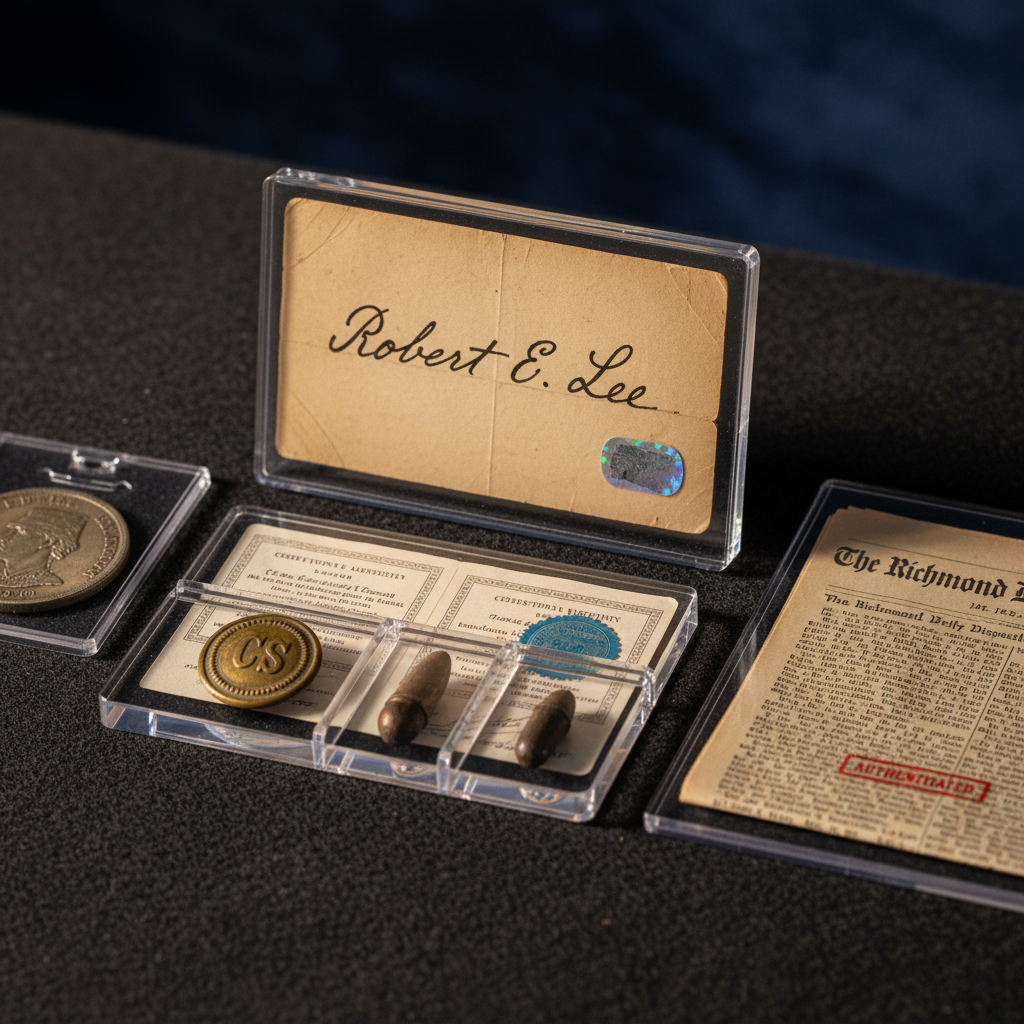
Forty-three years is a long time to do anything. In the brutally competitive world of antique militaria, it's practically a dynasty. Battleground Antiques, Inc., operating out of New Bern, North Carolina since 1981, has quietly become one of the most respected Civil War militaria dealerships in the country — a distinction earned not through marketing spend, but through decades of authenticated inventory and hard-won expertise.
Owner Will Gorges is both a licensed dealer and a certified appraiser, a dual credential that matters enormously in a collecting category where fakes, marriages, and misattributions are endemic. Civil War militaria is one of the most heavily reproduced segments in all of American antiques. A single authentic Confederate cavalry saber in documented condition can command anywhere from $4,000 to $25,000 depending on provenance, while a convincing reproduction can be had for under $200. The gap between those two numbers is exactly where dealers like Gorges earn their reputation — or destroy it.
Why New Bern, and Why It Matters
The geography here isn't incidental. New Bern, North Carolina sits in Craven County, a region that saw significant Union occupation beginning in March 1862 following the Battle of New Bern — one of the earliest major Union victories in the Eastern Theater. The area is archaeologically and historically dense with Civil War material culture. For a serious militaria dealer, it's the equivalent of setting up a numismatics shop in Philadelphia. You're embedded in the source material.
That regional rootedness gives Battleground Antiques a sourcing advantage that dealers operating out of, say, suburban Ohio simply can't replicate. Estate sales, private family collections, and local auction houses in eastern North Carolina regularly surface authentic period pieces that never make it to the national market. A dealer with 40-plus years of local relationships is positioned to see that material first.
The Civil War militaria market has also matured considerably since 1981. When Gorges opened his doors, the collector base was dominated by regional enthusiasts and a handful of serious institutional buyers. Today, the category draws crossover interest from investors who've watched top-tier pieces appreciate at rates that embarrass the broader antiques market. A documented Union officer's presentation sword that might have sold for $3,500 in 1995 could realistically fetch $18,000 to $30,000 at a Heritage Auctions or Rock Island Auction sale in the current environment — assuming the provenance holds up under scrutiny.
Authentication in a Category Full of Landmines
There is no PSA for Civil War militaria. No BGS. No universal grading standard that a collector can point to and say, definitively, that a piece is authentic and condition-graded to a specific tier. What exists instead is a network of specialists, reference texts, and hard-earned pattern recognition — and appraisers like Gorges who've spent decades building exactly that knowledge base.
The authentication challenge is severe. Confederate material in particular is so heavily faked that many advanced collectors operate under a default skepticism: if it's Confederate and it's for sale, assume it's wrong until proven otherwise. Authentic Confederate-issue items are genuinely scarce — the Confederacy was resource-constrained throughout the war, production was decentralized, and battlefield losses, postwar poverty, and time have reduced surviving examples to a fraction of what was originally manufactured. That scarcity drives prices and, inevitably, attracts forgers.
Union material is more abundant but presents its own attribution challenges. Identifying a rifle musket as a specific contractor's production, or confirming that a cartridge box is genuine Civil War-era rather than a Spanish-American War or later piece, requires the kind of granular knowledge that only comes from handling thousands of examples over decades. There's no shortcut.
This is precisely the market niche that a long-established, credentialed operation like Battleground Antiques fills. For collectors who don't have the expertise to authenticate independently — which is most collectors — buying from a licensed appraiser with a four-decade track record is a meaningful form of risk mitigation. Reputation, in this segment, is the only grading standard that exists.
The Broader Market Moment
Civil War militaria sits in an interesting position right now. The broader antiques market has been uneven since 2022, with brown furniture and decorative arts continuing their long structural decline while category-specific niches — militaria, political memorabilia, scientific instruments — have held firm or appreciated. Serious militaria, particularly documented battlefield-related pieces, has benefited from the same dynamic driving the high end of every collectibles category: scarcity of authenticated material meeting a buyer pool that has more capital and more information than any previous generation of collectors.
Regional dealers with deep local sourcing networks and genuine appraisal credentials are, in this environment, more valuable than they've ever been. The internet democratized access to buyers but didn't democratize expertise. That asymmetry is where Battleground Antiques — and dealers like it — continue to operate with a structural edge that no amount of online marketplace disruption has managed to erode.
Forty-three years in. Still standing. In Civil War militaria, that's not just longevity — that's the credential.