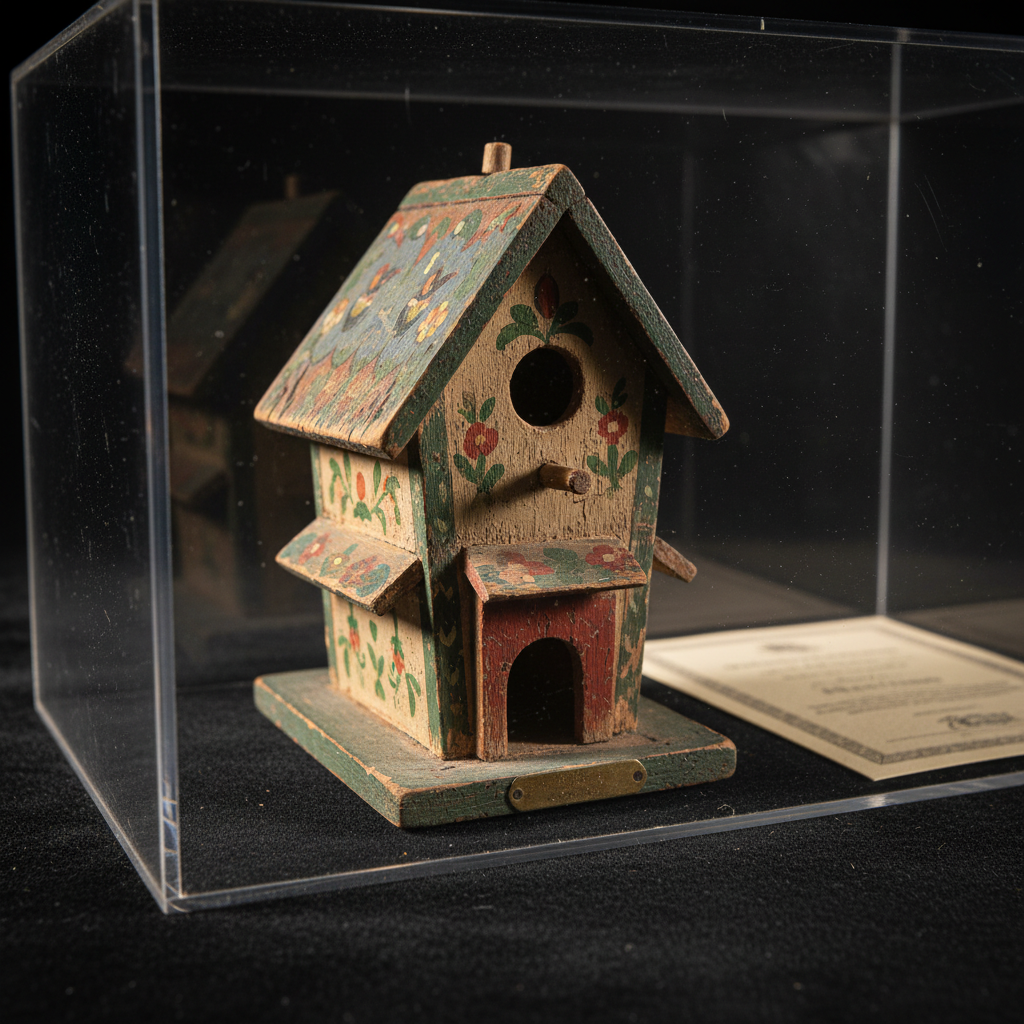
Southern folk art doesn't announce itself quietly. A birdhouse covered in cold-painted decoration, made from humble Southern pottery and transformed by the hand of Benny Carter, is exactly the kind of object that serious collectors of American vernacular art have learned to take seriously — and fast.
Carter's work sits at a compelling intersection: functional craft elevated to fine art through the application of cold paint, a technique that bypasses the kiln entirely and applies pigment directly to an already-fired ceramic surface. The result is vivid, immediate, and — critically — fragile. That fragility is part of what makes condition so consequential in this corner of the market.
What Cold Paint Means for Condition and Value
In the world of folk ceramics, cold paint is both a blessing and a liability. Because the pigment isn't fused to the clay through heat, it sits on the surface, vulnerable to wear, moisture, and handling. A birdhouse that has spent decades outdoors — or even in a dusty barn — can lose significant surface decoration. That means surviving examples with strong paint retention command meaningful premiums over worn counterparts.
This isn't unique to Carter's work. Across the broader American folk pottery market, condition differentials can swing realized prices by 40 to 60 percent on comparable pieces. A piece with 90 percent or better original paint is a different animal entirely from one showing heavy loss, even if the form and attribution are identical. Collectors who have followed the Outsider Art Fair circuit or tracked results through Brunk Auctions and Jeffrey S. Evans & Associates — two houses with deep expertise in Southern decorative arts — know this dynamic well.
Carter's birdhouses, specifically, benefit from the inherent charm of the form. Birdhouses occupy a sweet spot in folk art collecting: they're three-dimensional, visually engaging from multiple angles, and carry the kind of domestic warmth that draws both seasoned collectors and first-time buyers. Add a distinctive artist hand and bold polychrome decoration, and you have a category with genuine upward momentum.
The Southern Pottery Context
Southern alkaline-glaze pottery has been a collector staple for decades, with names like Dave Drake and the broader Edgefield tradition commanding serious institutional and private attention. But the folk art tradition in the South runs wider and deeper than any single lineage. Artists working in more recent generations — producing painted, decorated, and sculptural ceramics outside the fine art establishment — have seen their market profiles rise steadily since the 1990s boom in Outsider and self-taught art.
Carter fits within that trajectory. His use of cold paint to animate pottery forms places him in a tradition that values surface as storytelling — color and pattern doing work that the clay alone cannot. The birdhouse as subject matter amplifies this: it's a form with immediate recognizability, which lowers the barrier to entry for new collectors while rewarding the close attention of experienced ones.
Pricing for Carter's work at regional auction has historically been accessible relative to more canonized Outsider artists — think Howard Finster or Mose Tolliver, whose markets are well-documented and significantly deeper. That gap represents either an opportunity or a ceiling, depending on your read of where Carter's reputation goes from here. The trajectory of comparable self-taught Southern artists suggests the former is more likely, particularly as institutional collecting of vernacular American art continues to broaden.
What Collectors Should Know Before Buying
Attribution matters enormously in this category. Carter's birdhouses should come with clear provenance — ideally direct from the artist, a known dealer in Southern folk art, or a documented auction history. The cold-paint folk pottery market has not been immune to misattribution, and pieces that surface without paper trails deserve extra scrutiny.
Beyond provenance, the checklist for evaluating a Carter birdhouse is straightforward:
- Paint retention: Look for minimal loss, especially on raised surfaces and edges where cold paint is most vulnerable.
- Structural integrity: Check the entry hole surround and any applied decorative elements for chips or repairs.
- Surface consistency: Original paint has a different sheen and texture than later touch-ups — in strong raking light, repairs are usually visible.
- Provenance documentation: A receipt, exhibition record, or prior auction catalog entry adds meaningful value.
The broader folk art market has had a complicated decade — record results at the top end, softness in the middle, and a generational shift in collector demographics that is still playing out. But singular, well-documented pieces by artists with a genuine regional following have held up. Carter's birdhouses, when they surface in strong condition with clean history, belong in that conversation.
In a market full of mass-produced nostalgia, a hand-painted pottery birdhouse made by a living folk artist is a reminder of what the category is actually about. The paint is cold. The work is not.