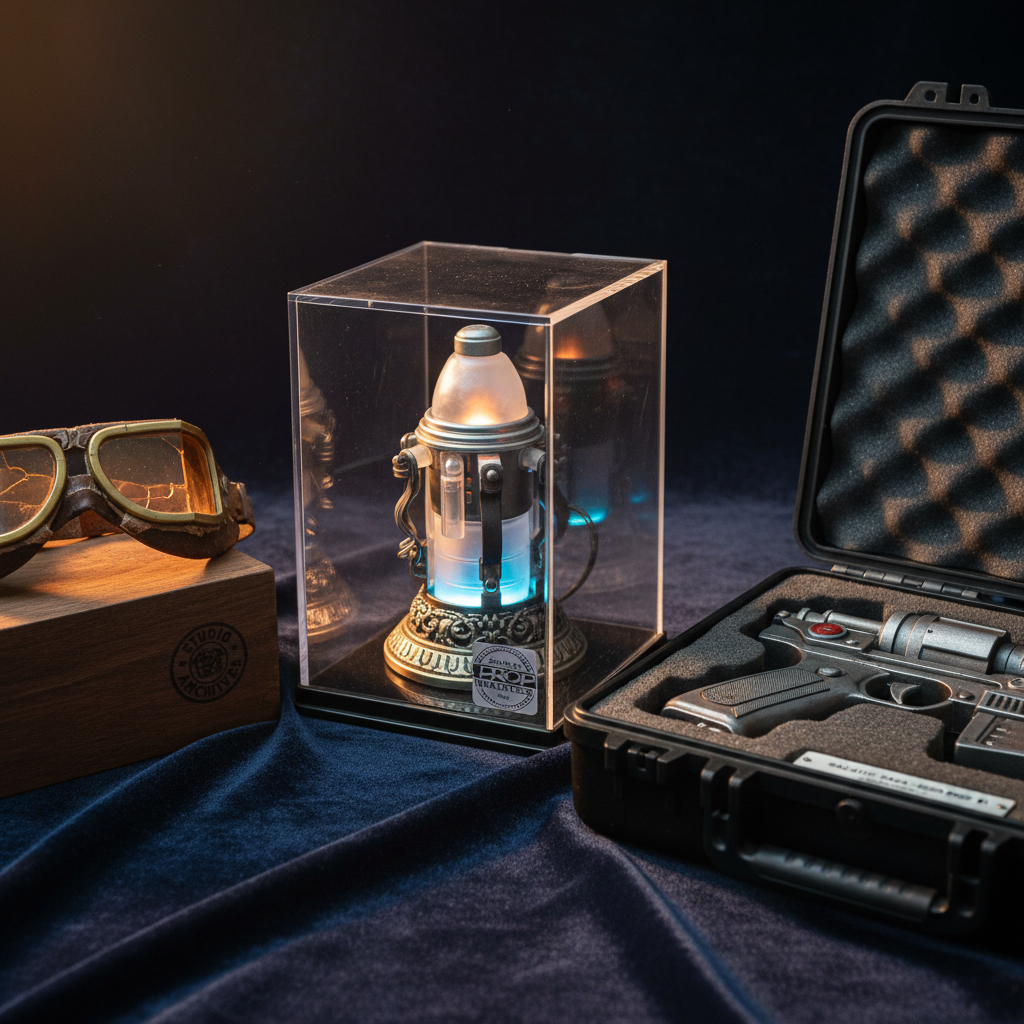
The props closet of 1980s and '90s Hollywood has become one of the most contested corners of the memorabilia market — and the bidding data backs it up. Screen-used artifacts from the blockbuster era are pulling serious money at auction, attracting both aging fans who lived through these films and younger collectors who grew up watching them on cable and streaming. That generational overlap is rare in collectibles, and it's creating pricing pressure that the market hasn't fully priced in yet.
Heritage Auctions and Prop Store have been the primary venues driving this category forward. Prop Store's annual live auction has consistently posted eight-figure totals in recent years, with individual lots from marquee franchises — Back to the Future, Indiana Jones, Ghostbusters, Terminator — routinely clearing six figures. A screen-used DeLorean time machine from the Back to the Future trilogy sold for $541,200 at Prop Store's 2022 Los Angeles event. That's not an outlier anymore. It's a comp.
Why the Blockbuster Era Specifically
The window from roughly 1977 to 1999 represents a unique sweet spot in Hollywood prop history. Pre-digital production meant physical objects were built, dressed, and filmed — not composited in post. A lightsaber from the original Star Wars trilogy is a physical artifact in a way that a CGI spacecraft from a 2015 sequel simply isn't. That tangibility is the entire value proposition.
The craftsmanship matters too. Prop houses like Independent Studio Services and fabricators working under production designers like Ken Adam and Norman Reynolds created pieces with genuine artisanal quality. These weren't cheap knockoffs thrown together for a single shot. Many were built to withstand repeated takes, location shoots, and the scrutiny of 35mm film. They hold up physically — which matters enormously for long-term preservation and display.
Provenance documentation has also matured significantly. Early prop sales in the 1990s and 2000s were often muddied by chain-of-custody gaps — items sold by crew members, stolen from sets, or passed through unlicensed dealers without paperwork. The auction houses operating today demand studio letters of authenticity, production call sheets, and in some cases photographic matching to specific frames of film. That rigor has given institutional buyers the confidence to participate at high price points.
The Cross-Generational Demand Engine
What separates this category from, say, vintage baseball cards or pre-war coins is the buyer demographic. Most blue-chip collectibles categories are dominated by collectors who grew up with the material — nostalgia is the primary fuel. Hollywood props from the blockbuster era are drawing from two distinct pools simultaneously.
Collectors in their 50s and 60s remember seeing Raiders of the Lost Ark in theaters in 1981. They have disposable income, established collections, and emotional stakes in the material. But Indiana Jones has also been streaming on Disney+ for years, introducing the franchise to a new generation of buyers in their 20s and 30s who are entering the collectibles market with different spending habits and a higher comfort level with auction platforms.
That second cohort is significant. They're the same buyers fueling the graded trading card market and the vintage sneaker space. They understand authentication, they're comfortable with third-party verification, and they treat collectibles as both cultural artifacts and investable assets. When they discover that a screen-used prop from a film they love can be authenticated and graded — CGC now offers entertainment memorabilia authentication, and Beckett has expanded its autograph verification services — the category starts to look a lot like the card market did in 2018.
Costume pieces have been particularly active. Screen-worn wardrobe from recognizable characters — Han Solo's jacket, Marty McFly's vest, Ellen Ripley's flight suit — commands premiums that raw prop pieces rarely match, because the human connection is immediate and visceral. Julien's Auctions sold a screen-worn Michael Jackson Thriller jacket for $1.8 million in 2011, a benchmark that still anchors the high end of the costume market over a decade later.
Market Risks and the Authentication Problem
This category isn't without landmines. The prop replica market is enormous — licensed and unlicensed — and the line between a production-made piece and a high-quality replica has always been blurry. Some replicas were made by the same fabricators who built originals, using the same materials and molds, which makes forensic differentiation genuinely difficult.
Forgeries have surfaced at auction. Several high-profile disputes in the past decade involved items that passed initial authentication reviews before being challenged by production veterans or forensic analysts. The lesson for buyers is straightforward: provenance documentation isn't optional at meaningful price points. If a seller can't produce a studio letter, a production inventory record, or photographic evidence matching the item to a specific scene, the risk premium should be reflected in your bid ceiling — not ignored.
The category is also illiquid compared to graded cards or bullion. A PSA 10 1986 Fleer Michael Jordan rookie has a deep secondary market with daily transaction data. A screen-used prop from a mid-tier 1990s film has one buyer at a time, and finding that buyer can take years. For collectors, that's fine. For investors treating this as a liquid asset class, it's a structural problem worth taking seriously.
Still, the trajectory is clear. As the blockbuster generation ages into peak earning years and the streaming era keeps these films perpetually in cultural circulation, the supply of authenticated screen-used material will only contract. Studios aren't making more of it. The props that survived are finite — and the people who want them are multiplying.