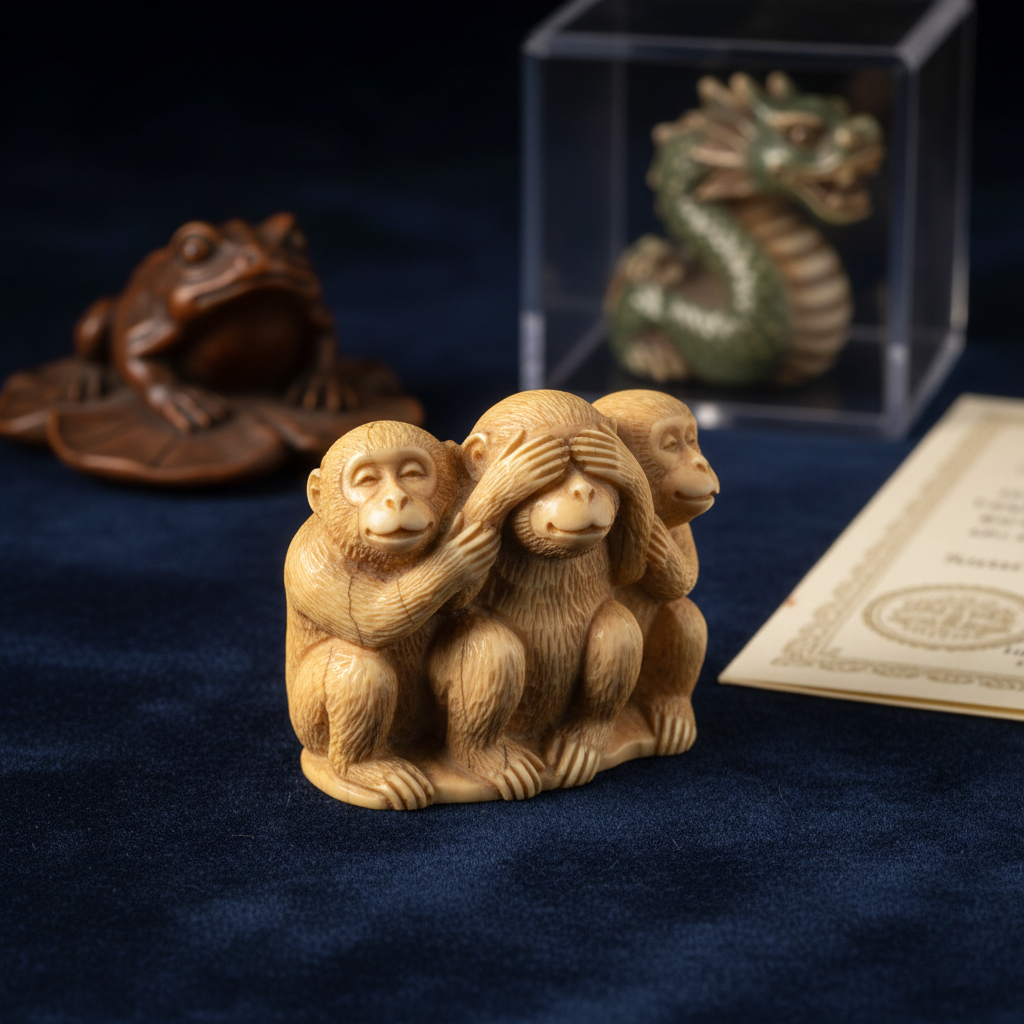
Few collecting categories reward patience and connoisseurship quite like netsuke — and Bonhams is about to remind the market of that fact. The London and New York auction house is preparing to bring selections from the Joseph and Elena Kurstin collection to the block, a sale that specialists are already flagging as a meaningful event for serious collectors of Japanese decorative arts.
Netsuke are miniature Japanese toggles, typically carved from ivory or boxwood, that were used to secure pouches and containers to the sash of a traditional kimono. The finest examples — sculpted by named masters of the Edo and Meiji periods — are among the most intensely studied objects in the decorative arts world. A single piece can fit in the palm of your hand and still command five or six figures at auction.
Why the Kurstin Name Carries Weight
Provenance is everything in netsuke, and the Kurstin name is one collectors recognize. Joseph and Elena Kurstin built their collection with the kind of focused, decades-long commitment that separates serious institutional-quality holdings from casual accumulations. Collections assembled with that level of intentionality — where each acquisition was vetted for artistry, condition, and attribution — tend to outperform at auction precisely because the due diligence has already been done.
Bonhams has long maintained one of the stronger Japanese art departments among the major Western auction houses, and their specialists' involvement signals that this sale will be handled with appropriate scholarly rigor. Attribution and condition documentation matter enormously in netsuke, where a piece signed by a recognized carver like Masanao of Kyoto or Tomotada can trade at multiples of an unsigned comparable.
The global netsuke market has remained surprisingly resilient. While broader Asian art categories have experienced volatility tied to shifting Chinese buyer appetite, netsuke occupies a more specialized niche — its collector base is international, obsessive, and largely insulated from the macro forces that buffet larger-scale decorative arts segments. The Netsuke Research Foundation has documented thousands of signed works, and serious buyers cross-reference auction results against that scholarship before bidding.
The Market Behind the Miniatures
To understand what the Kurstin sale might deliver, it helps to look at recent comps. Exceptional netsuke by documented masters have cleared $30,000 to $80,000 at major houses in recent years, with truly rare subjects — mythological figures, erotic carvings, or pieces with documented exhibition history — pushing well past six figures. More accessible examples from the same period, unsigned or by lesser-known carvers, regularly find buyers in the $1,500 to $8,000 range, making netsuke one of the few fine art categories that genuinely offers entry points at multiple price levels.
Condition grading in netsuke follows its own internal logic. Collectors prize a natural, well-developed patina — the result of generations of handling — over pieces that appear over-cleaned or restored. Himotoshi, the cord holes through which the toggle was threaded, should show authentic wear consistent with use. A piece that looks too pristine raises questions; one with honest age and surface warmth commands premiums. Bonhams' specialists are expected to address these factors in their catalogue entries, which for a collection of this stature will likely read more like scholarly monographs than standard auction descriptions.
The broader context here matters. Western interest in netsuke was turbulent for much of the early 2000s, but a sustained wave of museum exhibitions, academic publications, and the continued influence of collectors like the late Edmund de Waal — whose memoir brought netsuke to a mainstream literary audience — has kept the category firmly in view. De Waal's family history, centered on a collection of 264 netsuke that passed through Vienna and eventually to Japan, introduced the objects to readers who had never heard of them. That cultural visibility has a long tail in the collector market.
What to Watch When the Gavel Falls
The lots to watch will be those with the clearest attribution and the most compelling subjects. Animal carvings — particularly rats, rabbits, and the mythological creatures of the Japanese zodiac — have historically outperformed abstract or purely decorative pieces because they appeal to both specialist collectors and broader Asian art buyers. Ivory pieces from the pre-CITES era will carry the documentation burden that the current regulatory environment demands, and buyers should expect Bonhams to have addressed that paperwork thoroughly for a collection of this profile.
For dealers and collectors who have been waiting for a significant fresh-to-market netsuke offering, the Kurstin sale is the one to track. Collections of this depth and pedigree don't surface often — and when they do, the results tend to set the reference points that the market uses for the next several years.