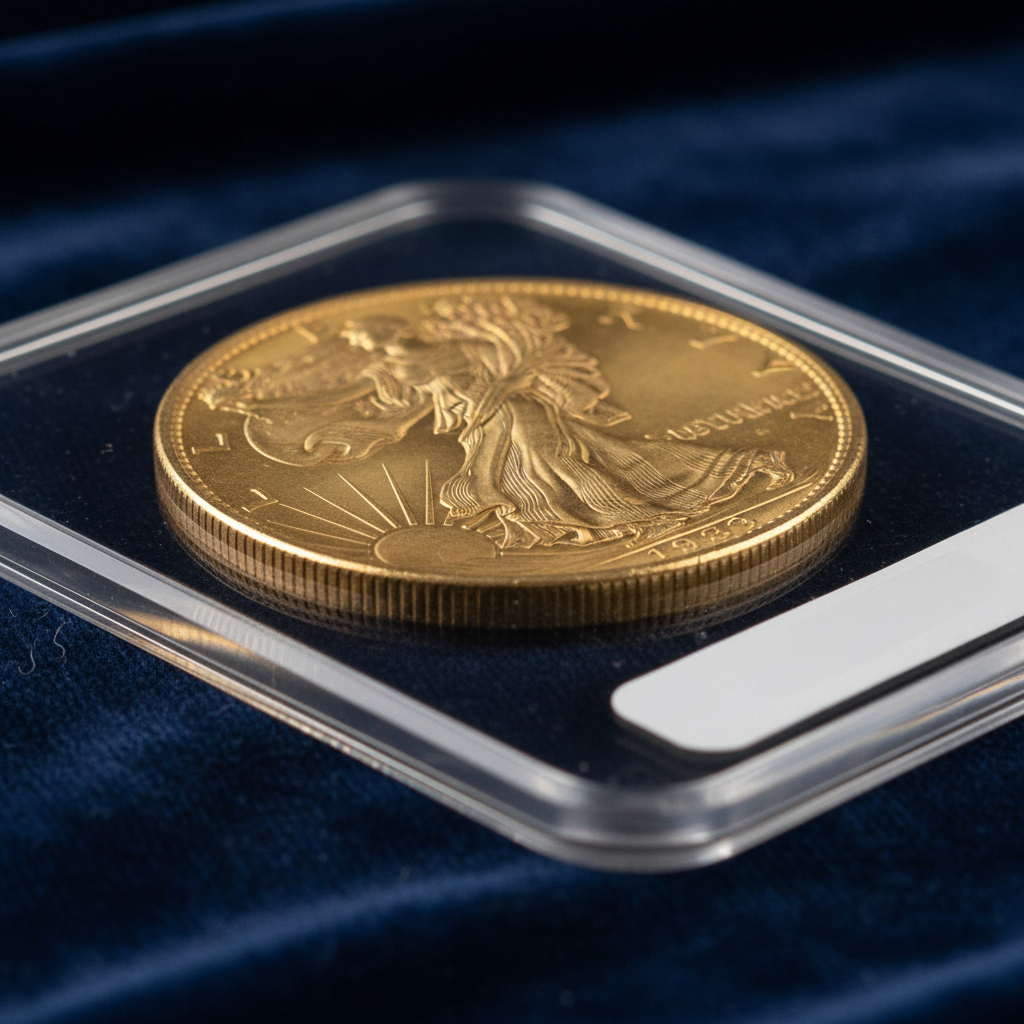
Q. David Bowers doesn't write bad numismatic references. He writes definitive ones. And after more than two decades, his landmark study of America's $20 gold double eagles has returned in a fully updated second edition from Whitman Brands — arriving at a moment when the double eagle market is anything but quiet.
The original edition of Double Eagle Gold Coins helped anchor Whitman's Red Book Series as a serious scholarly imprint, not just a price-guide publisher. That first edition came out when Heritage Auctions was still a regional player and PCGS population reports were consulted by phone. The numismatic world has changed dramatically. So has the double eagle market.
Why the Double Eagle Demands Its Own Book
No American coin series carries more financial and historical weight than the double eagle. Minted from 1849 through 1933, these $20 gold pieces circulated through the California Gold Rush, financed the Civil War era, and were ultimately pulled from circulation by executive order when Franklin Roosevelt ended private gold ownership in 1933. That final chapter — the 1933 Saint-Gaudens Double Eagle — remains the most expensive coin ever sold at public auction, fetching $18.9 million at Sotheby's in 2021.
The series spans three major design types: the Liberty Head (1849–1907), designed by James B. Longacre; the iconic Saint-Gaudens design (1907–1933), widely considered the most beautiful coin ever struck by the U.S. Mint; and the transitional Ultra High Relief of 1907, a collector grail that routinely clears $200,000 in any gradeable condition. PCGS and NGC combined have certified fewer than 700 examples of the Ultra High Relief across all grades — a scarcity that the market has priced accordingly.
Bowers has spent decades cataloguing the die varieties, mintmark placements, and population nuances that separate a $3,000 type coin from a $300,000 condition rarity. The second edition updates that scholarship with full-color photography — a significant upgrade over the original — and revised market valuations that reflect the bull run in U.S. gold coinage over the past five years.
The Market Context Behind the Timing
Whitman didn't release this book in a vacuum. Gold itself has surged past $3,000 per troy ounce in 2025, dragging bullion-weight double eagles — which contain just over 0.9675 troy ounces of gold — well above their historic floor values. A common-date MS-63 Saint-Gaudens that might have traded at $2,400 three years ago is now clearing $3,200 to $3,500 at major auction houses including Heritage and Stack's Bowers. Even circulated examples in AU-55 are seeing renewed dealer interest as gold-backed portfolio diversification attracts buyers who've never touched a coin slab.
That influx of new money into the double eagle market creates an obvious need for a serious reference. Casual buyers getting priced into six-figure condition rarities because gold is hot are exactly the audience that gets burned without proper scholarship. A well-researched Bowers volume arriving now isn't just timely — it's arguably essential.
The collector community has also seen a surge in PCGS and NGC submissions of double eagles over the past 18 months, as holders look to establish certified provenance ahead of potential estate sales or auction consignments. Population data matters enormously in this series: the difference between a PCGS MS-65 and MS-66 on a key-date Saint-Gaudens can represent a $50,000 to $150,000 swing depending on the date and mint.
Bowers and the Weight of the Reference
Bowers has authored or co-authored more than 50 numismatic books. His Guide Book of United States Coins work, his Morgan dollar studies, his early American coinage research — the bibliography is staggering. But the double eagle volume holds a particular place in that catalog because the series sits at the intersection of art, history, and raw financial value in a way few other American coins do.
The second edition's full-color treatment matters more than it might sound. Double eagle grading is a visual discipline. The difference between a cleaned example and a naturally toned one, between a strike weakness at the eagle's breast feathers and a true mint luster, requires seeing the coin — not reading a text description. High-quality photography in a reference book closes that gap in a way that even veteran collectors appreciate.
Whitman hasn't released full pricing on the second edition yet, but the original commanded strong secondary market premiums years after publication, routinely selling above cover price on eBay and at coin show tables. Expect the same trajectory here.
For anyone seriously invested in U.S. gold — whether you're holding a roll of common Saints or chasing a PCGS-64 1927-D — this is the reference that belongs on the shelf next to the slab.