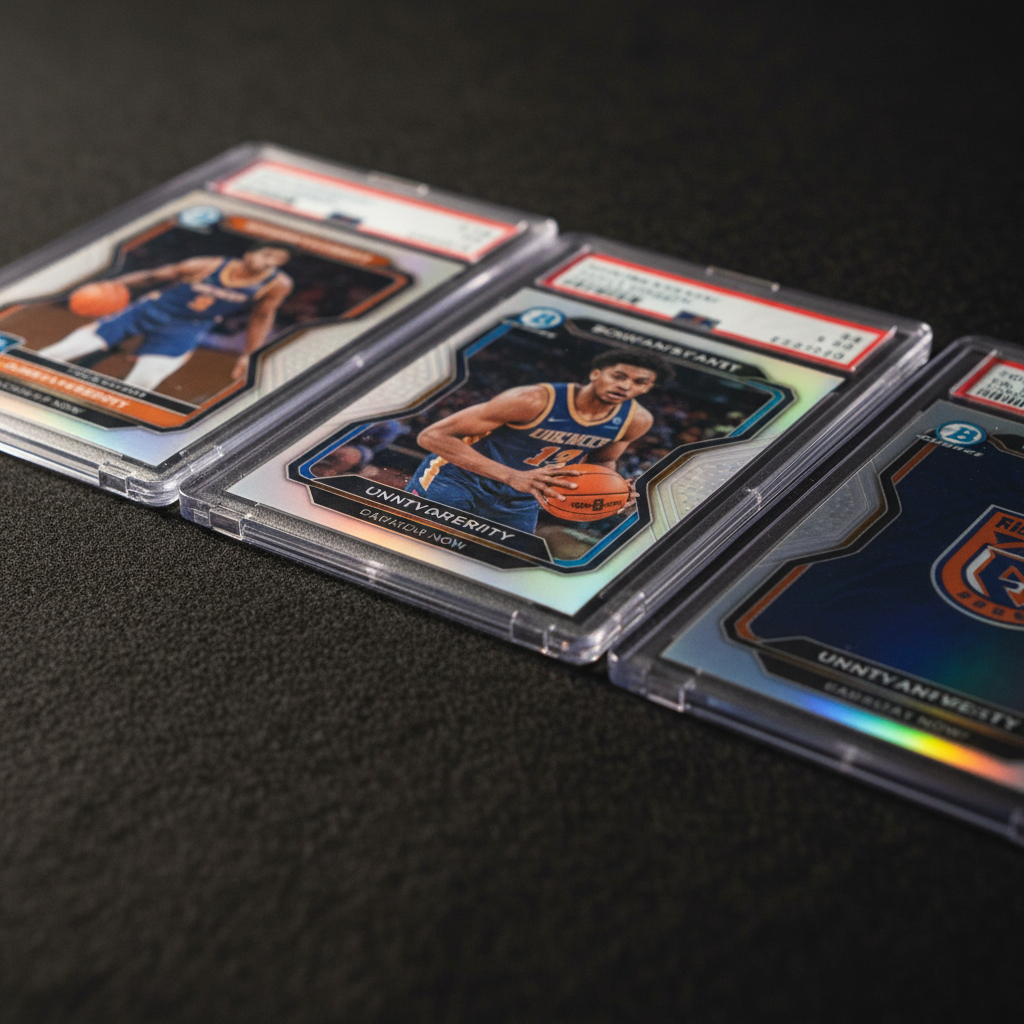
Topps is bringing back its on-demand college basketball format for another run, and the timing couldn't be more deliberate. 2025-26 Bowman University Now Basketball arrives on the heels of a college hoops season that produced some of the most hyped NBA Draft prospects in years — and the product is designed to capture that moment before the ink dries on any rookie contracts.
For the uninitiated, Bowman University Now operates differently from a traditional hobby release. Rather than a fixed print run distributed through hobby shops, these are on-demand cards produced in response to collector orders placed during a defined window. Once the window closes, the print run is locked. That number gets stamped on each card, giving buyers a precise population figure from day one — no waiting on PSA census updates to understand scarcity.
How the On-Demand Model Changes the Calculus
The on-demand structure is a double-edged sword, and experienced collectors know it. On one hand, you're never getting shut out by a distributor allocation or a case-ripper who bought the hobby store's entire stock. On the other hand, the print run reflects actual demand at the time of ordering — which means a prospect who goes cold between the order window and NBA Draft night could end up with a surprisingly high print run relative to his eventual market value.
That dynamic played out in previous Bowman University Now releases. Cards of prospects who slipped in the draft or landed in smaller markets saw their secondary market prices compress quickly, regardless of the initial enthusiasm. Conversely, players who outperformed their draft slot — or landed with marquee franchises — saw their Bowman University Now cards punch above their print-run weight.
The checklist for the 2025-26 edition follows the college season, meaning it pulls from the players who made noise this past year. That's the structural advantage of a post-season on-demand drop: Topps isn't guessing on prospects six months before tip-off. The checklist reflects performance, not projection.
What Collectors Are Actually Buying
These cards function as pre-rookie placeholders — the last officially licensed cards many of these players will have before Panini or Topps issues their NBA rookie paper. For collectors who want exposure to a prospect before the NBA rookie card market fully prices him in, Bowman University Now has historically offered a lower entry point.
The base design carries the Bowman DNA: clean, prospect-forward, with the collegiate branding that distinguishes it from the pro product. Parallels and autograph variants are where the real action happens, and print runs on those tiers can get genuinely tight depending on order volume.
- Base cards: print run determined by on-demand order window
- Parallel tiers: fractional print runs relative to base
- Autograph variants: typically the lowest-numbered cards in the set
- Checklist drawn from the 2024-25 college basketball season
From a grading standpoint, on-demand products like this tend to grade well at PSA and BGS — the cards ship directly from Topps with minimal handling, and centering issues that plague mass-produced hobby products are less common. That said, auto placement and surface quality on signed versions can vary, so grading before resale is still worth the calculus on higher-value pulls.
The Prospect Market Context
The 2025 NBA Draft class is drawing legitimate comparisons to some deep recent classes, and that matters for how this product performs on the secondary market. When a Bowman University Now card is the only licensed card of a player who ends up going lottery, that scarcity narrative writes itself — even if the print run is in the hundreds.
Heritage Auctions and Goldin have both moved Bowman University Now autographs of players who subsequently had strong NBA rookie seasons, with realized prices occasionally reaching into four figures for low-print auto variants. That's not the norm, but it establishes the ceiling for the right player.
The order window is the critical variable here. Collectors who move early, before broader consensus forms on which prospects are most coveted, tend to get the best value. By the time a player's draft stock peaks, the window may already be closed — and the print run already set.
On-demand college basketball cards don't generate the sustained secondary market heat of a flagship NBA rookie product. But for the collector who does the prospect homework and times the window correctly, Bowman University Now remains one of the more efficient ways to get early, licensed paper on the next wave of NBA talent. The 2025-26 edition gives you the players. What you do with that information is on you.