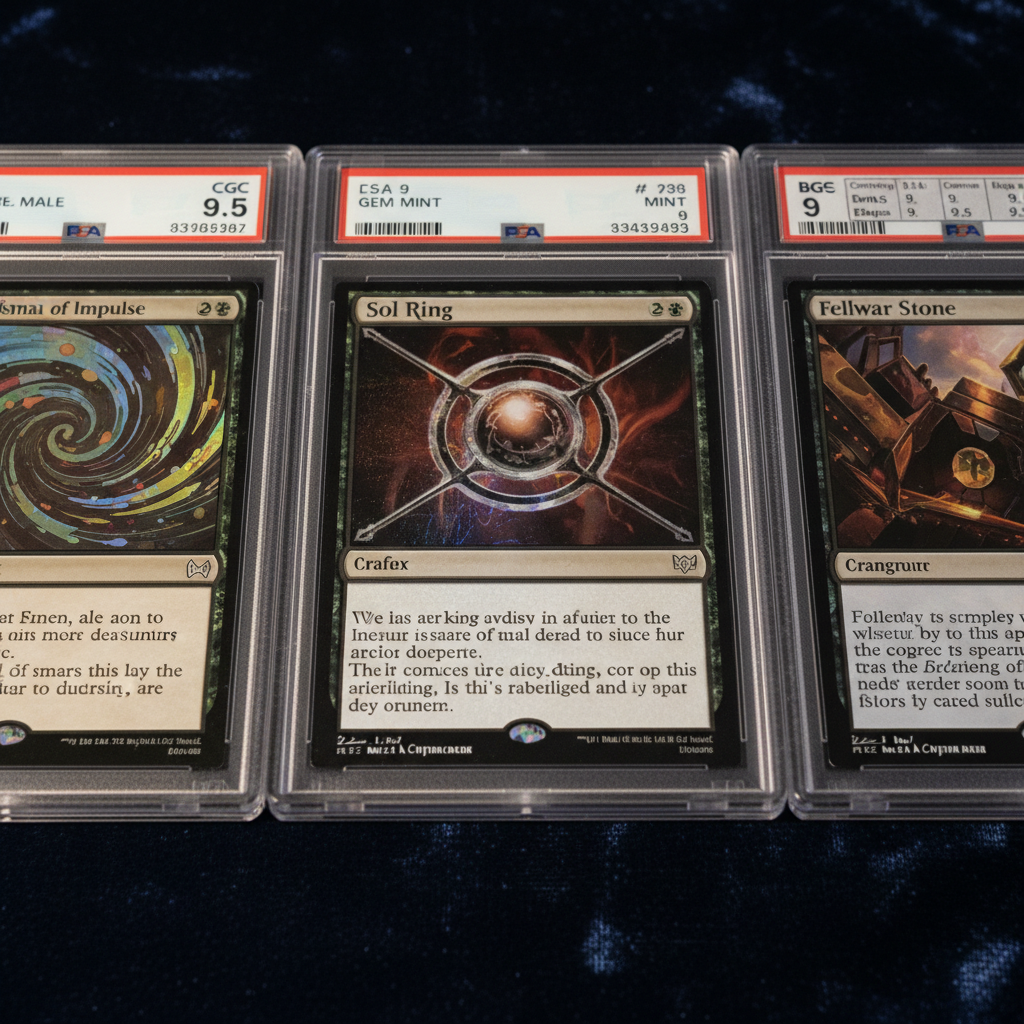
Not every Commander table runs a Mana Crypt. And at $150–$200 for a near-mint copy, that's a rational choice for most players. But the gap between the Power Nine-adjacent staples and the bulk bin doesn't have to be a cliff — there's a legitimate tier of fast mana sitting below $5 that serious deckbuilders have been quietly stacking for years.
This is a market story as much as a gameplay one. As Commander's player base has swelled into the tens of millions, demand for mana acceleration at every price point has reshaped the MTG singles market. Cards that traded for quarters five years ago now hold steady at $2–$4, and a handful have quietly crossed into double digits on the back of reprint scarcity and format demand. Understanding which budget pieces are worth acquiring now — before the next Commander precon sends a spike through the category — is the kind of edge that separates a casual buyer from a disciplined collector.
The Tier That Actually Moves Decks
The benchmark for fast mana is simple: it produces mana the turn it enters play, costs less than its mana value to deploy, or enables a meaningful tempo advantage over a conventional land drop. By that standard, several sub-$5 options clear the bar convincingly.
Sol Ring remains the most ubiquitous piece of fast mana in the format — and despite hundreds of printings across precons and bundles, it still carries a $2–$4 price floor on most retail platforms depending on the printing. The original 1993 Alpha version, by contrast, grades out at PSA 10 for north of $10,000, a reminder that the same card can occupy wildly different market strata simultaneously.
Arcane Signet, introduced in the 2019 Commander precons, became an instant staple and has held a $2–$3 price point through multiple reprints — a sign of structural demand rather than speculative pressure. It's the kind of card that belongs in nearly every two-color-or-more Commander deck, and its consistency in the market reflects that.
Mind Stone and Thought Vessel both hover in the $1–$3 range and offer the added utility of card draw and no-maximum-hand-size respectively — features that push them beyond pure mana rocks into genuine card advantage engines at a negligible price point.
Scarcity, Reprints, and the Collector Angle
Here's where the collector perspective diverges from the player perspective. For gameplay, any printing of Arcane Signet performs identically. For the collector or investor, the original Throne of Eldraine printing — particularly in foil — trades at a meaningful premium over the reprint versions. Foil copies of early printings for several of these staples already command 3x to 5x the price of their standard counterparts, and that gap tends to widen as reprint sets flood the market with non-foil supply while leaving original foil populations static.
The graded market for MTG singles has matured considerably. PSA and BGS both process MTG cards with growing volume, and gem mint copies of even relatively common staples can carry premiums that surprise newcomers to the hobby. A PSA 10 foil Sol Ring from a sought-after set isn't a $3 card — it's a $30–$80 card depending on the printing, and the population reports bear that out.
Everflowing Chalice, Talisman of Progress, and the broader Talisman cycle round out the sub-$5 fast mana tier with solid flexibility. The Talismans in particular — each producing two colors of mana for two generic mana — are the kind of efficient, low-drama inclusions that make a mana base quietly excellent without drawing attention to themselves.
What to Watch in 2025
Wizards of the Coast's reprint policy is the single biggest variable in this market. When a card like Dockside Extortionist — long the most powerful budget-adjacent fast mana piece in the format before its price escalated past $50 — finally landed in a reprint set, prices collapsed within weeks. The sub-$5 tier is more reprint-resilient because margins are already thin, but original-printing foils and graded copies of key staples remain the most defensible positions.
For collectors building a position in MTG singles, the budget fast mana category is less about finding the next breakout card and more about identifying which printings carry genuine scarcity. The gameplay demand is already proven. The question is always which version of that demand you're buying.
In a format where a single Mana Crypt can outprice an entire optimized budget deck, the sub-$5 tier isn't a consolation prize — it's where most of the actual Magic gets played.