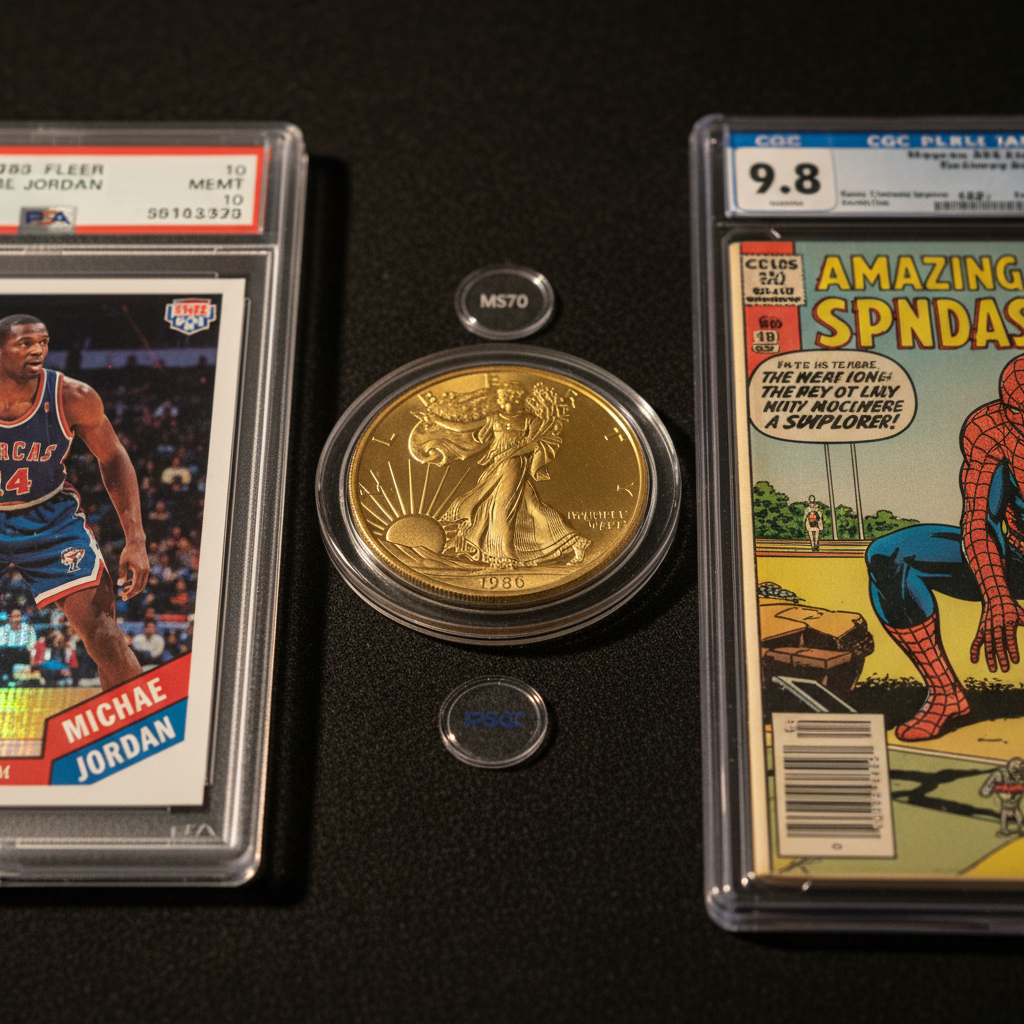
At $4,500 per troy ounce, gold isn't just making headlines — it's rewriting the calculus for every serious buyer in the market. The question that's splitting collector and investor communities right now isn't whether to own gold. It's which gold to own.
Modern bullion coins — your American Gold Eagles, Canadian Maple Leafs, South African Krugerrands — have always been the default answer for investors who want clean, liquid exposure to spot price. But at these altitude levels, a competing argument is gaining real traction: common-date numismatic gold coins, which have historically traded at meaningful premiums to melt, are currently sitting at or near spot in many cases. That compression creates an opportunity that doesn't exist in normal markets.
The Bullion Case: Liquidity Wins, But at a Cost
Modern bullion is the path of least resistance. A one-ounce 2024 American Gold Eagle is universally recognized, PCGS and NGC both offer straightforward grading and encapsulation, and any major dealer — APMEX, JM Bullion, SD Bullion — will quote you a buy price without hesitation. Liquidity is essentially guaranteed.
The problem is the premium structure at elevated spot prices. When gold was at $1,800, a 3–5% dealer premium on a one-ounce Eagle was manageable — roughly $54–$90 over spot. At $4,500, that same percentage premium translates to $135–$225 per coin, and in tighter supply environments, dealer spreads have been known to push toward 6–8% on popular products. You're paying more in raw dollars to get into the same trade.
Buyback spreads widen too. Dealers who might have bought Eagles at 1–2% under spot in quieter markets are often pulling back to 3–4% under when volatility spikes. The round-trip cost of owning modern bullion quietly expands just when you think the market is working in your favor.
The Numismatic Angle: Premium Compression Is Real
Here's where the analysis gets genuinely interesting. Common-date numismatic gold — think $20 Saint-Gaudens Double Eagles in circulated grades, $10 Indian Head Eagles, or $5 Liberty Half Eagles in AU-50 to MS-62 range — has historically commanded a 15–30% premium over melt value, sometimes higher for better-date coins in desirable grades.
In the current environment, that premium has collapsed. A common-date 1924 Saint-Gaudens Double Eagle in MS-63, which contains 0.9675 troy ounces of gold, is trading in the $4,600–$4,800 range at many dealers — barely above its ~$4,353 melt value at $4,500 spot. That's a numismatic premium of roughly 6–10%, which is historically thin for a coin with genuine collector demand and a century of market history behind it.
The asymmetry here is worth spelling out plainly. If gold retreats to $3,500, a bullion coin loses value in near-perfect lockstep with spot. A common-date Saint with numismatic identity has a floor that isn't purely melt-dependent — collector demand, historical significance, and the simple fact that these coins aren't being minted anymore all provide a buffer. That buffer is currently being offered to buyers at a discount.
PCGS population data reinforces the scarcity argument. The 1924 Saint-Gaudens in MS-65 has a combined PCGS and NGC population of roughly 8,000–10,000 coins across both services — a finite number that cannot grow. Compare that to modern Eagles, where the U.S. Mint produces millions annually on demand.
The Practical Verdict
Neither option is wrong. But the framing of the choice matters enormously depending on your time horizon and exit strategy.
If you're a pure commodity investor who needs to convert gold to cash inside 90 days, modern bullion is still the correct answer. The liquidity premium you're paying is real, but so is the ease of exit. No grading questions, no collector-market dynamics to navigate, no counterparty who needs to care about the coin's history.
If you're a collector-investor with a 3–7 year horizon — or someone who already understands how to sell numismatic coins through Heritage Auctions, Stack's Bowers, or established dealer networks — the current moment in common-date numismatics is legitimately compelling. You're acquiring genuine historical artifacts at melt-adjacent prices, with the realistic prospect that numismatic premiums re-expand as gold stabilizes and collector attention returns to the coins themselves rather than the metal content.
The market has essentially handed numismatic buyers a rare gift: the ability to own something with collector provenance and historical scarcity at prices that treat it like a generic ingot. That window doesn't stay open forever. When gold consolidates and the fever breaks, the premium on a well-struck Saint-Gaudens or Indian Head Eagle will quietly rebuild — and the buyers who stepped in at spot-plus-nothing will look very smart in hindsight.