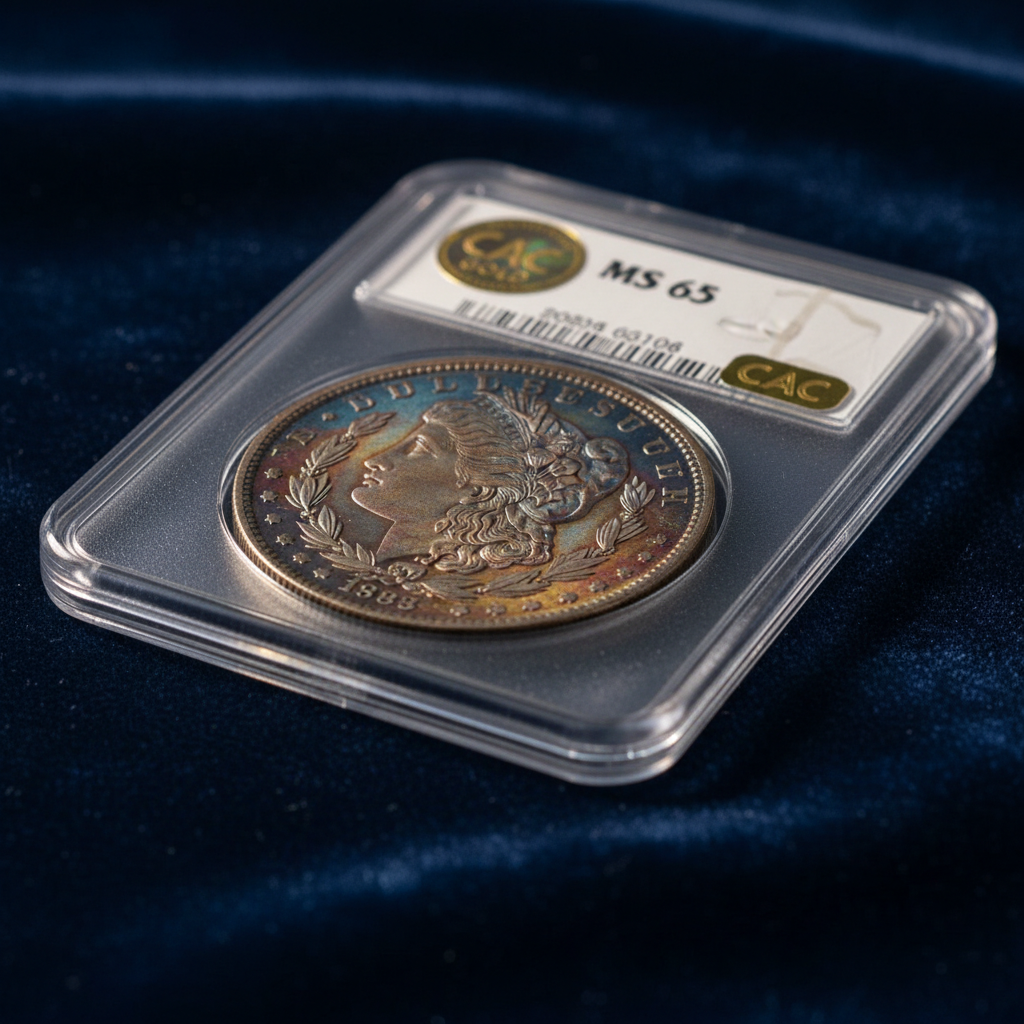
The market sent a clear message in April 2026: CAC approval is worth real money. Across four major auction platforms — Heritage Auctions, GreatCollections, David Lawrence Rare Coins, and Stack's Bowers — CAC-stickered and CACG-encapsulated coins consistently outperformed comparable non-CAC examples, with some lower-graded CAC pieces crossing the hammer ahead of coins graded a full point higher without the green bean.
Fourteen results from the month's public sales documented the trend. The pattern wasn't subtle. This wasn't a handful of outliers driven by aggressive bidders — it was a broad, multi-platform signal that the collector base has fully internalized CAC's quality premium into their bidding behavior.
What the April Results Actually Show
The most telling data point from April isn't any single sale — it's the consistency. When a CAC-approved MS-63 beats a raw or non-CAC MS-64 at auction, that's a market pricing in roughly one full grade point of quality confidence. That's not a small thing. In many series, the spread between a 63 and 64 can represent 30% to 50% in catalog value depending on the coin. For CAC to bridge — or invert — that gap in live competitive bidding means buyers are placing real trust in the sticker as a quality signal.
CACG-encapsulated coins, the grading service arm of the Certified Acceptance Corporation, added another layer to the story. Where traditional CAC stickers indicate that a coin meets the high end of its assigned grade, CACG encapsulation represents CAC's own numeric assessment. Both formats performed well in April, suggesting the market isn't drawing a hard line between the two expressions of CAC endorsement.
Heritage, the largest rare coin auction platform by volume, contributed multiple examples to the 14-result dataset. Stack's Bowers, which handles significant type coin and early American material, added further corroboration. GreatCollections and David Lawrence Rare Coins — both known for accessible price points and strong retail collector participation — rounded out the sample, which matters. CAC premiums holding up across platforms that serve different buyer demographics is a stronger signal than results concentrated at a single house.
The Grade-Inversion Effect
Grade inversion — where a lower numeric grade with CAC approval outbids a higher numeric grade without it — is the most dramatic expression of CAC's market influence, and April produced documented cases of exactly that.
This phenomenon has been building for years, but it's accelerating. As the third-party grading market has matured, sophisticated buyers have grown increasingly skeptical of coins sitting at the low end of their assigned grade. A PCGS MS-64 or NGC MS-64 is a wide range. It encompasses coins that are nearly 65-quality and coins that barely cleared 63. CAC's approval process — which involves a second-look evaluation by experienced numismatists — is specifically designed to identify where within that range a coin actually sits.
Collectors who've been burned by buying a 64 that looks like a 63 are now bidding differently. The CAC sticker reduces that uncertainty, and reduced uncertainty commands a premium. That's not sentiment — that's rational pricing.
The practical implication for dealers is significant. Non-CAC inventory in popular series is increasingly competing against a two-tier market. A coin that might have sold at full Greysheet bid a few years ago now faces pressure if a CAC example in the same grade is available. For collectors assembling registry sets or building type sets by quality rather than just grade, the calculus has shifted accordingly.
Reading the Market Going Forward
April 2026 didn't create the CAC premium — it reinforced it. The trend has been directionally consistent for the better part of a decade, with occasional softening during broader numismatic market slowdowns but no sustained reversal. What's notable now is the breadth: CAC's influence is no longer concentrated in high-value early American coinage or key-date series where quality variance is well-understood. It's showing up in type coins, 20th-century material, and price ranges accessible to mid-tier collectors.
That democratization of the CAC premium is arguably the bigger story. When the sticker adds value at a $500 hammer just as reliably as it does at a $50,000 hammer, the market has made a structural decision about quality verification — not just a luxury one.
For anyone sitting on non-CAC material in popular series, the April results are a quiet but pointed argument for resubmission.