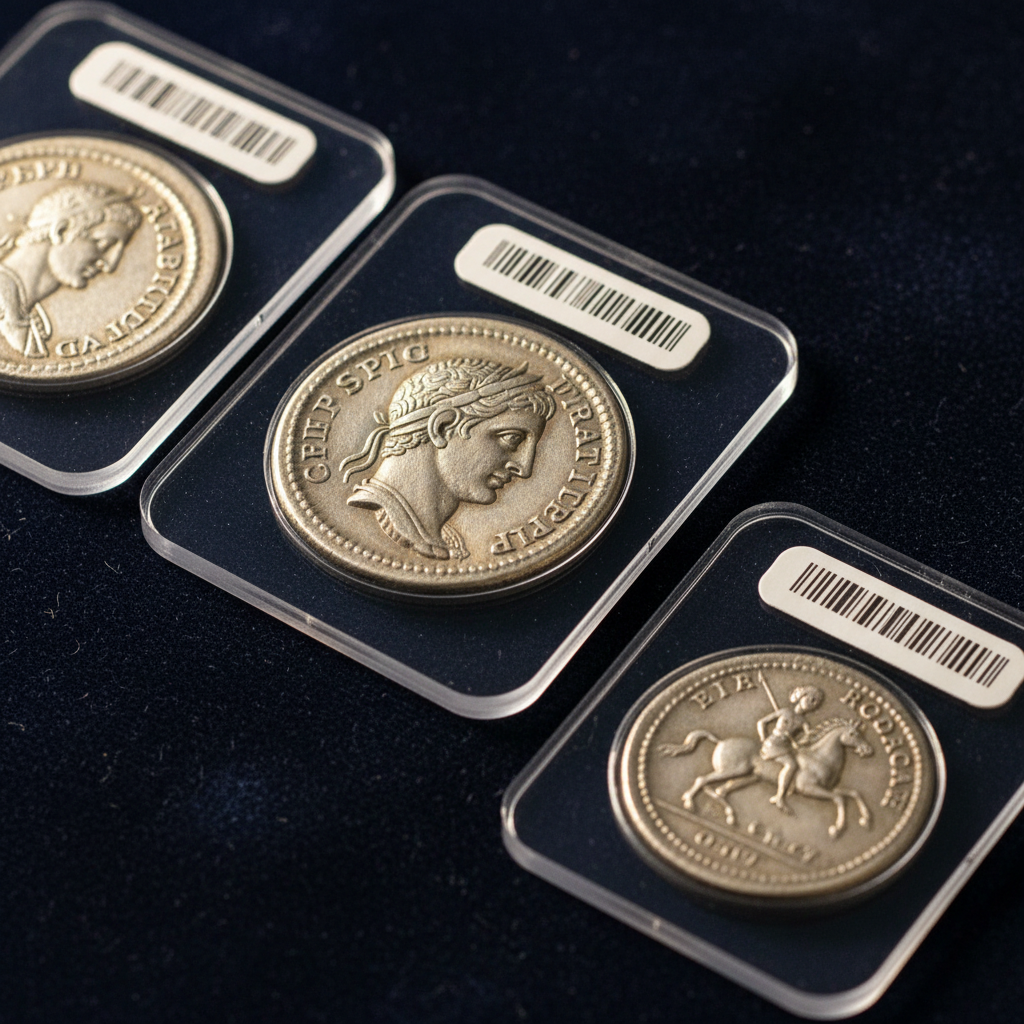
A courtesan's son inherited a kingdom. A Roman senator orchestrated its end. And the coins minted between those two moments — spanning roughly two centuries of Cappadocian rule — are among the most historically loaded, and most undervalued, series in ancient numismatics.
This is the story the Kings of Cappadocia coinage tells, and serious collectors who haven't looked closely at this series are leaving opportunity on the table.
A Kingdom Caught Between Empires
Cappadocia occupied a mountainous plateau in central Anatolia — modern-day Turkey — that made it strategically indispensable to every major power in the ancient Mediterranean world. The Achaemenid Persians valued it. Alexander the Great swept through it. And Rome, eventually, absorbed it. The Ariarathid and Ariobarzanid dynasties that ruled Cappadocia from roughly the 3rd century BCE through 17 CE did so largely by reading the room: aligning with whoever held the most legions at any given moment.
That political pragmatism is precisely what makes the coinage so rich. Each portrait type — and there are many, given how frequently Cappadocian rulers changed allegiances, names, and even identities — reflects a kingdom recalibrating its position in real time. The silver drachms issued under Ariarathes V, who ruled from approximately 163 to 130 BCE, are particularly striking: his portrait carries unmistakable Hellenistic idealism, modeled closely on the posthumous Alexander types that dominated royal coinage across the eastern Mediterranean. It was a deliberate statement of legitimacy, minted in silver.
Then came the complications. Dynastic murder. Disputed succession. A king — Archelaus, the last of his line — who was, by ancient accounts, the son of a courtesan and rose to the throne through a combination of Roman favor and personal cunning. His coinage, issued in the final decades before Cappadocia's absorption into the Roman provincial system in 17 CE, has an almost elegiac quality: the portraiture grows more Roman in style even as the kingdom it represents is visibly running out of time.
What the Market Looks Like Now
Cappadocian royal coinage occupies a peculiar corner of the ancient coin market. It is neither obscure enough to be ignored by specialists nor famous enough to command the premiums of, say, Athenian owls or Syracusan dekadrachms. That gap is, arguably, a buying opportunity.
Mid-grade examples — what the trade would describe as VF (Very Fine) to EF (Extremely Fine) — of Ariarathes-series silver drachms regularly appear at auction through houses like Stack's Bowers, Heritage Auctions, and European specialists including Roma Numismatics and Leu Numismatik. Hammer prices for solid VF specimens typically land in the $150–$400 range, with choice EF examples pushing past $800 to $1,200 depending on portrait quality and die state. Exceptional pieces with full luster and sharp royal portraits have cleared $2,000+ at major sales, though those are the exception rather than the rule.
For context: a comparable-grade silver tetradrachm from a more famous Hellenistic series — Seleucid, Ptolemaic, or Macedonian — will cost three to five times as much for equivalent numismatic quality. The Cappadocian series doesn't get the same catalog space, the same collector base, or the same auction-house marketing muscle. Which means the coins themselves are doing more work per dollar than almost anything else in the Hellenistic silver category.
NGC-certified examples do appear, though the population is thin relative to more mainstream ancient series. Collectors working with raw, uncertified coins should lean on established dealers with strong provenance documentation — the ancient coin market's version of due diligence.
Why the History Makes the Coin
There's a version of ancient coin collecting that treats these objects purely as art objects — beautiful portraits in silver, full stop. That approach works fine. But the Cappadocian series rewards a different kind of engagement.
Each ruler's portrait is a data point in a longer story about how small kingdoms survived — or didn't — in the shadow of great powers. Ariarathes IX, who briefly ruled in the 80s BCE during the chaos of the Mithridatic Wars, minted coins while his kingdom was being fought over by Rome and Pontus simultaneously. Holding one of those drachms means holding a physical artifact of that specific geopolitical crisis. The coin didn't just circulate through that moment in history. It was produced by it.
Archelaus, the final king, died in Rome in 17 CE — summoned by Tiberius under the pretense of a hearing and effectively held until he expired. Cappadocia became a Roman province the same year. The coins he issued in his final decades of rule are, in the most literal sense, the last documents of an independent Cappadocian state.
For a series that tells that complete an arc — from Hellenistic ambition to Roman absorption, across more than two centuries of minted silver — the market is still sleeping on it. That won't last indefinitely.