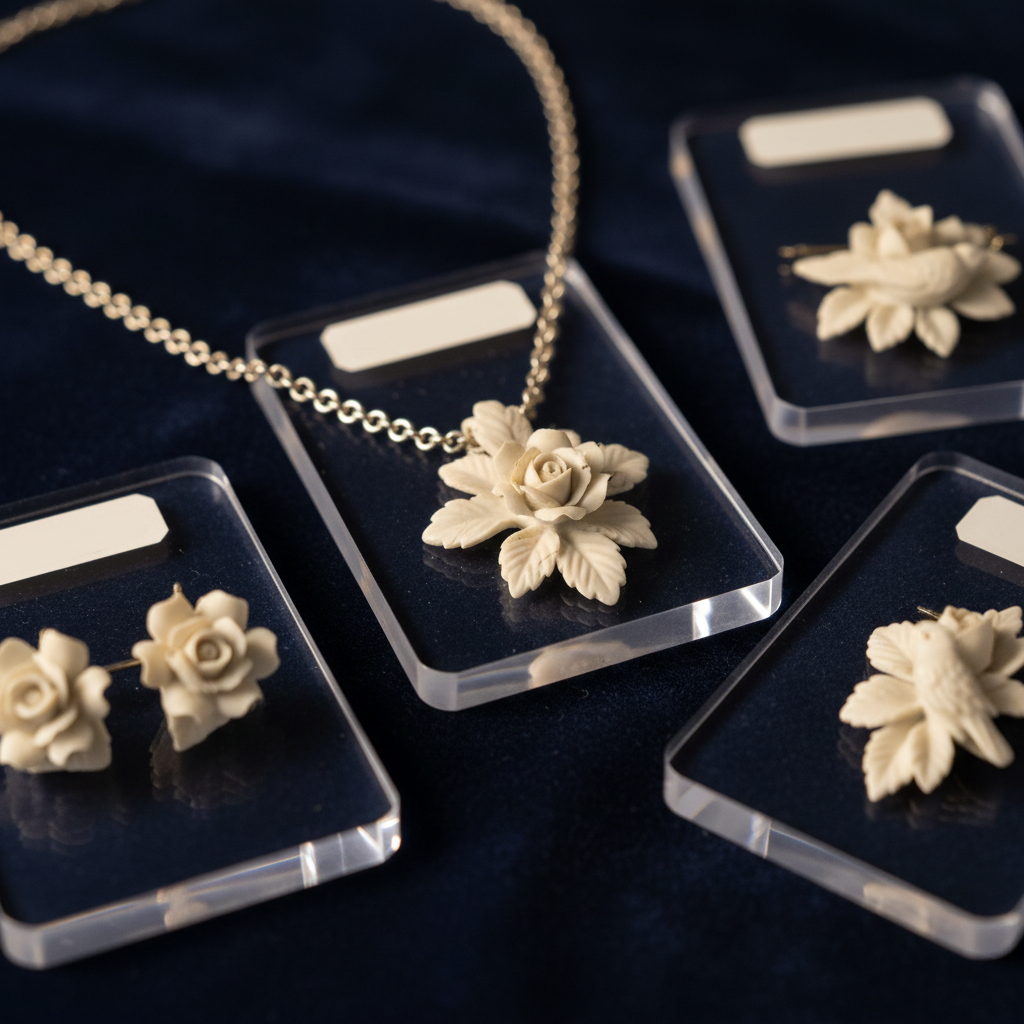
Somewhere between studio art and wearable craft, Carol Halmy built a quietly remarkable body of work in the 1980s — handmade bisque porcelain jewelry that sold through boutiques and craft fairs and then largely vanished from the cultural conversation. Forty years later, that obscurity is exactly what makes her pieces interesting to a certain kind of collector.
Halmy worked in bisque porcelain, an unglazed ceramic fired at high temperature that produces a matte, almost chalky surface with a tactile warmth that glazed pieces simply don't have. The technique demands precision — bisque is unforgiving, and hand-formed jewelry at small scale leaves no margin for error. Each piece was individually made, which means no two are identical and production volume was inherently limited. That's not a marketing line. It's a material reality that has direct implications for today's secondary market.
What You're Actually Buying
Halmy's output leaned toward botanical and figurative motifs — flowers, leaves, abstract organic forms — rendered in pale, natural tones that suited the earthy aesthetic dominating American craft jewelry in that era. Brooches appear to be the most common surviving form, followed by pendants and earrings. Sets surface occasionally, though matching pairs in comparable condition are harder to find than single pieces.
Condition is everything here, and that's where the category gets complicated. Bisque porcelain is more fragile than glazed ceramic — it chips at edges, absorbs oils from skin contact over decades, and doesn't clean easily without risking surface damage. Pieces that have been stored rather than worn command a meaningful premium over examples showing even minor edge wear. There's no formal grading infrastructure for studio craft jewelry the way there is for, say, vintage coins or trading cards, so buyers are essentially operating on their own visual assessment and whatever provenance documentation exists.
Most pieces currently circulating through eBay, Etsy, and regional antique markets are priced in the $15 to $75 range, with signed and documented examples occasionally pushing past that ceiling. The market is thin and inconsistent — which is both the risk and the opportunity.
The Affordable Collectibles Argument
The broader category of 1980s American studio craft jewelry has been attracting renewed attention from collectors who watched mid-century modernist jewelry — think Rebajes, Renoir, Matisse — appreciate dramatically over the past two decades and are now looking for the next underloved segment. The logic isn't complicated: handmade, signed, limited production, aesthetically coherent body of work, currently cheap. That's a checklist that has preceded price appreciation in other collecting categories more than once.
Halmy fits that profile. She was working in a tradition with genuine craft credibility, not mass-market costume jewelry. The bisque porcelain medium itself is unusual enough to be distinctive — most collectors of wearable ceramics are more familiar with glazed pieces from the same era. Rarity of medium, combined with low current prices and minimal collector competition, creates an entry point that won't exist indefinitely if the category catches broader attention.
The comps worth watching are pieces by contemporaries working in similar craft-jewelry traditions from the same decade. When signed examples from comparable studio artists start moving consistently above $100 at auction, that's typically when generalist antique dealers begin pulling pieces out of the $20 bins and repricing them. Halmy isn't there yet. The window is open.
Building a Position Now
For collectors approaching this seriously, a few practical notes. Signature verification matters — look for pieces marked Carol Halmy or with her studio mark, and cross-reference against known examples before paying any premium. Original tags or hang cards, if present, are worth preserving; they establish provenance and period authenticity in a category where documentation is sparse.
Condition triage is the other critical skill. Edge integrity on the porcelain, surface cleanliness, and hardware condition on brooches and earring backs all factor into long-term value. A piece with a hairline crack is decorative at best; a pristine example in original condition is the collectible.
The honest assessment: this is a speculative, illiquid, niche category with no grading standard, thin auction history, and limited price discovery. It is also genuinely affordable, genuinely handmade, and genuinely scarce. For collectors who do their homework and buy selectively, Carol Halmy's bisque porcelain jewelry represents exactly the kind of overlooked American craft that tends to look obvious in hindsight — after the prices have already moved.