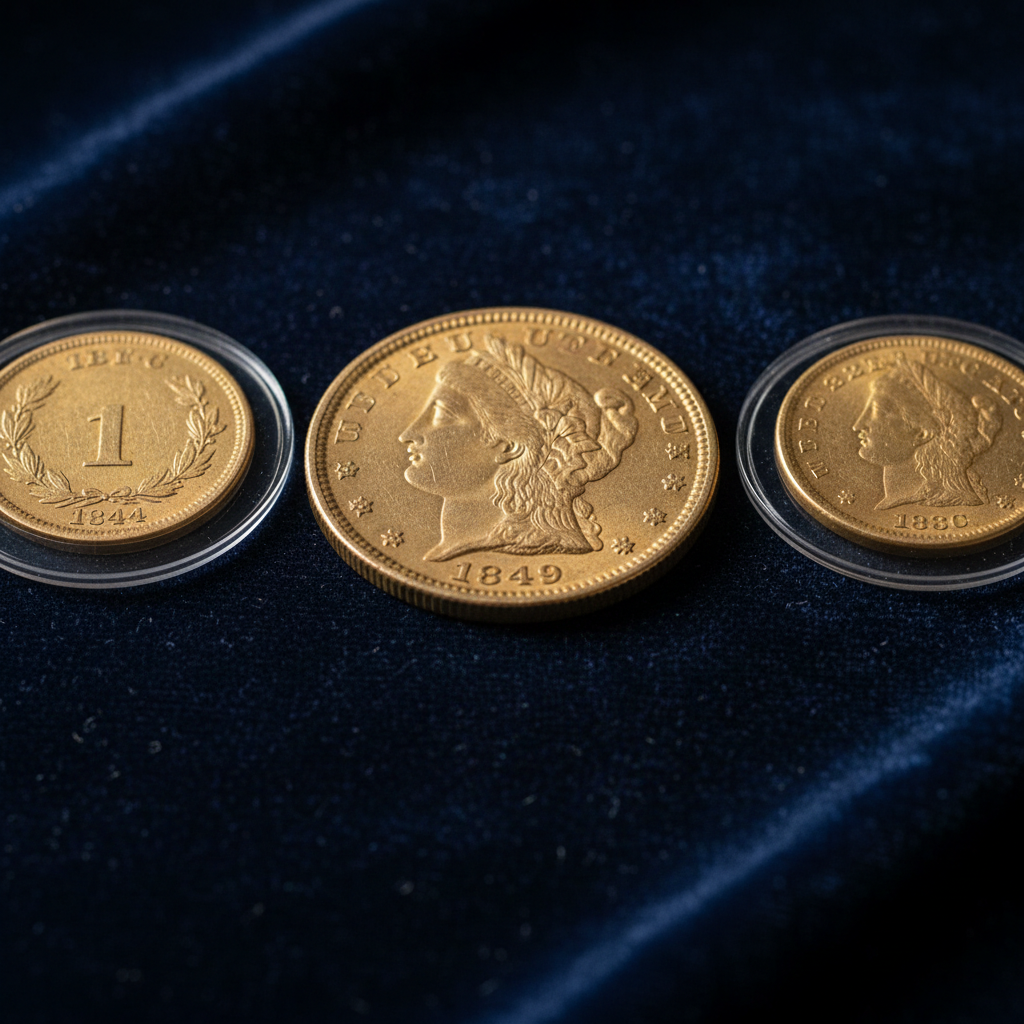
Before the Civil War severed the South from the federal monetary system, a small mint tucked into the Carolina Piedmont was quietly striking some of the most historically significant — and today most undervalued — gold coins in American numismatics. The Charlotte Mint operated for just 23 years, from 1838 to 1861, and every coin it produced carries a story that the market hasn't fully priced in yet.
That's the argument serious collectors of early American gold have been making for years. The data backs them up.
Gold Rush Origins and the Case for a Southern Mint
The Charlotte Mint didn't emerge from bureaucratic planning. It was born out of geographic necessity. After gold was discovered in western North Carolina and northern Georgia around 1830, the region's mining operations exploded — but the nearest coining facility was in Philadelphia, hundreds of miles away over roads that barely deserved the name. Transporting raw ore that far was expensive, dangerous, and slow. The economic logic for a regional mint was overwhelming.
Congress agreed. The Charlotte Mint, along with companion facilities in Dahlonega, Georgia and New Orleans, Louisiana, was authorized in 1835 and began operations three years later. From day one, Charlotte was a specialized operation — it struck gold coins exclusively, never silver, never copper. That singular focus shapes the entire collecting landscape for these pieces today.
The coins produced at Charlotte bear the "C" mintmark, one of the rarest and most coveted in all of U.S. coinage. Denominations included the gold dollar, quarter eagle ($2.50), half eagle ($5.00), and — for a brief window — the three-dollar gold piece. Mintages were modest by Philadelphia standards, and survival rates are correspondingly thin.
What Collectors Are Actually Dealing With
This is where the Charlotte series gets genuinely interesting from a market perspective. Low original mintages combined with Civil War-era melting, general circulation wear, and over a century of attrition mean that high-grade examples are legitimately scarce — not artificially scarce, not hype-scarce. Actually scarce.
Consider the 1842-C Small Date Half Eagle. PCGS has certified fewer than 60 examples across all grades, with only a handful reaching MS-61 or better. At Heritage's January 2024 FUN auction, a PCGS MS-61 example brought $28,800 — a figure that would have seemed ambitious five years ago. The broader half eagle market for Charlotte issues has shown consistent appreciation across the 2019–2024 period, with circulated examples in the VF-35 to EF-45 range seeing 20–35% gains depending on date and die variety.
Gold dollars with the C mintmark tell a similar story. The 1849-C Open Wreath dollar — a first-year issue from the denomination's inaugural run — trades regularly in the $1,800 to $4,500 range depending on grade, with PCGS and NGC MS-63 examples occasionally breaching $12,000 at major auction. Population reports from both services show fewer than 20 mint-state survivors for most individual Charlotte gold dollar dates. That's not a deep market. That's a market where a single fresh consignment can move prices.
Quarter eagles from Charlotte — the $2.50 denomination — are arguably the most accessible entry point for new collectors. Circulated examples of common dates like the 1847-C can still be found in the $800 to $1,500 range in VF grades, offering genuine historical significance at a price point that doesn't require a wire transfer and a deep breath.
The Collector's Calculus
What makes Charlotte gold compelling isn't just rarity. It's the intersection of rarity, historical narrative, and relative obscurity within the broader rare coin market. While registry-set competition for classic U.S. coins like the Saint-Gaudens double eagle or the Morgan dollar has driven premiums into the stratosphere, the Charlotte series remains comparatively under-the-radar. Most PCGS Set Registry participants building Charlotte collections are working against a small field of competitors — which means the coins themselves still do the talking, not speculative momentum.
Condition is everything here, as it is across all pre-Civil War gold. The grading standards applied by PCGS and NGC to early American gold are rigorous, and the line between an EF-45 and an AU-50 can represent a $2,000 swing on a common-date half eagle. New collectors should prioritize problem-free, original-surface examples over high-grade coins with questionable originality — the market for cleaned or improperly conserved Charlotte gold is thin and punishing.
Doug Winter, who has spent decades as one of the foremost dealers in early American gold, has long argued that Charlotte coins represent one of the last genuine value opportunities in the series. The mint's brief lifespan, its exclusively gold output, and its direct connection to a transformative moment in American economic history give these coins a depth of context that purely condition-driven collectors sometimes overlook.
The Charlotte Mint closed in 1861 when North Carolina seceded from the Union. It never reopened. What it left behind is a finite, fixed population of coins that will only get harder to find in original, problem-free condition as the years pass. That's not a sales pitch. That's arithmetic.