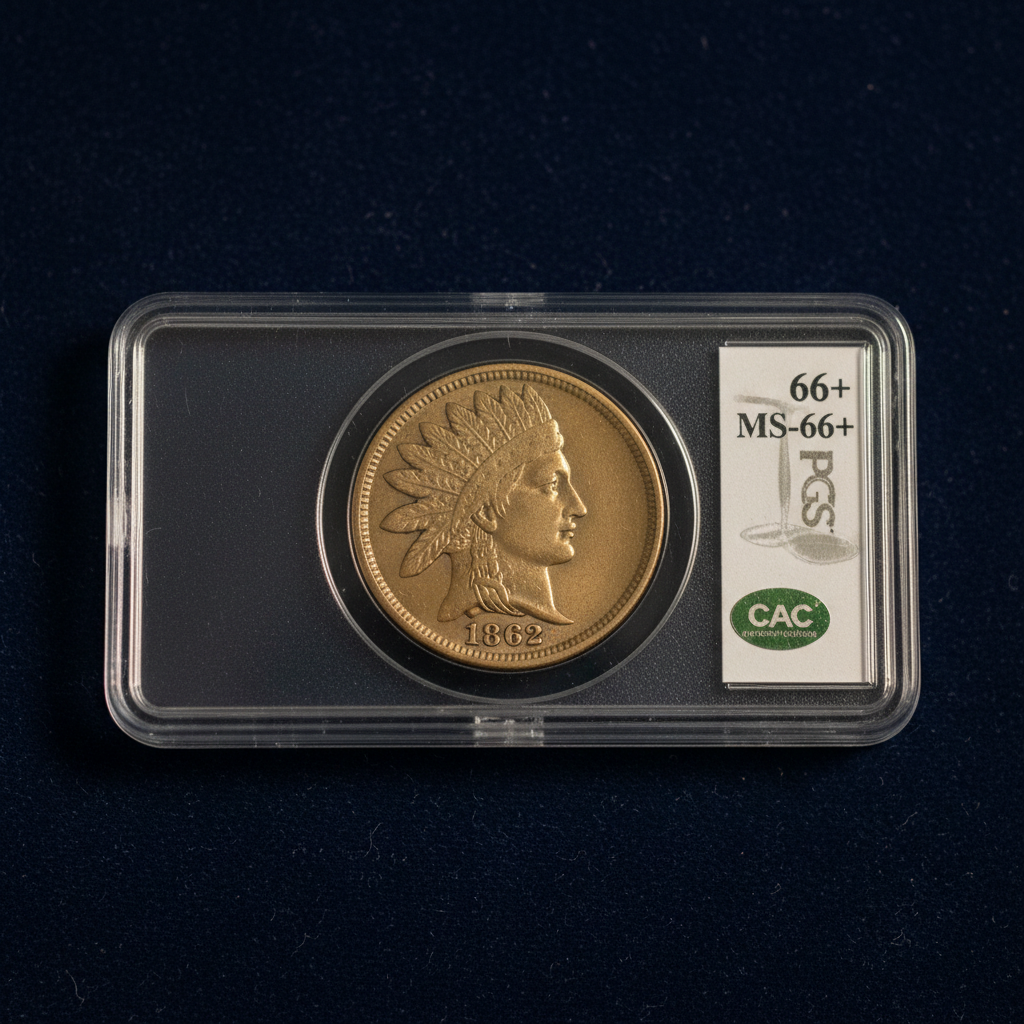
An 1862 Indian Head Cent certified PCGS MS-66+ with CAC Green approval is heading to auction at GreatCollections, with bidding closing Sunday, May 3, 2026. The coin, listed as Item 1981836, represents one of the finest surviving examples of a series struck during one of the most turbulent years in American history — and the population data backs that up.
At MS-66+, this cent sits in rarefied air. PCGS has certified relatively few Indian Head Cents at the 66 level across all dates, and the plus designation — indicating a coin that exceeds the standard for its grade without quite clearing the bar for the next — adds meaningful premium. CAC's green sticker signals that a second set of expert eyes confirmed the coin meets or exceeds the quality standard for its PCGS holder. In a series where eye appeal varies wildly even within the same grade, that sticker isn't decoration. It's due diligence.
The 1862 Cent in Historical and Numismatic Context
The 1862 Indian Head Cent was struck at the Philadelphia Mint during the first full calendar year of the Civil War. Coin hoarding was rampant — civilians were pulling hard money out of circulation in anticipation of economic chaos — yet the Mint produced over 28 million cents that year, making 1862 one of the higher-mintage dates in the early copper-nickel Indian Head series. That abundance in circulated grades is precisely why a gem-quality survivor commands attention. High mintage means plentiful circulated examples. It does not mean plentiful gems.
The early Indian Head Cents, struck in 88% copper and 12% nickel from 1859 through 1864, are notoriously difficult to find with full strikes and clean surfaces. The alloy was hard on dies, and the designs — particularly the feathers on the headdress and the details on Lady Liberty's portrait — were prone to weakness. A fully struck, mark-free example at MS-66+ isn't just old. It's exceptional by any standard the series demands.
Context matters here: the series shifted to bronze composition in 1864, and many collectors treat the copper-nickel years as a distinct subset. Within that subset, the 1862 is attainable in lower grades but becomes genuinely scarce above MS-65. The plus grade narrows the field further.
Why GreatCollections, and What to Expect at Hammer
GreatCollections has carved out a legitimate position in the rare coin market as a transparent, low-fee platform that draws serious bidders for certified material. Their no-buyer's-premium model for coins under certain thresholds — and competitive rates above them — means realized prices often land closer to true market value than what you'd see at houses that layer on 20% buyer's fees. For a coin like this, that structural difference matters when comparing comps.
What should bidders expect to pay? High-grade Indian Head Cents with CAC approval have shown consistent strength at auction over the past several years. PCGS MS-66 examples of the 1862 — without the plus — have traded in the $2,000–$4,500 range depending on strike quality and surface preservation. The plus designation and CAC sticker together typically push realized prices meaningfully above the base MS-66 comp, sometimes by 30–50% or more when eye appeal is strong. An MS-66+ CAC in a date with limited population at that tier could realistically challenge the upper end of that range or exceed it outright.
- Date: 1862
- Series: Indian Head Cent (copper-nickel composition, 1859–1864)
- Grade: PCGS MS-66+
- Approval: CAC Green
- Auction House: GreatCollections
- Lot Number: Item 1981836
- Closing Date: Sunday, May 3, 2026
A Coin That Outlasted the War
There's something quietly remarkable about a coin struck in 1862 — the year of Antietam, the year Lincoln drafted the Emancipation Proclamation — surviving 160-plus years in essentially mint condition. Most of the 28 million cents produced that year were spent, lost, or worn smooth by the turn of the century. This one wasn't.
For type collectors building a set of early Indian Head Cents, a PCGS MS-66+ CAC is about as good as the market routinely offers. For date collectors, the 1862 is an accessible entry point in lower grades — but at this level, accessibility ends. The population at MS-66 and above is thin enough that opportunities like this don't surface on a predictable schedule.
Bidding closes May 3rd. The market will say what it's worth. History already has.