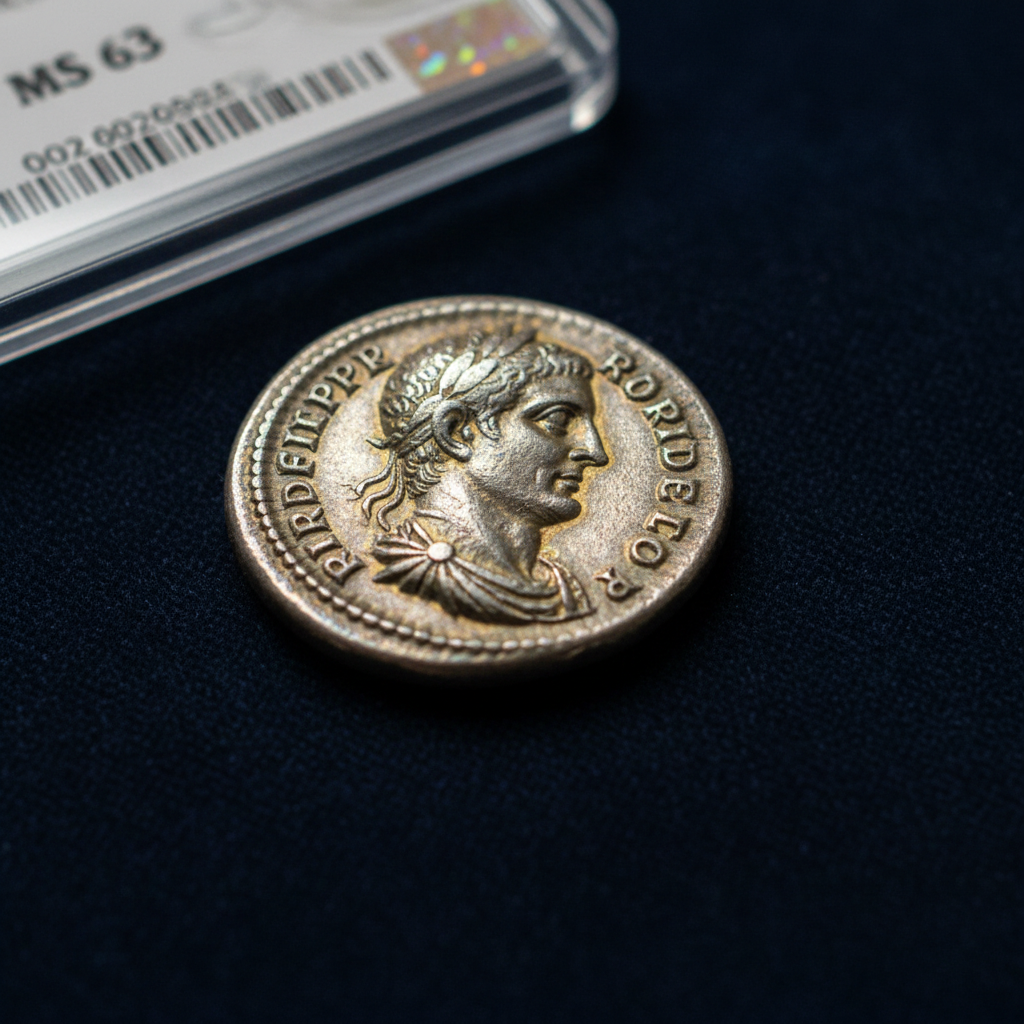
Every coin portrait is a lie of omission. The monarch, president, or deity staring back at you from a circulated quarter or a freshly graded NGC MS-67 specimen was once a full human form — and a designer made a deliberate, consequential decision about exactly where to cut them off. That cut has a name: truncation. And understanding it changes how you read every coin you've ever handled.
The term comes from the Latin truncare — to cut short. On a coin, truncation refers to the bottom edge of a portrait or bust, the point at which the engraver chose to end the image. In most cases, that's the neck. Sometimes it's the shoulder. Occasionally it extends to the breast or draped chest, depending on the era, the denomination, and the artistic ambition of the mint's chief engraver. The truncation isn't an accident or a space-saving afterthought. It is a design statement.
Why Truncation Is a Numismatic Fingerprint
For serious collectors and attributers, the truncation line is one of the most diagnostic elements on any coin. Variety hunters — particularly those working through Sheldon's Early American Cents or the Overton reference for Bust Half Dollars — rely on truncation details to distinguish one die marriage from another. The position of a letter, a die crack intersecting the neck, or the precise angle at which the bust terminates can be the difference between a common die state and a condition rarity worth multiples at auction.
Consider the classic Capped Bust series of the early 19th century. John Reich's design, introduced in 1807, features Liberty with a distinctive cap and a truncation that cuts cleanly below the shoulder, leaving a drapery fold visible on many die varieties. That drapery — its depth, its curvature, its relationship to the rim — is catalogued with obsessive precision in collector references. A 1812 Cbust Half in PCGS MS-64 and a matching coin in MS-65 might look nearly identical to a casual observer. To a variety specialist, the truncation tells them exactly which obverse die they're looking at.
The same logic applies to ancient coinage. Greek and Roman portrait coins — the bread and butter of dealers like Stack's Bowers and Heritage Auctions' world coin division — are routinely attributed in part by how the engraver handled the bust terminus. A laureate head cut sharply at the neck reads differently, both aesthetically and historically, than a draped bust extending to the chest. These choices reflected the artistic conventions of specific mints and specific periods, which is exactly why they matter to attribution today.
The Artistic and Political Dimensions
Truncation wasn't purely a technical decision. It carried political and symbolic weight, particularly in monarchical coinage traditions. A bust that extended further down the body — showing robes, armor, or regalia — communicated power and status. A tighter crop at the neck was more intimate, more humanizing. British sovereigns across multiple centuries can be traced through their truncation styles almost as reliably as through their engravers' initials, which often appear on the truncation itself.
That practice — engravers signing their work directly on the bust cut — is one of the more elegant traditions in numismatic history. On many 18th and 19th century coins, you'll find initials, full surnames, or abbreviated signatures nestled into the truncation line. Christian Gobrecht did it. So did Robert Scot. The truncation became a canvas within a canvas, a designer's quiet signature on a mass-produced object meant to circulate through millions of hands.
On U.S. coinage specifically, the evolution of truncation style tracks the evolution of American artistic ambition at the mint. Early coinage was rough, the busts crude, the truncations uneven. By the time Augustus Saint-Gaudens was commissioned by Theodore Roosevelt in the early 1900s to redesign American gold coinage, the conversation about portrait placement had become genuinely sophisticated. Saint-Gaudens' double eagle famously avoided the traditional bust format altogether — but the design debate that preceded it was, in part, a debate about truncation and what it communicated about the nation.
Reading Truncation as a Collector
For collectors building type sets or chasing registry points, truncation is rarely the primary focus. But it should inform how you examine a coin. A sharp, well-defined truncation line — crisp against the field, free of contact marks — is a quality indicator. On high-relief coins especially, the truncation can be one of the first areas to show wear, since it often sits at or near the coin's highest relief point relative to the surrounding design.
On Morgan Dollars, the truncation of Liberty's neck is a known strike-weakness zone on certain mint issues, particularly Philadelphia and New Orleans strikes from the 1880s and 1890s. Graders at PCGS and NGC account for this when evaluating luster and surface preservation in that area. A coin that looks MS-64 everywhere else but shows softness at the truncation may well end up a 63 — and the price differential on a key date can be significant.
Truncation is one of those concepts that sits quietly in the background of numismatics, rarely headlining a catalog description, almost never mentioned in auction lot notes unless it's relevant to attribution. But it shapes every portrait coin ever struck. The next time you're examining a coin under a loupe, find the truncation line. Ask why it ends where it does. The answer is usually more interesting than you'd expect.