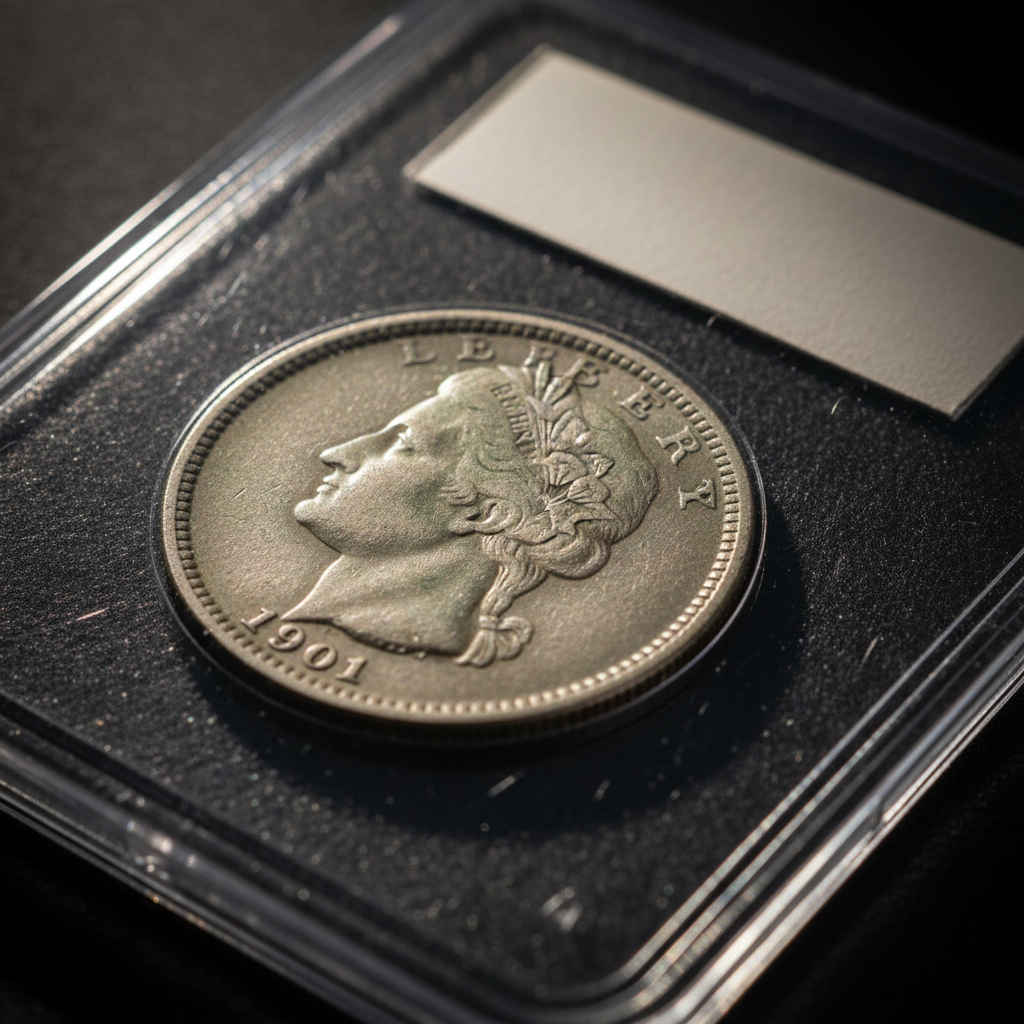
The 1901-S Barber quarter doesn't need much introduction to serious numismatists. With a mintage of just 72,664 pieces — the lowest of any Barber quarter issue — it sits at the apex of the series, commanding prices well into five figures for problem-free examples. A circulated VG-8 will run you $4,000 to $6,000 at auction. A Fine-12 can push past $10,000. That kind of money, attached to a coin that most collectors will never own, is exactly what counterfeiters target. And apparently, they keep succeeding.
Researcher and fraud investigator Jack D. Young of the Dark Side Group has flagged another counterfeit 1901-S Barber quarter that passed through the authentication process and received a certification slab — the second such case Young has publicly documented. The first, detailed in a collaborative CoinWeek article with collector Kevin Bailey roughly four years ago, was supposed to serve as a cautionary benchmark. Clearly, the lesson hasn't fully landed.
A Target Too Valuable to Leave Alone
The 1901-S exists in a dangerous zone for the rare coin market: expensive enough to justify sophisticated counterfeiting, obscure enough that most buyers — and apparently some graders — aren't intimately familiar with every diagnostic. Genuine examples are scarce across all grades. The NGC census and PCGS population reports combined show only a few hundred certified survivors, with the overwhelming majority grading below VF-20. High-grade examples are essentially unicorns.
That scarcity creates an authentication problem. When a coin type is rare, graders see fewer genuine examples over the course of their careers. Counterfeiters who do their homework — and the sophisticated ones absolutely do — can exploit that familiarity gap. The result is what Young's research keeps turning up: fakes inside holders, wearing the credibility of a third-party grading service like a stolen badge.
The mechanics of how these counterfeits are produced matters here. The most dangerous 1901-S fakes are typically altered-date coins — most often 1901-P or 1901-O Barber quarters with the mintmark added or a date altered to mimic the San Francisco issue. Done well, with period-appropriate wear applied afterward, these can fool visual inspection. The tells are there, but they require either die diagnostics, precise weight and measurement checks, or both.
The Grading System's Persistent Blind Spot
Young's documentation of a second certified counterfeit in roughly four years isn't just an anecdote — it's a pattern. And patterns in numismatics demand structural responses, not just collector advisories.
The third-party grading industry, led by PCGS and NGC, has made enormous strides in counterfeit detection over the past two decades. XRF analysis, die variety databases, and increasingly sophisticated imaging tools are all part of the modern grading workflow. But the system isn't airtight. It never claimed to be, technically — both services include language in their terms acknowledging the limits of human and instrument-based review. That legal fine print, however, does little to comfort a collector who paid $8,000 for a slab that contains a fake.
What makes Young's ongoing work so valuable — and so uncomfortable for the industry — is that he doesn't just identify problem coins in the abstract. He documents specific certified examples, with images, diagnostics, and traceable case histories. That's not a blog post. That's forensic numismatics, and the market needs more of it.
The broader implication is one the hobby has been slow to fully reckon with: a slab is not a guarantee. It is an opinion, rendered at a point in time, by fallible human beings using the best tools available. For the overwhelming majority of coins, that opinion is reliable. For the most valuable, most frequently counterfeited issues — the 1901-S Barber quarter, the 1916-D Mercury dime, the 1909-S VDB Lincoln cent — the due diligence cannot stop at the holder.
What Buyers of Key-Date Coins Must Do
If you are in the market for a certified 1901-S Barber quarter, the existence of at least two documented certified fakes should recalibrate your risk model immediately. A few non-negotiable steps:
- Request die variety attribution. Genuine 1901-S Barber quarters have documented die marriages. If a seller or dealer can't speak to variety, that's a gap.
- Verify the holder's certification number directly through PCGS or NGC's online lookup before any money changes hands. Counterfeit slabs — holders that are themselves fake — are a separate threat layered on top of counterfeit coins.
- Commission an independent second opinion from a specialist in Barber coinage before purchasing any example above $3,000. The American Numismatic Association and major specialist dealers can provide referrals.
- Review Young's published work in CoinWeek and through the Dark Side Group. His diagnostic images are among the most detailed publicly available resources on this specific issue.
The 1901-S Barber quarter is one of American numismatics' great rarities. It deserves the same level of scrutiny that the market applies to a 1794 Flowing Hair dollar or a 1913 Liberty nickel. The fact that certified counterfeits keep surfacing isn't a reason to avoid the coin — it's a reason to buy smarter. The slab opens the conversation. It doesn't end it.