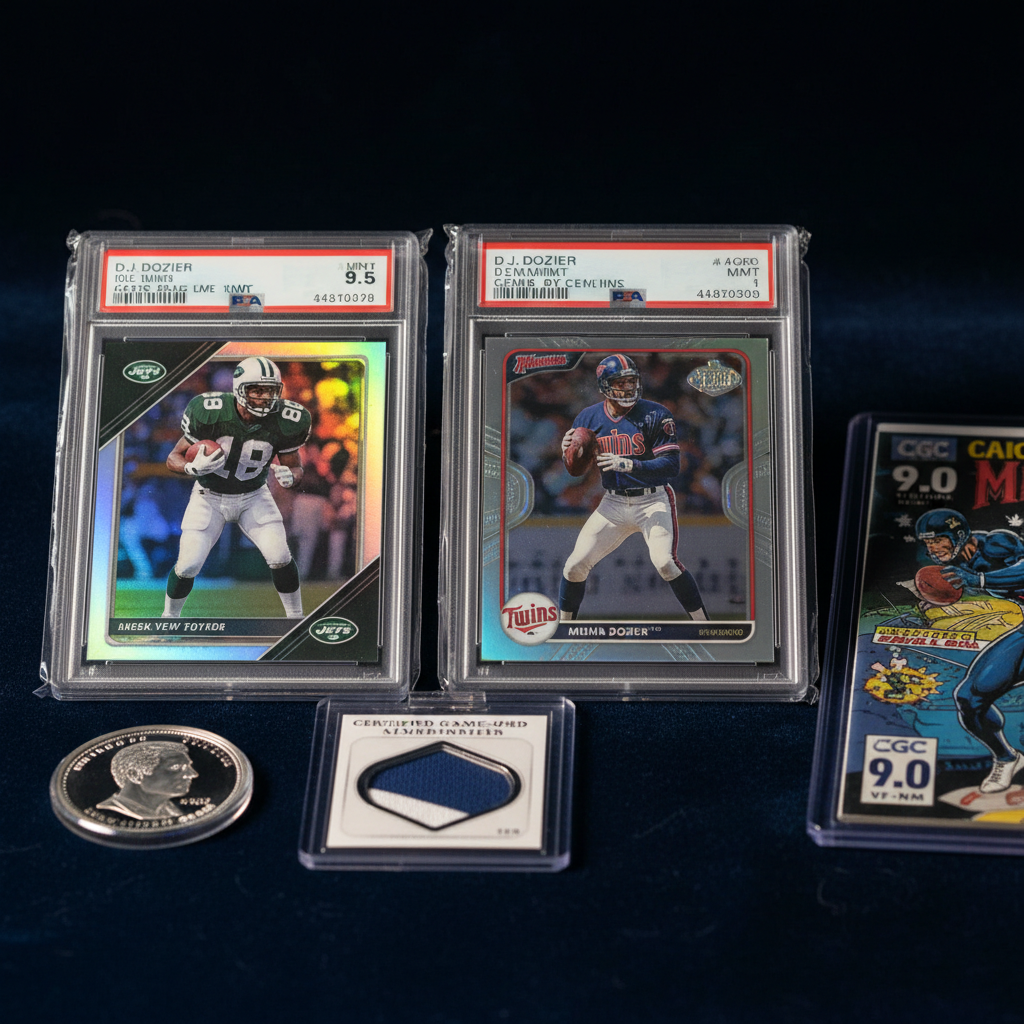
D.J. Dozier occupies one of the rarest niches in American sports history — a man who didn't just talk about playing two professional sports, but actually did it. Running back for the Minnesota Vikings. Outfielder in the MLB. Penn State national champion. First-round draft pick. His cardboard footprint spans two major sports and nearly a decade of professional play, yet his collectibles market remains dramatically undervalued relative to his biographical profile.
That's either a problem or an opportunity, depending on which side of the transaction you're on.
The Career That Built the Checklist
Dozier's path to professional sports was legitimately elite. A three-time All-East running back at Penn State — earning the distinction in 1983, 1984, and 1986 — he was part of the Nittany Lions squad that claimed the 1986 national championship. That alone would cement a legacy. Then came the 1987 NFL Draft, where the Vikings selected him 14th overall, a consensus All-American heading into a league that had just watched the Bears and Giants redefine what a running back could do.
He spent five seasons in the NFL before pivoting to baseball — not as a novelty act, but as a genuine professional prospect. That two-sport credibility is the engine behind any serious collector argument for Dozier's cards.
The NFL rookie card market for late-1980s players has been quietly heating up. 1987 Topps football rookies — the set that captures Dozier's NFL debut — have seen renewed interest as collectors who grew up watching that era enter peak buying years. Dozier's rookie in that set remains attainable, with raw copies frequently moving in the $5–$15 range and PSA 9s occasionally surfacing under $40. Population reports on high-grade copies are thin, which cuts both ways: low PSA 10 populations can signal either scarcity or collector indifference. For Dozier, it's likely some of both.
The Two-Sport Premium — And Why the Market Hasn't Priced It In
Bo Jackson and Deion Sanders set the ceiling for two-sport collectibles. Bo's 1986 Topps Traded baseball rookie in PSA 10 has cleared $1,500 at Heritage, and his 1987 Topps football rookie in the same grade routinely trades above $800. Sanders' dual-sport cards command similar premiums. The market has spoken loudly on athletes who played both sports at the highest level.
Dozier belongs in that conversation — at least historically. He doesn't belong at Bo's price point, and nobody serious is arguing that. But the gap between what Dozier's cards trade for and what his biography justifies is wide enough to attract attention from patient, research-driven collectors.
His baseball cards, issued during his MLB tenure in the early 1990s, add a second layer to any Dozier collection. Sets like 1992 Topps and 1992 Score capture his outfielder days and are essentially free at current market prices — bulk commons that haven't been touched by the nostalgia wave yet. If that wave ever arrives, early movers will look prescient.
The honest assessment: Dozier's market is speculative. He wasn't a Hall of Fame-caliber performer in either sport. But the two-sport narrative is a genuine hook, his Penn State and Vikings pedigree is legitimate, and his cards are cheap enough that building a complete run across both sports costs less than a single slabbed Jordan common.
Building a Dozier Collection in 2024
For collectors interested in assembling a meaningful Dozier holdings, the checklist is manageable and the price of entry is low. Key targets include:
- 1987 Topps Football #296 — NFL rookie card, the anchor of any football-side collection
- 1987 Topps Football #296 PSA 9 or 10 — population is sparse; a PSA 10 would be a legitimate find
- 1992 Topps Baseball — his primary MLB issue, available raw for under $2
- 1992 Score Baseball — secondary MLB card, equally attainable
- Penn State-era collegiate memorabilia — programs, photographs, and signed material from the 1986 championship season carry the strongest narrative weight
Signed material is where the real value proposition lives. Dozier isn't a mainstream signing target, which means authenticated autographs through JSA or Beckett Authentication aren't being produced at scale. A signed 8x10 or a dual-sport signed item — football card on one side, baseball card on the other — would be a genuinely unusual piece.
The collectors who win on athletes like Dozier are the ones who do the work before the profile piece runs, not after. That window may already be closing.