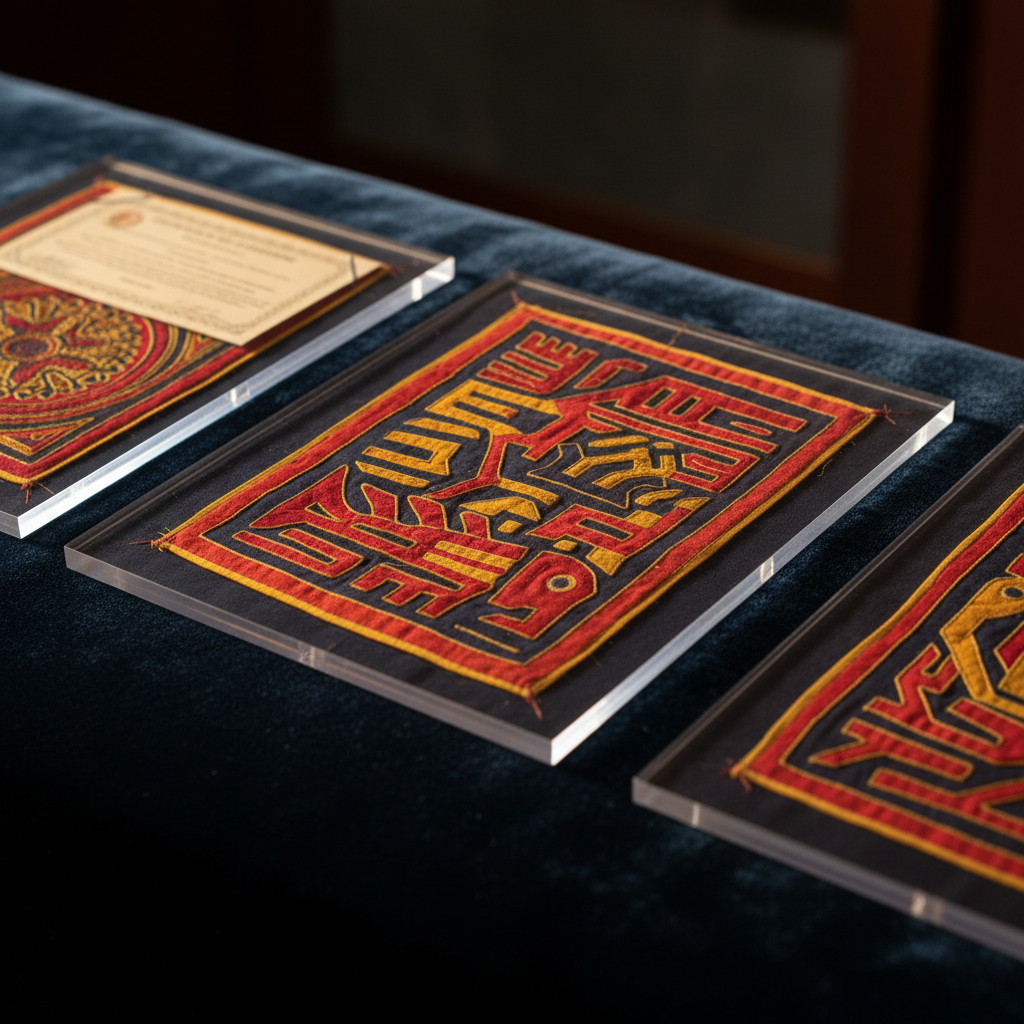
Some collections take decades to assemble. The Parker-Neal Mola Collection is one of them — and on May 16, Dana Auctions will disperse it in a simulcast sale spanning Princeton, New Jersey and online bidders worldwide.
The auction centers on Kuna molas, the hand-stitched textile panels produced by the Kuna (Guna) people of Panama's San Blas archipelago. These aren't decorative souvenirs. Museum-quality molas represent one of the most technically demanding textile traditions in the Western Hemisphere, built through a reverse appliqué process that layers and cuts fabric to reveal intricate geometric and figurative designs. The finest examples — particularly pre-1960 panels with dense stitching, complex layering, and vibrant natural dyes — have no meaningful supply pipeline. They stopped being made at that level of quality generations ago.
What Makes This Sale Different
The Parker-Neal provenance is the central selling point here. Named collections carry a premium in the textile and ethnographic art market for the same reason a CGC 9.8 with a pedigree outperforms a raw copy: documented history collapses uncertainty. Buyers know where the piece has been, how it was stored, and that it survived the 20th century's aggressive export market with its integrity intact.
Dana Auctions has positioned this as a landmark sale, and the descriptor is defensible. Significant mola collections rarely come to market intact. Most are absorbed quietly into private hands or donated to institutions — the Smithsonian's National Museum of the American Indian holds important holdings, as does the Textile Museum in Washington, D.C. When a private collection of this caliber surfaces at public auction, it's an event for a very specific, very serious buyer pool.
That buyer pool has grown. Ethnographic textiles have seen sustained institutional and collector interest over the past decade, driven partly by a broader reappraisal of Indigenous art as fine art rather than folk craft. Auction results at Christie's and Sotheby's for high-grade Kuna textiles have climbed accordingly, with exceptional early panels occasionally clearing five figures. The Parker-Neal sale gives the secondary market a real data point at a moment when the category lacks consistent public comps.
The Simulcast Format and What It Means for Bidders
Dana Auctions is running this as a simulcast — live floor bidding in Princeton alongside real-time online participation. For textile collectors, that format matters. Molas are tactile objects; serious buyers want to examine stitching density, dye saturation, and structural integrity in person before committing. The Princeton floor session gives that access. Online bidding broadens the competitive field, which is good for sellers and creates genuine price discovery rather than a thin-room result.
The sale date of May 16 puts it squarely in spring auction season, competing for collector attention with the major New York houses running their ethnographic and decorative arts sales. That's not a disadvantage — buyers already in acquisition mode are primed to spend, and a specialized single-collection sale often outperforms comparable lots scattered across a general auction.
For dealers and institutional buyers, the practical upside is obvious: this is a chance to acquire depth in a category where depth almost never comes available. Individual molas can be sourced. A curated, provenance-documented collection of this scope cannot.
Reading the Room on Ethnographic Textiles
The broader ethnographic textile market has been recalibrating. Increased scrutiny around provenance and cultural patrimony has made some buyers cautious about categories with complicated export histories. Kuna molas occupy a relatively clean position in that conversation — they were traditionally traded and gifted, and the Kuna have historically maintained agency over their textile tradition in ways that distinguish molas from more contested categories of Indigenous material culture.
That distinction matters to institutional buyers navigating acquisition policies and to private collectors who want long-term holding confidence. A well-documented American collection assembled through legitimate channels is exactly the kind of provenance narrative that holds up.
Whether the Parker-Neal collection delivers the kind of headline results that reshapes the mola market or simply satisfies a waiting list of serious collectors quietly — either outcome advances the category. The real question is how many of these lots end up in institutions versus private hands, and whether Dana Auctions has the marketing reach to surface the international buyer pool this material deserves.
May 16. Princeton. Watch the results.