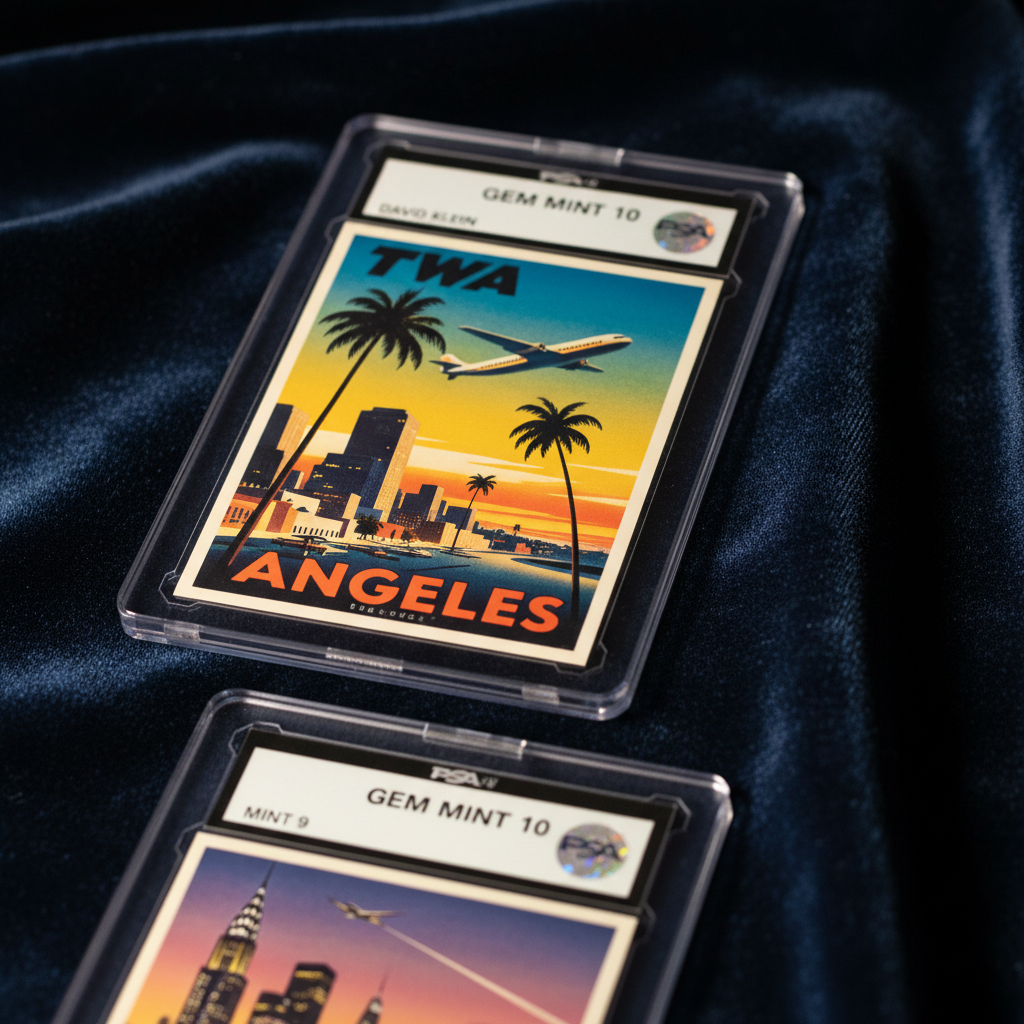
Before the internet, before budget airlines, before travel became a transaction — there was the Golden Age of Air Travel, and nobody captured its glamour more precisely than David Klein. His lithographic posters for Trans World Airlines, produced from the mid-1950s through the 1960s, didn't just advertise flights. They sold a dream. Decades later, that dream is still appreciating.
Klein's TWA work represents a convergence of factors that serious paper collectibles investors understand well: a singular artistic voice, a defunct brand with enormous nostalgic equity, and a finite supply of original period lithographs. That combination has driven sustained demand at auction for the better part of two decades — and the market shows no signs of leveling off.
The Art Behind the Altitude
Klein came to TWA in 1956, recruited by the airline at a moment when commercial aviation was positioning itself as aspirational luxury rather than mere transportation. His assignment was to make cities — New York, Paris, Rome, Las Vegas, Los Angeles — look irresistible from 30,000 feet. He delivered, repeatedly.
His style was unmistakable: bold, flat color fields borrowed from European modernism, dynamic compositions that pushed figures and skylines to the edges of the frame, and a typographic sensibility that treated the TWA logo as a design element rather than an afterthought. The posters were printed as large-format lithographs, typically 25 x 40 inches, and distributed through travel agencies across the country. Most were discarded when campaigns ended. Survival rates were low — which is precisely what makes originals so valuable today.
Klein's most sought-after designs include his New York skyline composition, his Las Vegas poster featuring a stylized roulette wheel and showgirl silhouettes, and his Rome image built around the Colosseum at dusk. These aren't interchangeable. Condition, print run, and subject matter all drive significant price variation between individual pieces.
What the Auction Record Actually Shows
The market for vintage travel posters broadly — and Klein's TWA work specifically — has matured considerably since the early 2000s, when original lithographs could occasionally be found at estate sales for low three figures. That window closed a long time ago.
At major auction houses including Swann Galleries and Heritage Auctions, Klein's TWA originals in fine to very fine condition regularly achieve $1,500 to $4,500, with exceptional examples of the most iconic compositions pushing past $6,000. His 1958 New York poster — arguably the definitive image of mid-century American aviation advertising — has sold multiple times in the $3,000–$5,500 range depending on linen-backing quality and color saturation. A pristine, unrestored example with original margins is a different animal entirely from a linen-backed restoration, and sophisticated buyers price that distinction accordingly.
Condition grading in the vintage poster market doesn't follow PSA or CGC conventions, but the underlying logic is identical: paper quality, fold lines, color fading, and restoration work all factor into realized prices. A poster graded A condition — no folds, no restoration, full color — can command a 40 to 60 percent premium over a comparable B+ example. That spread has widened over the past decade as the collector base has grown more sophisticated.
Linen-backed examples deserve a specific note. Linen backing is a conservation technique that stabilizes fragile paper, and it's standard in the trade — but it's also a modification. Purists increasingly prefer unrestored originals, even with minor imperfections, over heavily restored pieces. It's a philosophical divide that mirrors debates in the graded card world over cleaned coins or trimmed cards.
Why Klein's Work Has Staying Power
Plenty of mid-century commercial artists produced beautiful work that has since faded into obscurity. Klein hasn't, for reasons that go beyond nostalgia.
His TWA posters occupy a specific cultural moment — the late Eisenhower and Kennedy years, when American optimism about technology and modernity was at its postwar peak — and they do so with genuine artistic authority. Klein wasn't producing assembly-line advertising. He was making images that held their own against the fine art of the period. That's a judgment the market has consistently validated.
The TWA brand itself adds a layer of collectibility that a living airline couldn't replicate. TWA ceased operations in 2001, absorbed by American Airlines after decades of financial turbulence. The brand's death transformed every piece of TWA ephemera — posters, menus, timetables, uniform buttons — into a closed archive. No new supply is coming. Klein's posters aren't competing with fresh printings.
For collectors entering this market now, the calculus is straightforward: identify the highest-condition examples of the most iconic compositions, understand the restoration history of any piece before buying, and treat provenance documentation as non-negotiable. Dealers who can't produce paper trails deserve skepticism.
The Golden Age of Air Travel ended somewhere over the deregulation era of the late 1970s. Klein's posters didn't just survive it — they became its most eloquent eulogy.