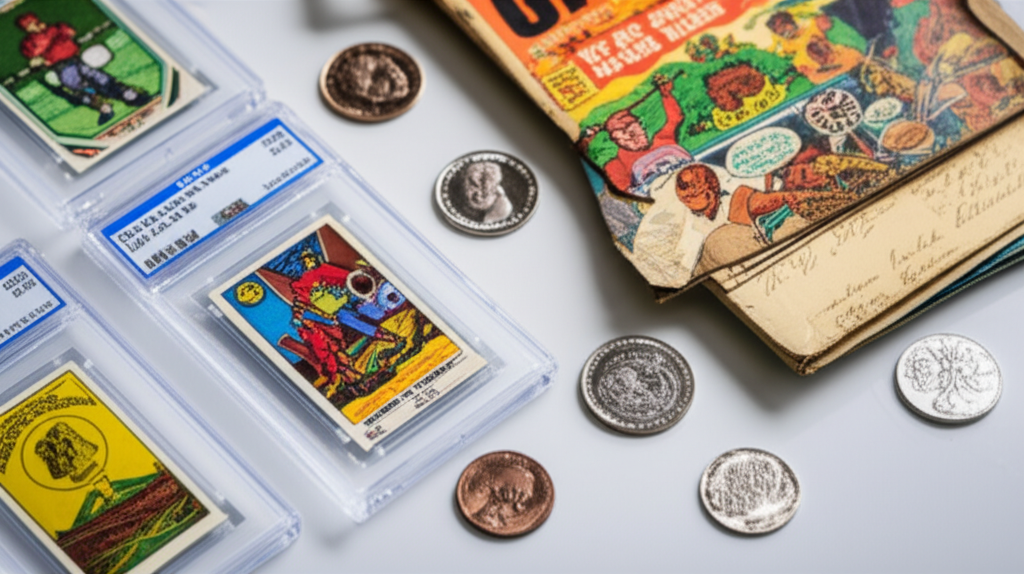
Before there was a United States, there was Delaware. On December 7, 1787, Delaware became the first state to ratify the Constitution — a fact that collectors of early Americana have quietly leveraged for decades, snapping up documents, coins, tokens, and ephemera tied to the nation's most historically underappreciated state. With the U.S. Semiquincentennial arriving in 2026, that market is starting to heat up in ways that should have serious collectors paying attention right now.
The 250th anniversary of American independence is not a soft cultural moment. It is a hard commercial catalyst. Heritage Auctions and Stack's Bowers have both seen sustained upticks in early American material over the past 18 months, with pre-Constitutional and founding-era lots drawing aggressive bidding from a collector base that is simultaneously patriotic and investment-minded. Delaware material, long overshadowed by Virginia and Massachusetts provenance, is emerging as one of the more compelling value plays in the space.
The Deep History Behind the Collectibles
Delaware's story as a collectible territory begins well before 1787. The Lenape people inhabited the Delaware Valley for thousands of years, and authentic Indigenous artifacts from the region — when properly provenanced and legally transferred — carry both cultural weight and serious market value. Trade beads, stone tools, and wampum associated with the Lenape have appeared at regional auction houses, though collectors must navigate a complex legal and ethical landscape governed by the Native American Graves Protection and Repatriation Act.
European contact came via Dutch and Swedish settlers in the early 17th century before English control was established. That layered colonial history produced a remarkable diversity of material culture. Swedish colonial documents, Dutch West India Company trade goods, and early English land grants from the Delaware territory are among the rarest items a pre-Revolutionary collector can chase. A colonial-era Delaware land grant with original wax seal, when it surfaces at auction, reliably clears five figures — and provenance to a known Delaware family pushes that ceiling considerably higher.
The state's role as a commercial and legal hub through the 18th and 19th centuries generated an enormous volume of paper ephemera: banknotes issued by Delaware chartered banks, stock certificates from early corporations incorporated under Delaware law, and political broadsides tied to the state's contentious position during the Civil War era. Delaware never seceded, but it was a slave state — a tension that produced historically significant printed material that surfaces rarely and sells hard when it does.
Coins, Currency, and the Statehood Quarter Premium
For numismatists, Delaware presents two distinct collecting lanes. The first is colonial coinage — pieces that circulated in the Delaware Valley during the 17th and 18th centuries. These include British copper halfpennies, Spanish reales, and the occasional Dutch stuiver, all coins that passed through Wilmington and New Castle in the pre-Federal period. PCGS and NGC population reports for colonial-era coins attributed to Delaware circulation are thin almost by definition; provenance is everything here, and documented Delaware merchant inventories or estate records can transform an ordinary circulated coin into a premium lot.
The second lane is more accessible: the 1999 Delaware Statehood Quarter, the first coin released in the U.S. Mint's enormously popular 50 State Quarters program. In PCGS MS-68, the Delaware quarter has a population of fewer than 50 certified examples — a meaningful scarcity at the top of the registry. Gem examples in MS-67 have traded in the $30–$75 range depending on the holder and the buyer, but MS-68s with strong strikes command premiums well above that. With 2026 anniversary attention likely to drive renewed interest in founding-state symbolism, the registry-grade Delaware quarter is a quietly logical accumulation target.
Early Delaware banknotes deserve a separate mention. The Bank of Delaware, chartered in 1796, issued notes that are genuinely scarce in high grades. PMG-graded examples in the 58–64 range have cleared $800–$2,500 at Stack's Bowers depending on denomination and visual appeal. Uncut sheets, when they appear, can push well past that.
What the Semiquincentennial Actually Means for the Market
Anniversary cycles are real market drivers. The U.S. Bicentennial in 1976 produced a measurable spike in early Americana prices that took several years to normalize. The Centennial in 1876 generated its own commemorative collecting culture, some of which — Centennial Exposition ribbons, medals, and ephemera — now trades at strong premiums in its own right.
The 2026 Semiquincentennial is arriving into a collector market that is simultaneously more sophisticated and more liquid than anything that existed in 1976. Online auction infrastructure, third-party grading, and a generation of investors who treat collectibles as an asset class mean that anniversary-driven demand will be faster, sharper, and more globally distributed than prior cycles.
Delaware, as the First State, occupies a symbolic position in that narrative that no other state can claim. The collector who builds a serious Delaware Americana collection in 2024 and 2025 — documents, coins, currency, Indigenous material with clean provenance — is positioning ahead of a wave that, historically speaking, always comes.
The First State got there first once. The collectors who recognize that now may find themselves in a familiar position come 2026.