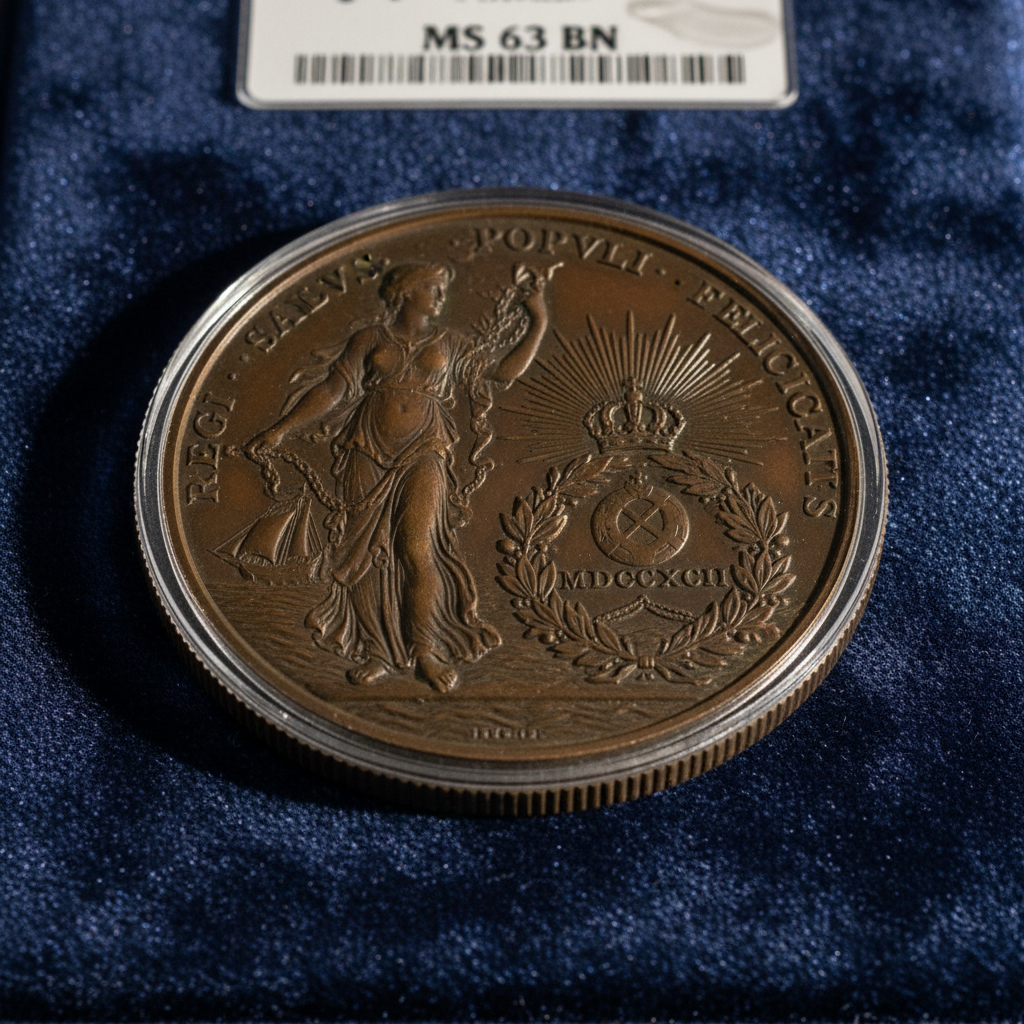
Before Britain abolished the slave trade. Before the United States. Before any nation on earth had codified the end of transatlantic slavery into law, Denmark did it first — and struck a medal to prove it. That bronze disc, produced in Copenhagen in 1792, is one of the most historically loaded numismatic objects in existence, and it remains scandalously underappreciated in the Western collector market.
The medal commemorates a royal decree issued under King Christian VII, which made Denmark the first sovereign nation to formally ban the transatlantic slave trade. The decree passed in 1792, with enforcement set to begin in 1792 and full prohibition phased in by 1803 — a timeline that gave Danish colonial interests in the Caribbean time to wind down operations, but nonetheless established a legal precedent that the rest of the world would spend decades catching up to. Britain's landmark Slave Trade Act didn't arrive until 1807. The United States followed suit the same year. Denmark beat them both by over a decade.
What You're Actually Holding
The medal itself is a struck bronze piece, produced in Copenhagen with the craft standards you'd expect from a Danish royal commission of the era. The obverse carries a portrait of Christian VII, rendered with the formal regality of late 18th-century European medallic art. The reverse commemorates the abolition decree directly — making this not a general royal portrait piece, but a purpose-struck historical document in metal.
That distinction matters enormously to serious collectors. Commemorative medals tied to specific legislative or historical events occupy a different tier than standard portrait issues. They are primary sources. A historian can cite this object. That's rare.
In terms of condition survivorship, Danish bronze medals from this period face the same attrition as any 230-year-old copper-alloy piece: environmental oxidation, cleaning damage, and the simple entropy of centuries. Surviving examples in problem-free, original-surface condition are genuinely scarce. NGC and PCGS have both handled Danish colonial-era medals, though population data on this specific issue remains thin — itself a signal that the market hasn't fully woken up to what's sitting in European estate collections and museum deaccessions.
For context, comparable 18th-century European commemorative medals with direct legislative provenance — think British abolition pieces from the Wedgwood tradition, or French Revolutionary medallic issues — have traded at auction in ranges from $2,000 to upward of $25,000 depending on grade, provenance, and the auction house handling the sale. Heritage Auctions and Stack's Bowers both have deep catalogs in world medals, and either would be the natural venue for a high-grade example of this Danish piece.
The Market Case for Danish Numismatic History
Here's the editorial reality: Scandinavian numismatics is chronically undervalued relative to British, French, and American material of comparable historical weight. The collector base is smaller, the auction presence in North America is thinner, and the historical narrative — while objectively significant — hasn't been packaged and marketed the way, say, British Empire coins have been for generations.
That's a buying opportunity, not a criticism.
The abolition medal sits at the intersection of three collector categories that are all experiencing genuine demand growth: world coins and medals, slavery and civil rights-related historical artifacts, and 18th-century European commemoratives. Museum acquisition interest in objects tied to the history of slavery and abolition has increased sharply over the past decade, which creates an institutional floor under prices that didn't exist twenty years ago.
Provenance documentation amplifies value dramatically here. A medal that can be traced to a specific Danish colonial official, a Copenhagen institution, or a documented 19th-century collection isn't just worth more — it's a fundamentally different object. Collectors pursuing this material should treat provenance research as part of the acquisition process, not an afterthought.
The 1792 Danish Abolition Medal isn't a footnote. It's the opening line of one of history's most consequential legal stories, struck in metal at the moment it happened. The market just hasn't priced it that way yet.