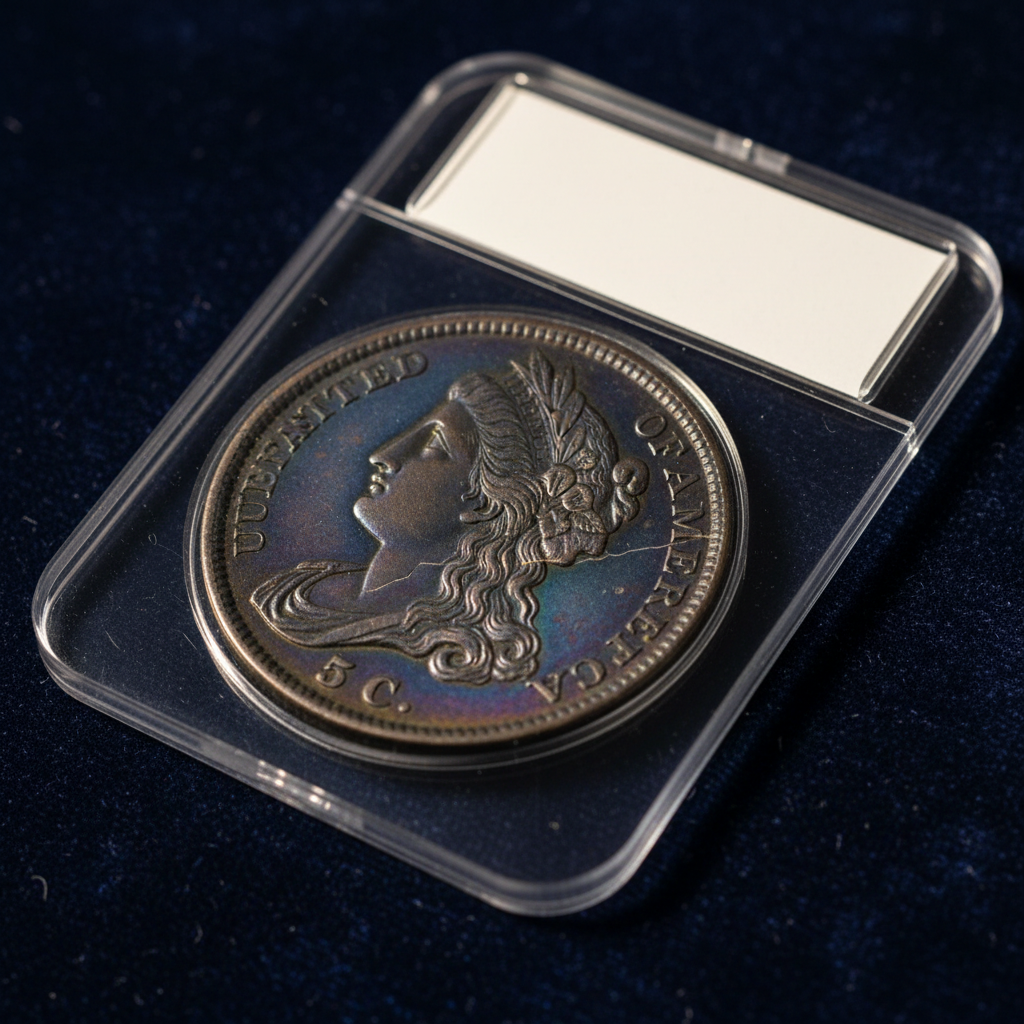
Five years. Six date varieties. Mintage figures so low they'd embarrass a modern proof set. The Draped Bust Heraldic Eagle half dime — struck at the Philadelphia Mint between 1800 and 1805 — is one of early American coinage's most underappreciated series, and for collectors willing to do the homework, it remains a market where knowledge still beats capital.
The denomination itself had gone dark for two years before 1800. When the Mint revived it, chief engraver Robert Scot kept the Draped Bust obverse he'd already deployed on larger silver — the same flowing-hair Liberty portrait familiar from the dollar and half dollar — but paired it with a dramatically redesigned reverse. Out went the small eagle. In came the Heraldic Eagle: shield-breasted, arrows in one talon, olive branch in the other, a constellation of stars overhead. It was federal symbolism rendered in miniature, on a coin barely larger than a modern shirt button.
A Short Run With Long Complexity
The series ran just six years and produced total combined mintage that wouldn't fill a shoebox. The 1802 is the crown jewel — with only a few thousand struck and survivors in any grade numbering in the dozens, it is one of the most coveted early American coins in existence. A circulated 1802 half dime in VF-20 has traded above $100,000 at major auction. Gem examples are effectively museum pieces.
But the 1802 tends to overshadow the rest of the series, which is a mistake. The 1800, 1801, 1803, and 1805 dates each carry their own variety complexity — die marriages catalogued by researchers like Valentine in the early 20th century and refined since. Collectors working the series by die variety rather than just date will find genuine rarity lurking in issues that look, at first glance, like the more affordable entries. A seemingly routine 1800 in a specific die pairing can carry a significant premium over its generic counterpart.
The 1804 presents a different puzzle: it doesn't exist. No half dimes were struck dated 1804, a gap that mirrors the famous dollar non-issue of the same year and reflects the Mint's production priorities during that period. Completionists building date sets stop at five coins. Variety collectors have considerably more to chase.
What the Grade Population Actually Tells You
PCGS and NGC combined have certified relatively few survivors across the entire series in Mint State — we're talking populations where a single MS-64 example represents a meaningful fraction of all known specimens at that grade level. For context, the 1800 half dime in MS-63 or better is a genuinely rare coin; PCGS has graded fewer than ten examples in that range across all die varieties. The 1803 is similarly thin at the top.
This scarcity has a direct market consequence: when a high-grade example surfaces, it doesn't just attract type collectors. It draws specialist bidders, registry set builders, and institutional buyers simultaneously. That convergence tends to produce aggressive hammer prices. Heritage Auctions and Stack's Bowers have both seen strong results for this series in recent years, particularly for problem-free, original-surface examples — the market punishes cleaning and improper conservation harshly on early American silver.
Circulated coins in the VF-20 to EF-45 range represent the realistic entry point for most collectors. A problem-free 1800 or 1801 in EF-40 can be acquired for $2,000–$5,000 depending on variety and eye appeal. The 1803 runs slightly higher. That's real money, but it's a fraction of what comparable early American silver in larger denominations commands — the half dime's size has historically suppressed demand relative to its actual rarity, and that disconnect is an opportunity.
Design, Condition, and the Eye Appeal Premium
On a coin this small — 16.5mm in diameter, 1.35 grams — strike quality varies considerably, and weakness in the eagle's breast or the stars flanking Liberty is common. Full, sharp strikes command a premium that doesn't always show up in the technical grade. A coin grading EF-45 with exceptional strike and original skin can be more desirable — and more valuable — than a technically higher-graded example that's been lightly cleaned or shows strike weakness on the eagle's shield.
This is the kind of nuance that separates specialist collectors from casual buyers, and it's where the Draped Bust half dime rewards deep engagement. The series is small enough to master, rare enough to matter, and still priced at levels where a knowledgeable collector can build a meaningful set without institutional resources.
Early American coinage doesn't get more compact — in size or in available supply. The Heraldic Eagle half dime is five years of federal history pressed into silver the size of a fingernail, and the market hasn't fully caught up to what that means.