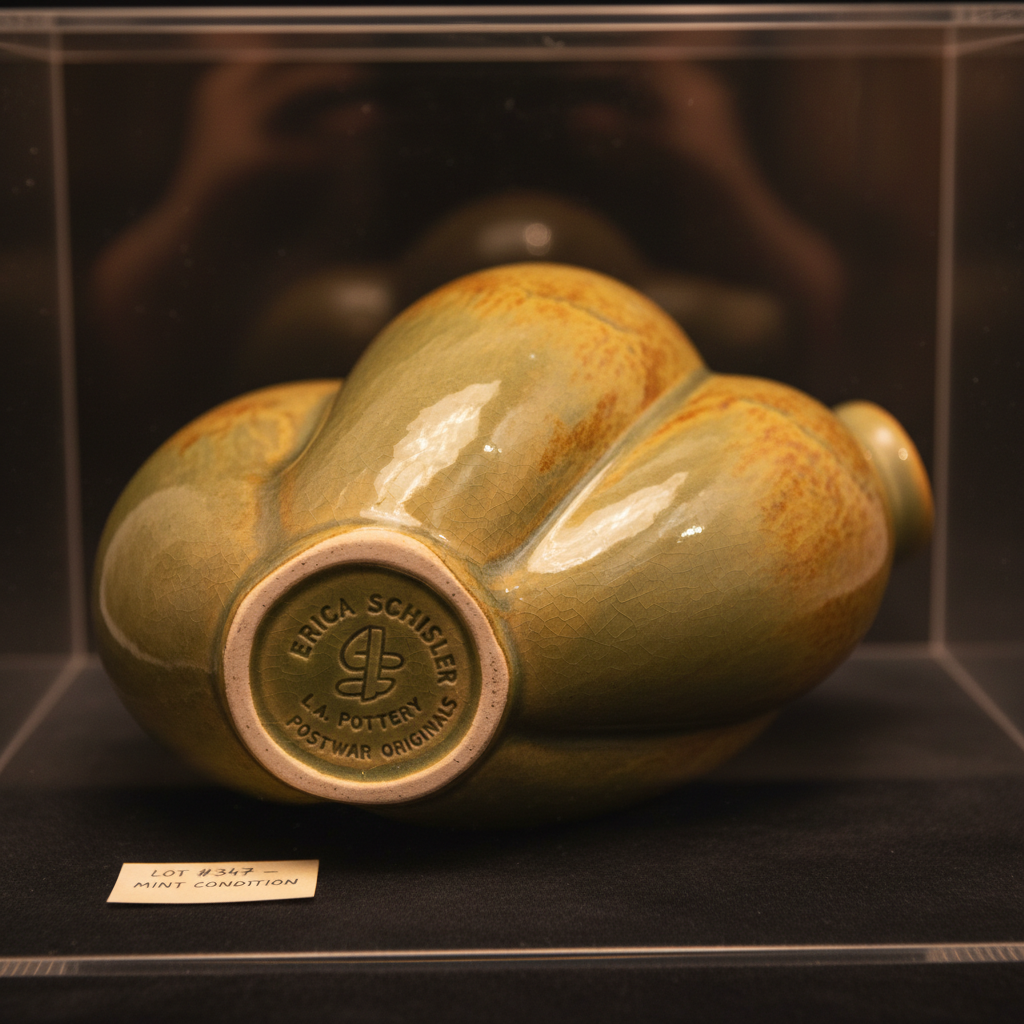
Postwar American ceramics have long occupied an undervalued corner of the collectibles market — and Erica K. Schisler's new visual documentary on Los Angeles potteries may be exactly the kind of authoritative reference that changes that.
Published through Antique Trader, Schisler's work chronicles the evolution of California's most consequential serveware producers through high-quality photography and firsthand historical accounts. The result is less a coffee-table curiosity and more a collector's field guide — the sort of primary resource that dealers dog-ear and auction specialists cite when establishing provenance and pricing context.
Why California Ceramics Deserve a Second Look
The Los Angeles pottery scene didn't emerge in a vacuum. The postwar economic boom, California's proximity to Pacific trade routes, and a regional design culture that blended modernist sensibility with mass-market ambition created a genuinely distinct aesthetic tradition. Studios like Metlox Potteries, Vernon Kilns, and Bauer Pottery produced work that sold in department stores from Bullock's to Sears — pieces that were utilitarian by design but are now legitimately collectible by any serious measure.
Bauer's ring dinnerware, for example, regularly clears $200–$600 per piece at regional auction houses and specialist dealers depending on color rarity and condition. Intact sets in desirable colorways — jade green, delph blue, orange-red — can command $3,000 to $8,000 at the upper end of the market. Metlox's Poppytrail line has seen sustained dealer interest, with complete cookie jar sets in excellent condition trading in the $400–$1,200 range depending on pattern scarcity.
These aren't fringe prices. They reflect a category that has matured quietly while the broader antiques market fixated on mid-century furniture and studio art glass.
What Schisler's Documentation Adds to the Record
The value of a reference work like this one isn't just academic. In a category where condition grading remains informal and documentation is scattered across estate sales and regional society archives, a well-photographed, rigorously sourced visual record becomes a pricing anchor. Dealers use books like this to justify estimates. Buyers use them to challenge inflated asks. The market, in short, gets more efficient.
Schisler's use of firsthand accounts is particularly significant. Much of what's known about mid-century California potteries exists in the memories of former employees, family members of founders, and longtime regional collectors — a knowledge base that is, bluntly, aging out. Capturing that oral history in print before it dissipates entirely is the kind of archival work that tends to be underappreciated until it's too late.
The photography matters too. Glaze variation, mold seam placement, backstamp evolution — these are the details that separate a $40 thrift store find from a $400 authenticated example. Visual documentation at this level gives collectors a comparative baseline that auction listings and eBay photos simply cannot replicate.
The Broader Market Moment
California ceramics are benefiting from a broader shift in collector demographics. Younger buyers who grew up with mid-century modern interiors — partly through the mainstreaming of design culture via platforms like Pinterest and later Instagram — have developed genuine appetite for functional art objects with regional identity. A Bauer ring plate isn't just a plate; it's a legible artifact of a specific time and place.
That narrative appeal is increasingly bankable. Heritage Auctions has expanded its decorative arts categories in recent years, and California ceramics have appeared with greater frequency in specialist sales. Prices at the top of the market have held firm even as broader antiques categories softened post-2021.
A reference work arriving at this particular moment — when collector interest is rising but documentation remains thin — has the potential to do real market work. It establishes a vocabulary, anchors valuations, and gives serious buyers the confidence to move beyond casual acquisition into deliberate collection-building.
For a category this visually rich and historically underexamined, Schisler's timing looks less like coincidence and more like good editorial instinct.