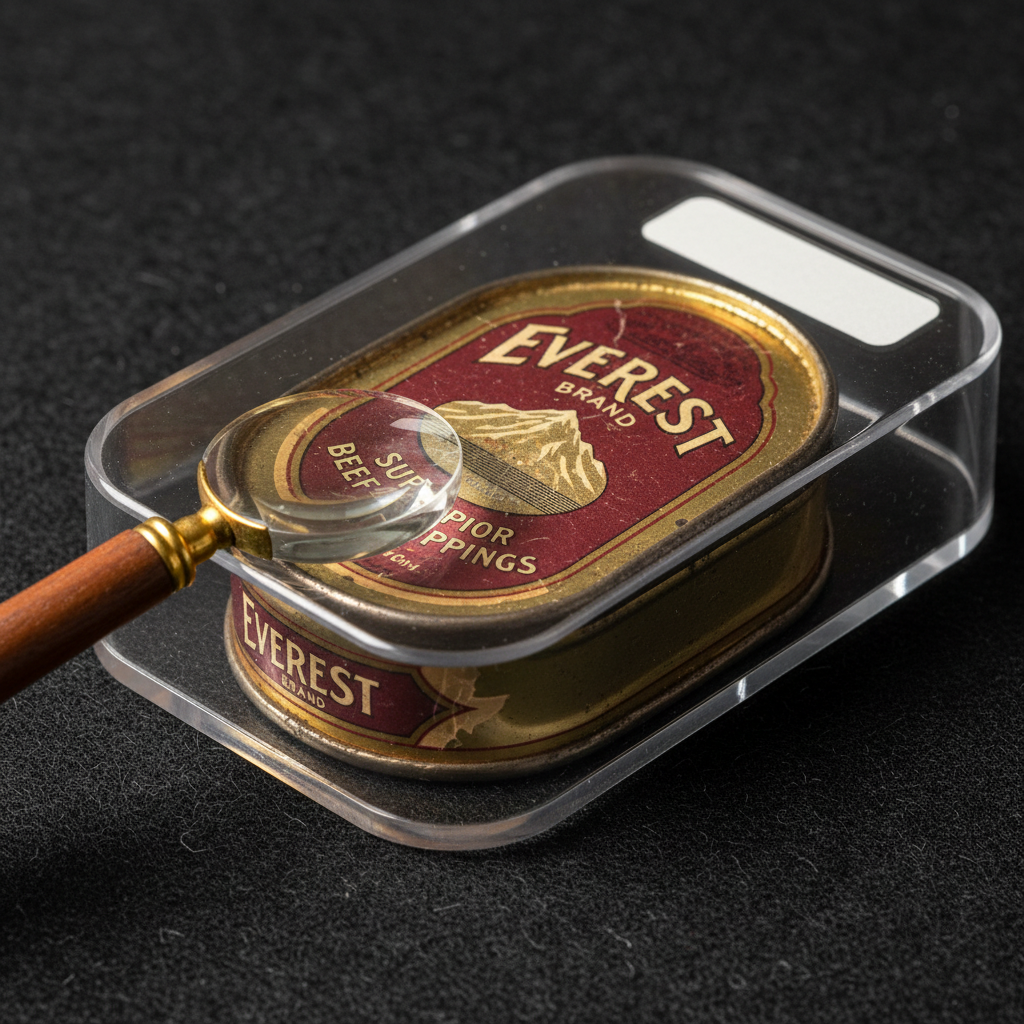
A dented, decades-old tin of beef drippings just outperformed nearly everything else in the room — because it once sat at the base of Mount Everest.
The lot, which crossed the block at a recent auction, was a relic from an early Everest expedition: a mundane provisions tin that survived the mountain's brutal conditions and made it back down with the kind of provenance that turns grocery staples into collectibles. The auction house had modest expectations. The hammer price told a different story.
What pushed the bidding wasn't the tin itself — it was the story attached to it. And the buyer, reportedly a fellow Everest climber, clearly understood that story better than anyone else in the room.
When Provenance Does All the Heavy Lifting
In the broader collectibles market, provenance is everything — and nowhere is that more true than in expedition memorabilia. A standard-issue mountaineering artifact with no documented history might fetch a few hundred dollars at a specialist sale. Attach it to Everest, one of the most mythologized physical challenges in human history, and the calculus changes entirely.
The beef drippings tin sits in a category that serious collectors and institutions have quietly tracked for years: summit and expedition ephemera. These are objects that were never meant to be collected. They were tools, rations, gear. Their value derives entirely from where they went and who carried them — the opposite of a manufactured collectible.
That scarcity is structural, not artificial. There is a hard ceiling on how many objects can claim genuine Everest provenance from the mountain's early ascent era. The 1953 British expedition that put Edmund Hillary and Tenzing Norgay on the summit for the first time remains the most coveted reference point, but artifacts from any pre-1970s attempt carry serious weight with the right buyer.
The buyer here wasn't a generalist antiques collector. A fellow Everest climber acquiring this piece is the collecting equivalent of a Hall of Fame pitcher buying a game-used ball from a perfect game — the emotional and experiential resonance is layered in a way no casual bidder can fully replicate. That personal connection almost always pushes a final price beyond what comparables would suggest.
The Sleeper Lot Problem — and Opportunity
Auction houses routinely underestimate expedition memorabilia. It's a niche with a small but intensely motivated buyer pool, and standard valuation frameworks — condition, maker, age — don't map cleanly onto objects whose entire value proposition is narrative. A tin of beef drippings in pristine condition with no story is worthless. A battered, oxidized tin that sat in a supply cache above 17,000 feet is a different object entirely.
This dynamic creates genuine opportunity for collectors who do the research. Expedition lots frequently appear in general antiques sales rather than specialist auctions, often with thin catalog descriptions and estimates that reflect the object's face value rather than its contextual value. A buyer who identifies the provenance before the auction house does — or before competing bidders arrive — can find significant arbitrage.
The flip side is that authentication matters enormously. Unlike a graded PSA 10 card or an NGC MS-70 coin, expedition artifacts don't have a standardized third-party verification system. Provenance chains — letters, photographs, expedition logs, family documentation — carry the full burden of proof. A tin without paper is just a tin.
For this particular lot, the provenance was apparently compelling enough to drive real competition. The fact that the winning bidder was themselves an Everest climber adds a layer of legitimacy to the result — this wasn't a speculative flip. It was a collector who understood exactly what they were buying and valued it accordingly.
What the Market Is Telling Us
Expedition and exploration memorabilia has been on a slow, steady climb for over a decade. Bonhams and Christie's have both staged dedicated polar and mountaineering sales that have drawn serious institutional and private interest. A 1924 Mallory and Irvine expedition oxygen canister sold for well into five figures at a specialist sale several years ago. Handwritten summit logs, original expedition photographs, and personal effects from pioneering climbers have all set records that would have seemed implausible twenty years ago.
The beef drippings tin fits neatly into this arc. It's not a headline-grabbing result — we don't have a confirmed hammer price to anchor the story — but the pattern it represents is consistent: objects with authentic, documented connections to landmark human achievements are finding buyers willing to pay serious premiums, even when the object itself is about as unglamorous as it gets.
A can of fat that went to Everest. Sold. To another climber who knew exactly what it meant.
That's the collecting instinct in its purest form.