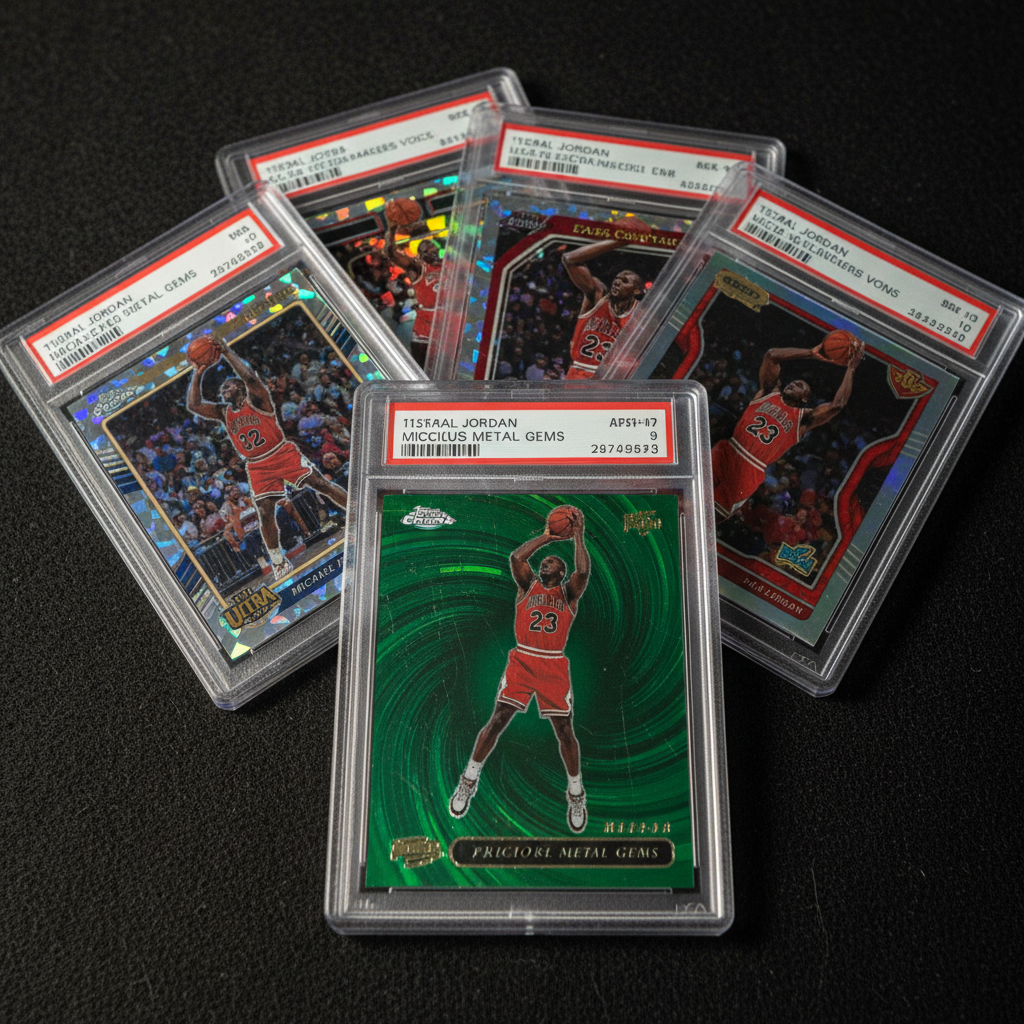
Budget collecting and Michael Jordan don't often appear in the same sentence. A PSA 10 of his 1986 Fleer rookie regularly trades north of $7,000, and his high-end autograph pieces have crossed $100,000 at Heritage and Goldin. But the insert market — particularly from the mid-1990s through the early 2000s — still has pockets of legitimate Jordan cardboard sitting under $50, and some of it is genuinely worth your attention.
This isn't a consolation prize segment. Insert cards from that era represented real innovation in the hobby. Die-cuts, refractors, holo-foil technology — manufacturers were competing aggressively, and Jordan landed in nearly all of it. The result is a sprawling secondary market where name recognition drives prices on some cards while nearly identical pieces from the same sets go overlooked.
Where the Value Hides
The sweet spot for sub-$50 Jordan inserts tends to cluster in a few specific product lines. Fleer's mid-90s insert programs — think Flair Showcase, Ultra, and Metal Universe — produced visually striking cards that graded collectors often ignore because raw copies flood the market. That supply pressure keeps prices accessible even when the aesthetic quality is genuinely high.
Upper Deck's Collector's Choice and SP lines from 1994 through 1997 are another hunting ground. Jordan's inserts from those sets routinely surface at $15–$40 in raw condition, and even PSA 8s on some of the lower-pop parallels stay under the threshold. The 1995-96 SP Championship Series die-cuts, for instance, are undervalued relative to their visual appeal and the difficulty of finding clean corners on the die-cut edges.
Topps Stadium Club entries from the same window are worth a look too. The Beam Team and Finest inserts from 1993–1996 have devoted followings, but the broader Stadium Club insert checklist has enough depth that non-Finest pieces still trade affordably. A raw 1993-94 Stadium Club Beam Team Jordan can be had for under $30 if you're patient on the secondary market.
Grading Math on a Budget
Here's the honest calculus: at this price point, submitting most of these cards to PSA or BGS doesn't pencil out unless you're sitting on a near-perfect copy. PSA's standard service tier runs $25–$50 per card depending on the current queue, which means a card you bought for $35 raw needs to grade at least an 8 — and ideally a 9 — to justify the submission cost and the wait time.
That math changes if you find a high-grade candidate at a card show or in a lot purchase. A PSA 9 on a mid-tier Jordan insert from 1995 can trade at 2x–4x the raw price depending on the specific card and population. Some of these sets have surprisingly thin PSA populations at the 9 level because collectors historically dismissed them as filler — which means there's real upside for anyone willing to do the grading legwork.
Raw collecting at this tier is also just fine. Not every card needs a slab. The hobby spent decades without them, and a visually clean Jordan insert in a quality sleeve and top-loader holds its appeal regardless of what PSA thinks about the centering.
The Longer Case for Affordable Jordan
The broader Jordan market has compressed at the top over the past two years. Post-pandemic auction records set in 2020 and 2021 haven't been consistently replicated, and some of the premium parallel and auto market has softened. That doesn't mean Jordan is cooling as a long-term collectible — his cultural footprint is arguably more durable than any other athlete in the hobby — but it does mean the frothy speculation that briefly made even mediocre Jordan cards expensive has largely receded.
What's left is a cleaner market. The $50-and-under insert tier is populated by collectors who actually want the cards, not flippers chasing a quick return. That's a healthier environment to buy into, and it means the cards you acquire at these prices are less likely to be overvalued relative to genuine collector demand.
For anyone building a Jordan collection on a real-world budget, the insert market from his Chicago Bulls era is the most logical starting point. The cards exist in volume, the price ceiling is defined, and the visual quality — especially from the mid-90s foil and die-cut programs — holds up better than most collectors give it credit for. You're not settling. You're just being smart about where you enter.