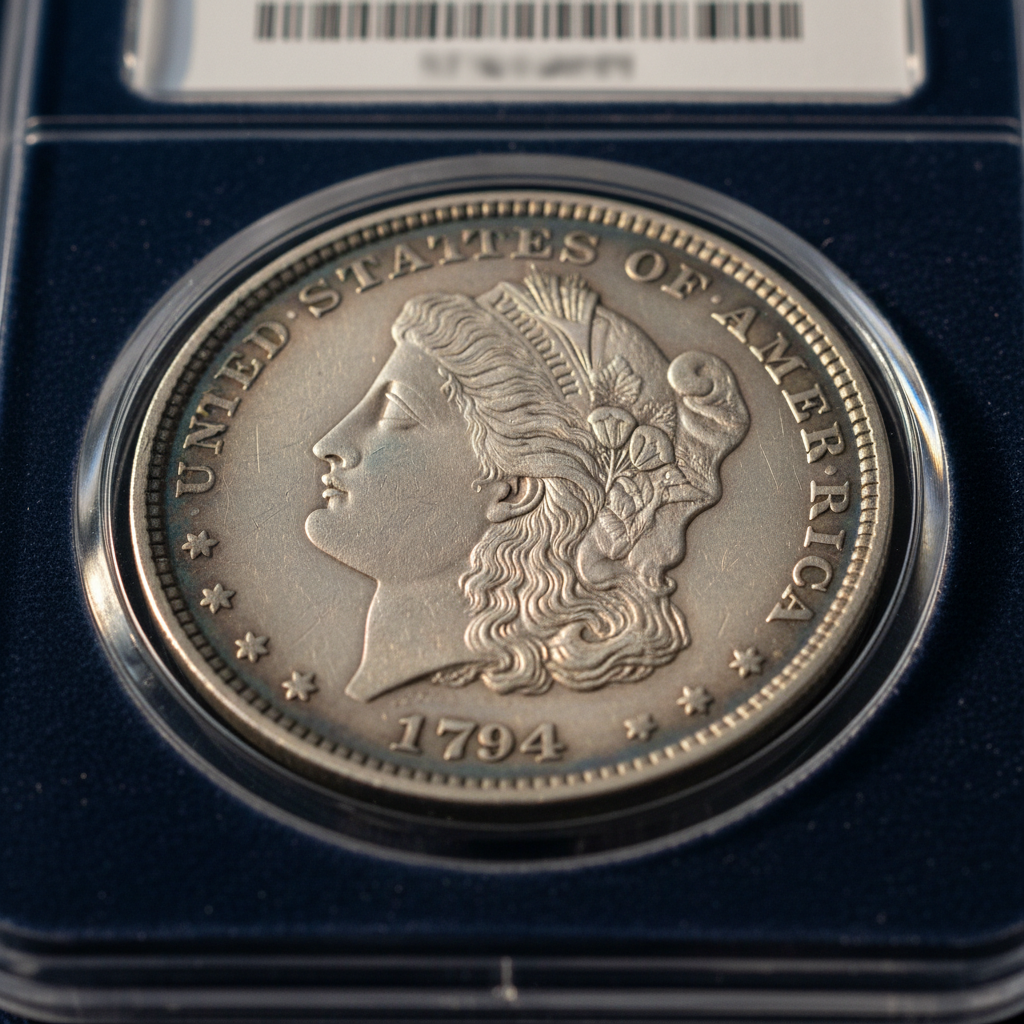
Before there was a Federal Reserve, before there was a gold standard, before there was even a functioning national economy, there was a single silver coin struck in Philadelphia in 1794 that declared — in metal — that the United States of America was a real country with real money. The Flowing Hair Dollar is not merely the first American silver dollar. It is arguably the most historically significant coin ever produced on U.S. soil.
The legal foundation came fast. The Mint Act of April 2, 1792, authorized the newly established United States Mint to produce a full range of coinage — copper half cents and cents, silver coins from the half dime through the dollar, and gold denominations above that. Within two years, the Mint delivered on the dollar. What followed was a coin that collectors have been fighting over ever since.
The Making of a National Symbol
The Flowing Hair Dollar was struck across two years: 1794 and 1795. The 1794 issue is the rarer and more coveted of the two, with a mintage estimated at just 1,758 coins — and survival rates that make that number feel generous. The design, attributed to engraver Robert Scot, features Liberty with her hair flowing freely on the obverse and an eagle surrounded by a wreath on the reverse. It was a distinctly young nation's attempt to project classical authority onto brand-new metal.
The 1795 issue saw substantially higher production, but both dates remain genuinely scarce in any grade. Most surviving examples show heavy circulation wear — these coins actually circulated, used in commerce in a country that desperately needed a functioning monetary system. Finding one in VF or better is an event. Finding one in AU is a career moment for most collectors.
The series was short-lived. The Flowing Hair design was replaced in 1795 by the Draped Bust Dollar, making the entire Flowing Hair dollar series a two-year window into the earliest days of American coinage. That brevity only amplifies the demand.
What the Market Says
The auction record for a Flowing Hair Dollar is not a footnote — it is a headline. In January 2013, a 1794 Flowing Hair Dollar graded SP-66 by PCGS sold through Stack's Bowers for $10,016,875, setting the record at the time for the most expensive coin ever sold at auction. The coin, known as the finest known specimen, was later acquired by collector Bruce Morelan and subsequently resold. Its provenance alone reads like a chapter of American numismatic history.
That stratospheric result belongs to a different universe than most collectors will ever access. But the broader market for Flowing Hair Dollars in circulated grades remains active and, by historical standards, surprisingly attainable for what you're getting. A problem-free example in VG-10 can change hands in the $15,000–$25,000 range depending on eye appeal and surface quality. A Fine-15 with original surfaces and no cleaning history can push $35,000 to $50,000 at major auction. These are not bargain-bin coins, but for the first dollar ever struck by the United States Mint, the entry point is arguably reasonable.
Cleaned and improperly cleaned examples — the bane of early American coinage — trade at steep discounts. PCGS and NGC both assign details grades to cleaned coins, and the market responds accordingly. A details-graded Flowing Hair Dollar might fetch 40–60% of what a problem-free example commands in the same numeric grade. The premium for originality in this series is real and persistent.
Grading, Population, and the Collector Reality
PCGS and NGC combined have graded only a few hundred Flowing Hair Dollars across all dates and varieties. The population of problem-free, straight-graded examples in EF-40 and above is genuinely small — we are talking about coins where individual pedigrees matter, where auction appearances get tracked, and where the same coin surfacing twice in a decade is considered notable.
For variety collectors, the series offers additional depth. The 1795 date in particular has several recognized die varieties, documented in the Bolender reference and tracked by specialists. Some varieties are considerably rarer than others, and attribution can meaningfully affect value. This is a series where doing your homework pays off — not just intellectually, but financially.
The Flowing Hair Dollar sits at the intersection of American history and numismatic rarity in a way that almost nothing else does. You can own a piece of the first year the United States Mint produced a silver dollar. That is not a marketing line. That is just what the coin is.
For a nation that spent its first decade arguing about whether it would survive, the Flowing Hair Dollar turned out to be one of the more durable things it produced.