Ryan Cohen may have already undermined GameStop's most ambitious pivot yet — and he didn't need to say a word to do it.
Reports surfaced this week that GameStop ($GME) has been exploring a bid for eBay, the dominant peer-to-peer marketplace that processed roughly $73.2 billion in gross merchandise volume in 2023. For collectors and dealers who rely on eBay's infrastructure daily — to sell raw cards, move graded slabs, flip vintage coins, and liquidate estate finds — the news landed somewhere between intriguing and deeply unsettling.
The problem isn't the idea itself. The problem is the messenger.
Cohen's Track Record Cuts Both Ways
Cohen built his reputation on Chewy, a pet supplies e-commerce company he sold to PetSmart for $3.35 billion in 2017. He understands online retail. That credential is real. But his stewardship of GameStop since taking the chairman role in 2021 has been defined more by meme-stock theatrics and strategic ambiguity than by operational execution. The company has shed revenue for three consecutive fiscal years, closed hundreds of retail locations, and has yet to articulate a coherent digital future — despite sitting on a cash pile north of $4 billion accumulated during the 2021 short squeeze frenzy.
Collectors have short memories when prices are rising and long ones when platforms fail them. The eBay they know — flawed, fee-heavy, occasionally maddening — still moves more collectibles volume than any other single marketplace on earth. Heritage Auctions, Goldin, and PWCC combined don't come close to eBay's raw transaction count in the trading card category alone.
The collector community's anxiety isn't paranoia. It's pattern recognition.
What a GME-Owned eBay Actually Looks Like
Assume for a moment the bid gains traction. eBay's current market cap hovers around $32 billion. GameStop's cash reserves, while substantial for a brick-and-mortar retailer in structural decline, fall well short of financing an acquisition at that scale without significant leverage or dilution. Any deal would almost certainly require debt financing, equity issuance, or both — neither of which inspires confidence in a company whose stock trades largely on sentiment rather than fundamentals.
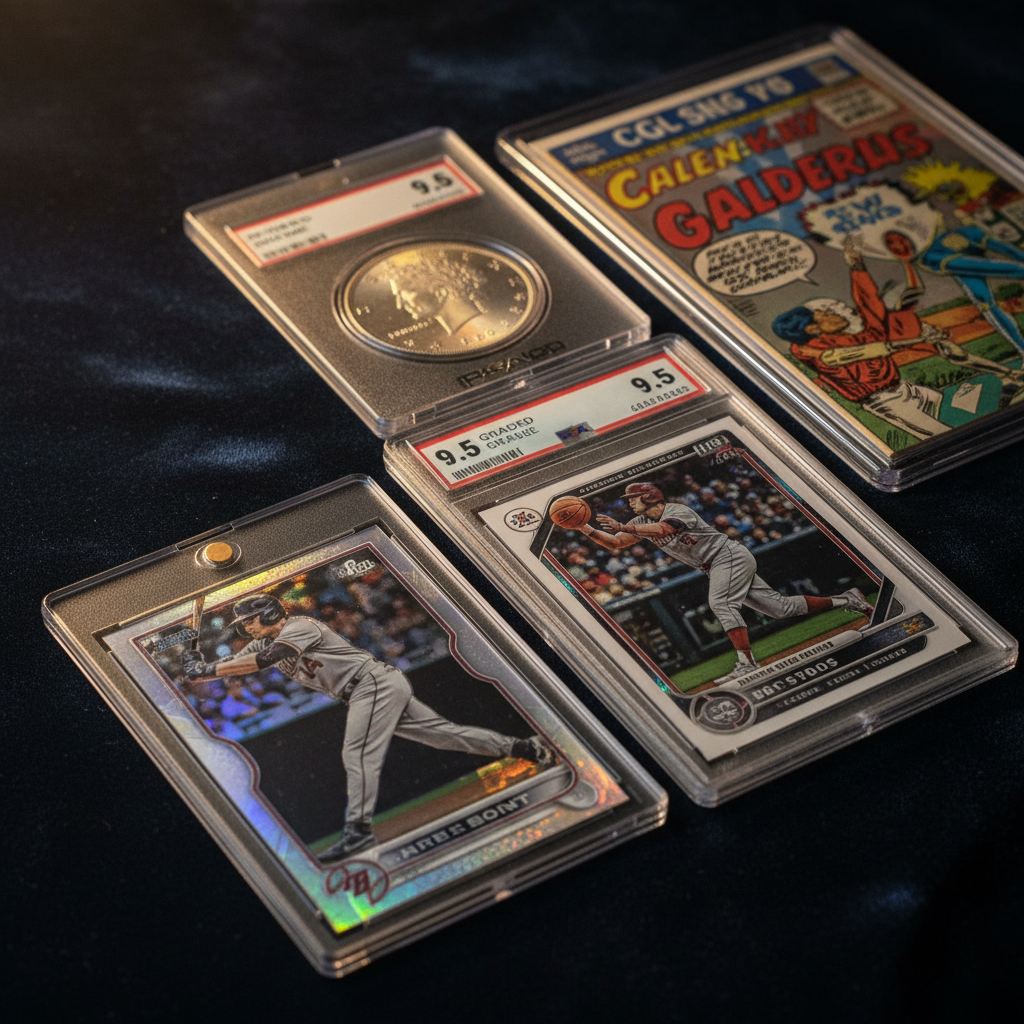
Then there's the operational question. eBay's collectibles ecosystem is a sprawling, self-regulating organism. It includes raw sellers, PSA and BGS submitters, vintage coin dealers navigating PCGS and NGC population reports, comic book flippers cross-referencing CGC census data, and antique dealers who've built entire businesses on eBay's search visibility. Managing that ecosystem requires platform expertise, seller trust, and years of category-specific institutional knowledge. GameStop has none of those things in the e-commerce context.
A Cohen-led eBay could theoretically lean into collectibles as a core identity — doubling down on authentication, integrating grading partnerships, building out a more curated marketplace experience. The vision isn't impossible to sketch out. But vision and execution are different currencies, and Cohen has spent more of the former than the latter at GameStop.
The Seller Calculus Right Now
For active dealers, the immediate question is practical: do you adjust your selling strategy based on rumors of a potential ownership change at a platform that may or may not be acquired by a company that may or may not have the capital to close the deal?
Probably not yet. But the conversation has started, and that matters.
eBay's seller fees — currently sitting at 13.25% for most trading card sales after the category-specific fee structure was introduced — are already a friction point. Any hint of further monetization under new, debt-burdened ownership would accelerate the migration of serious dealers toward alternatives like MySlabs, direct auction consignment, or even Instagram and Facebook group sales for high-value transactions.
The collectibles market has spent the last four years building infrastructure — better grading turnaround times, more transparent population data, live auction platforms — that reduces its dependence on any single marketplace. A destabilized eBay doesn't kill the hobby. It reshuffles it. And reshuffling always creates winners and losers.
Cohen has a habit of making moves that generate more noise than signal. This one might be different. Or it might be exactly what it looks like: a billionaire with a war chest, a struggling retail brand, and an eye for headlines. The collectibles world will be watching which version shows up.