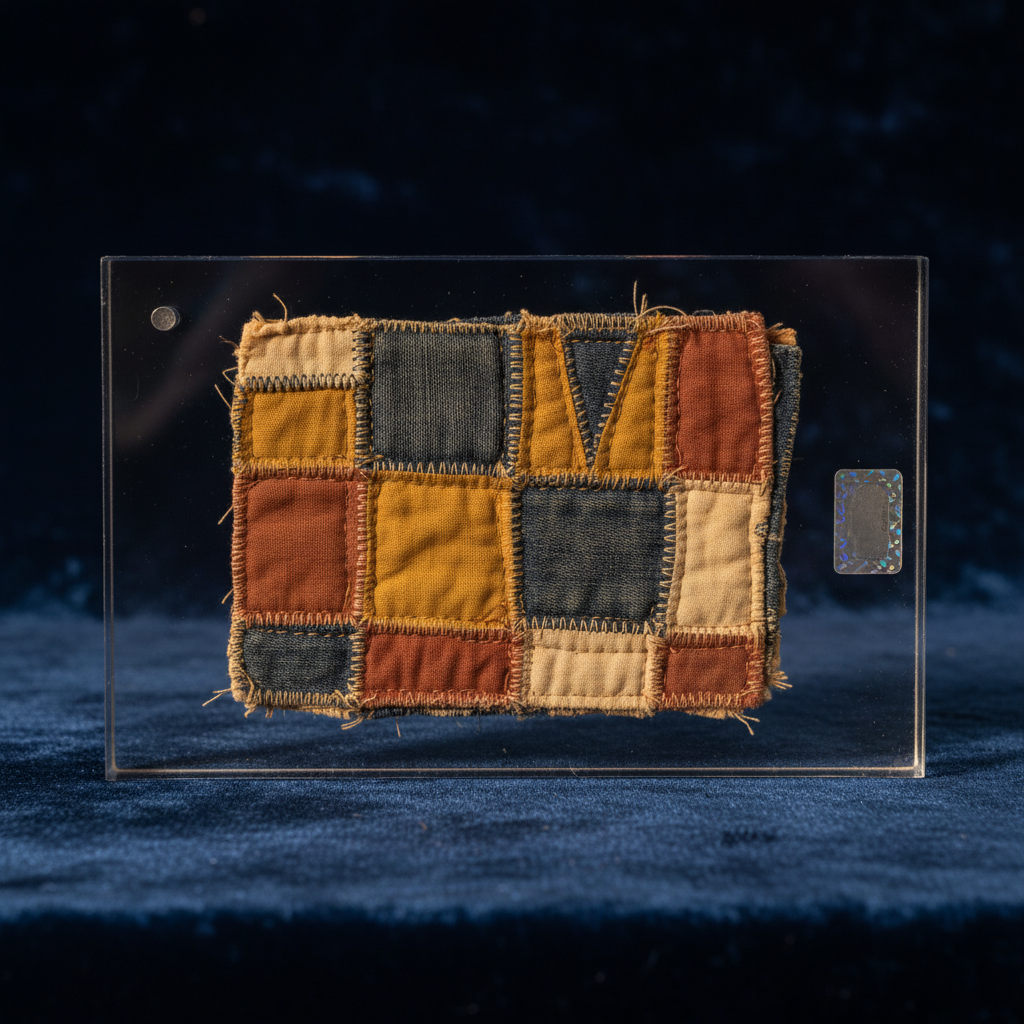
Some of the most consequential American textiles ever made are getting a rare outdoor airing. The Gee's Bend Yard Show has brought the celebrated quilts of Gee's Bend, Alabama into an open-air exhibition format — a presentation choice that feels less like curatorial novelty and more like a deliberate act of cultural reclamation.
For collectors and dealers who track the American folk art market, this matters. Gee's Bend quilts have spent the last two decades migrating from rural Alabama church halls to the walls of the Whitney Museum of American Art, from estate sales to six-figure auction results. Their trajectory is one of the most dramatic reappraisals in American decorative arts history.
From Isolation to Institution
Gee's Bend — a remote community on a bend of the Alabama River, populated largely by descendants of enslaved people from the Pettway plantation — produced quilts for generations with almost no outside audience. The women who made them worked in a tradition that was simultaneously improvisational and rigorous, producing geometric compositions that drew inevitable comparisons to abstract expressionism and minimalist painting when the broader art world finally took notice in the early 2000s.
That notice arrived with force. A 2002 traveling exhibition organized by the Museum of Fine Arts, Houston introduced Gee's Bend quilts to major institutional audiences across the country. The critical reception was not polite appreciation — it was genuine reassessment. Scholars and collectors began treating these works not as craft curiosities but as major contributions to 20th-century American visual culture.
The market followed. Quilts that might have changed hands for a few hundred dollars in regional antique shops began appearing at major auction houses. Strong examples from recognized makers — particularly members of the Pettway, Bendolph, and Young families — have commanded prices well into the tens of thousands of dollars, with exceptional pieces pushing higher. The Souls Grown Deep Foundation, which has been instrumental in documenting and placing Gee's Bend works in museum collections, has helped establish provenance standards that give serious buyers confidence in attribution.
Why the Yard Show Format Carries Weight
The yard show tradition has deep roots in African American Southern folk culture. Displaying objects — bottles, sculptures, found materials, textiles — in outdoor domestic spaces is a practice with spiritual and aesthetic dimensions that predate any gallery context. Presenting Gee's Bend quilts in this format is not a step down from institutional display. It is, arguably, a step toward authenticity.
For collectors, the exhibition raises a question worth sitting with: how much of a quilt's value is embedded in the object itself, and how much is constructed by the institutional apparatus around it? Gee's Bend quilts were extraordinary before the Whitney showed them. The yard show format makes that argument visually, stripping away the white-cube framing and letting the work hold its own against sky and soil rather than climate-controlled gallery walls.
From a market standpoint, events like this tend to function as awareness accelerators. Regional collectors who may not track major folk art auction results get direct exposure to the material. Dealers scout. Interest compounds. The pipeline from community exhibition to institutional acquisition to secondary market activity is well-established in the folk art world, and Gee's Bend has already proven it can move through that pipeline at velocity.
Condition, Attribution, and the Collector's Due Diligence
Unlike graded trading cards or slabbed coins, textile collecting demands a different kind of scrutiny. There is no PSA population report for a Loretta Pettway quilt. Condition assessment requires evaluating fading, fiber integrity, repairs, and the presence of original backing — factors that can swing value dramatically on comparable pieces.
Attribution is equally complex. The most sought-after Gee's Bend quilts carry documented maker attribution, ideally supported by Souls Grown Deep provenance or equivalent scholarly documentation. Works without clear attribution trade at significant discounts to documented examples, sometimes 50 percent or more depending on visual quality and age.
Buyers entering this market for the first time should treat the yard show as an education, not a shopping opportunity. Handle the work if permitted. Study the construction. Talk to people who have lived with these objects. The folk art market rewards the collector who does the fieldwork — and Gee's Bend, more than almost any other category in American textiles, punishes the buyer who skips it.
These quilts survived a century of obscurity. They'll outlast any collector who underestimates them.