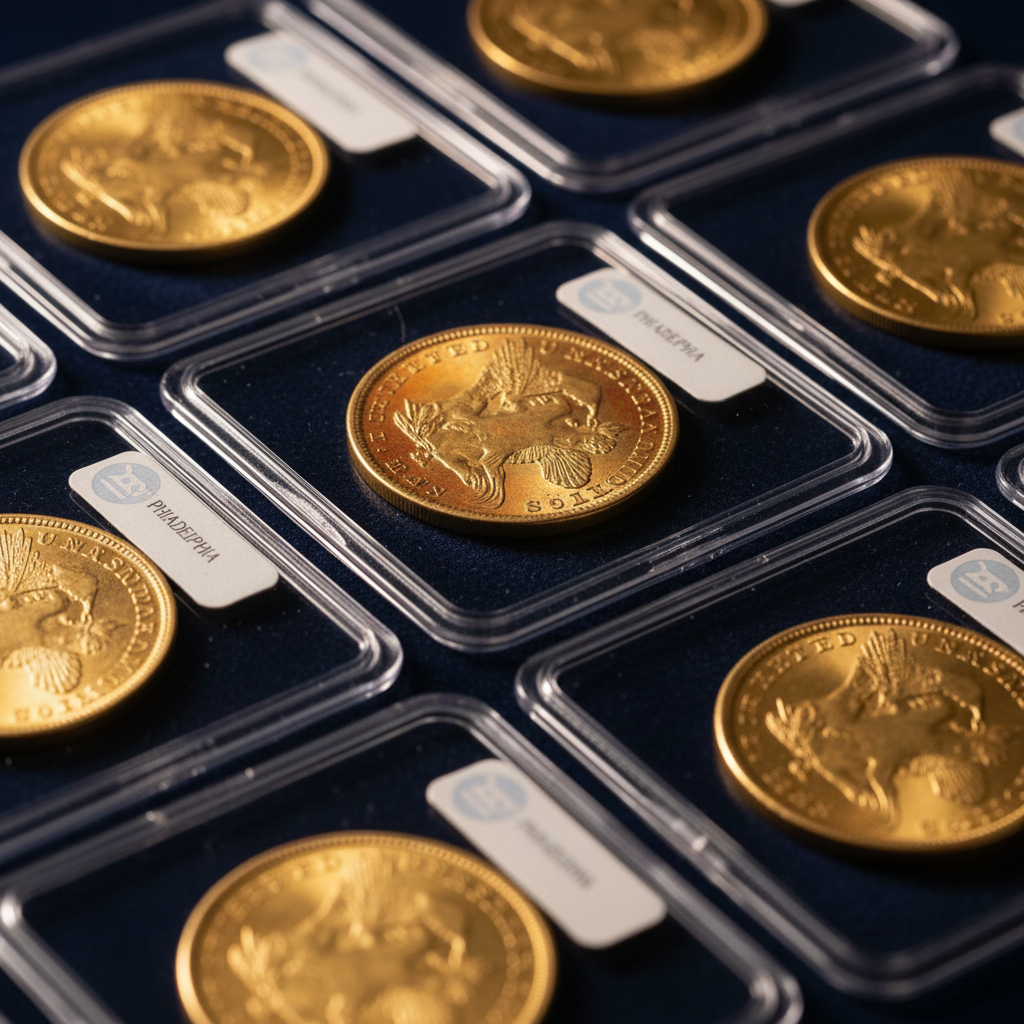
When gold bullion clears $4,475 per ounce, most investors panic-buy bars and ETFs. Serious numismatists do something more interesting — they look at the coins that gold prices left behind.
That's the argument Jeff Garrett is making for NGC, and it's one that deserves attention from anyone sitting on the sidelines of the rare coin market right now. Garrett, a former president of the American Numismatic Association and one of the most respected voices in U.S. coinage, isn't just talking theory. He's pointing at a specific, historically undervalued series: the U.S. gold dollar, minted from 1849 to 1889.
The timing is deliberate. Gold's recent run — driven by dollar weakness, geopolitical instability, and institutional flight from equities — has pushed bullion to levels that make raw metal plays feel crowded and late. Stocks have dropped sharply. Alternative assets are volatile. And into that environment, Garrett is making a case for numismatic gold as a category that benefits from bullion momentum without being entirely hostage to it.
The Case for Gold Dollars Specifically
The U.S. gold dollar series spans three distinct design types across four decades, giving collectors genuine variety within a compact format. Type 1 coins (1849–1854) feature the Liberty Head design. Type 2 (1854–1856) introduced the controversial small Indian Princess head — widely considered one of the weakest designs in American coinage history, which ironically makes it a fascinating area for specialists. Type 3 (1856–1889) corrected the proportions with a larger Indian Princess portrait and runs long enough to include both common-date Philadelphia issues and legitimately scarce branch mint coins.
What makes the series compelling from a market standpoint is the gap between bullion value and numismatic premium on mid-grade examples. A circulated Type 1 gold dollar in VF-30 carries meaningful collector demand independent of spot price, but it's not so rare that a determined collector can't build a complete date set over time. The series rewards patience and knowledge — the two things that separate collectors from speculators.
The genuinely rare pieces — think the 1849-C Open Wreath or the 1875, with a mintage of just 400 business strikes — trade at multiples that have historically held up through multiple gold price cycles. That's not a coincidence. Coins with sub-1,000 mintages don't suddenly become common when spot gold corrects.
What the Market Is Actually Doing
Garrett's recommendation lands in a market that's been quietly rerating numismatic gold upward. Heritage Auctions and Stack's Bowers have both seen strong results for certified U.S. gold across the past 18 months, with NGC- and PCGS-graded type coins in MS-62 through MS-64 outperforming expectations at major sales. The NGC population data on gold dollars reflects a series where truly gem examples — MS-65 and above — remain genuinely scarce across most dates, even common ones.
That scarcity isn't manufactured. Gold dollars circulated hard. They were the workhorse denomination of mid-19th century commerce, and they show it. Finding a Type 2 gold dollar in MS-64 with original skin and no problems is legitimately difficult. The NGC registry competition in this series is real, and it's been intensifying.
The broader context matters here too. When bullion surges past $4,000 per ounce, collector coins with meaningful gold content get a floor that didn't exist at $1,800 spot. A gold dollar contains roughly 0.04837 troy ounces of gold — not much at any price, but at $4,475 spot, even that floor is higher than it's been in the series' modern collecting history. The numismatic premium on common-date circulated pieces is essentially free at current bullion levels.
The Entry Point Question
For collectors who haven't touched U.S. gold, the gold dollar is arguably the most accessible entry point in the entire series — more so than Liberties, Saints, or Indians, which require significantly larger capital commitments per coin. A type set of all three gold dollar designs in AU-55 is achievable for well under $5,000 total, depending on market timing and source. A complete date-and-mintmark set is a lifetime project, but an attainable one.
Garrett's broader point — that numismatic gold offers a smarter alternative when bullion feels frothy — isn't novel. But the specific moment he's making it, with gold at multi-decade highs and equity markets under pressure, gives the argument unusual force. Collectors who've been waiting for a reason to start a U.S. gold program are looking at one of the more compelling setups in recent memory.
The gold dollar won't make anyone rich overnight. But in a market where everything feels overpriced and overheated, a series with genuine historical depth, real scarcity at the top end, and a bullion floor that's never been higher is exactly the kind of contrarian play that tends to look obvious in hindsight.