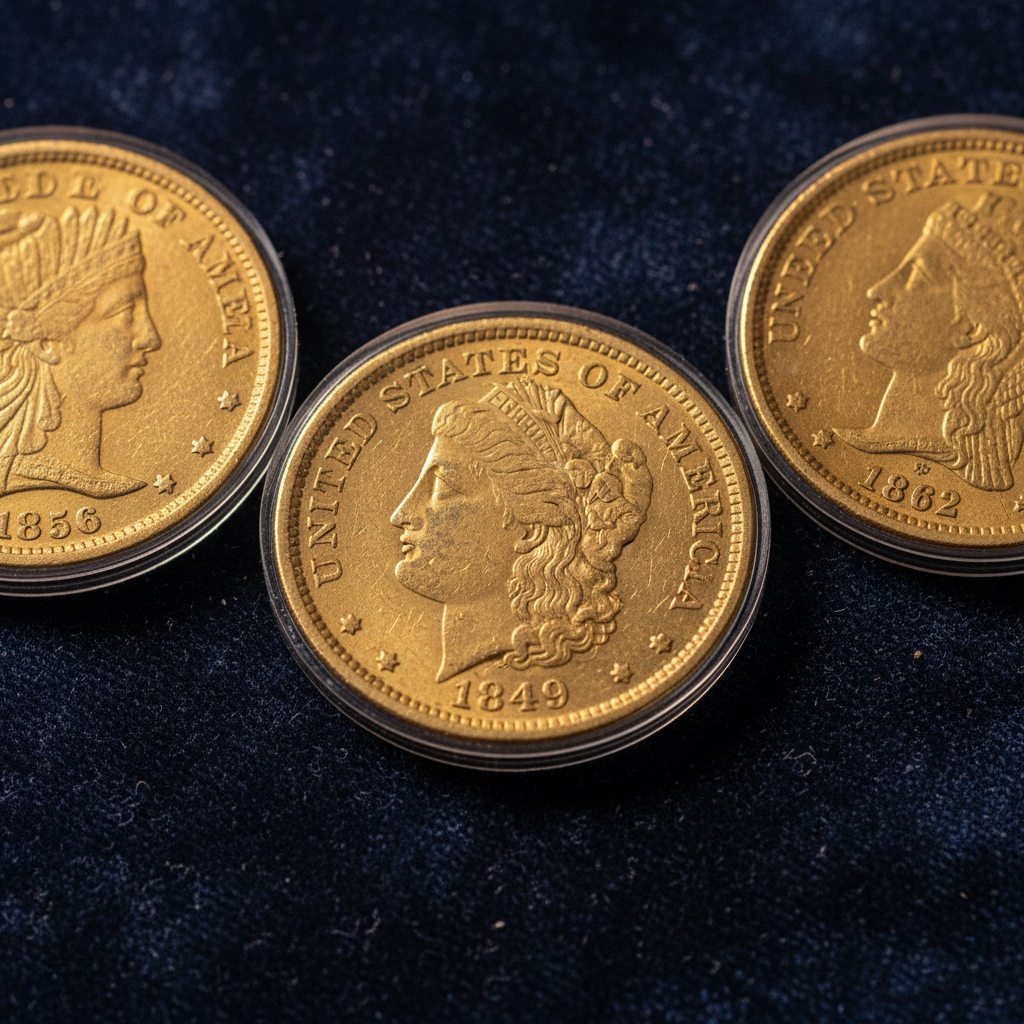
Doug Winter has spent decades handling rare U.S. gold coinage at the highest levels of the market, and his assessment of gold dollars is blunt: finding a specimen with genuine eye appeal is genuinely hard. Not hard as in competitive-auction hard. Hard as in the coins themselves seem constitutionally opposed to looking good.
That's a significant statement about a series that spans 1849 to 1889 and includes three distinct design types — the Liberty Head (Type 1), the Indian Princess Small Head (Type 2), and the Indian Princess Large Head (Type 3). Across all three, the combination of small diameter, shallow relief, and the realities of 19th-century production conspired against visual quality in ways that still punish collectors today.
Why Gold Dollars Fight You on Every Front
Eye appeal in numismatics isn't one thing. It's the intersection of strike, luster, color, and surface preservation — and gold dollars tend to fail on multiple counts simultaneously.
Strike is the first problem. The Type 2 Indian Princess, minted from 1854 to 1856, is arguably the most poorly struck U.S. coin type ever produced in quantity. The design was simply too intricate for the small planchet. High-grade Type 2 examples with full, sharp detail are genuinely rare — not just scarce in a population-report sense, but rare in the way that makes experienced dealers stop and look twice. A PCGS MS-64 Type 2 with full strike commands a premium that the bare grade doesn't begin to reflect.
Luster compounds the issue. Gold dollars circulated heavily in commerce during the 1850s and 1860s, meaning that most surviving examples were handled, spent, and worn before anyone thought to save them. Uncirculated survivors frequently show the kind of baggy, abraded surfaces that result from bulk coin storage — the marks are small given the coin's size, but under magnification they're everywhere. A coin grading MS-63 on a gold dollar often looks worse to the naked eye than an MS-63 on a larger format coin, simply because the damage is concentrated on a surface roughly the size of a pencil eraser.
Then there's color. Original, undipped gold dollar surfaces — warm honey-gold or rich orange-gold with natural cartwheel luster — exist, but they're the exception. The market for cleaned, processed, or recolored gold dollars is deep precisely because original-surface coins are so hard to find. Experienced buyers at Heritage, Stack's Bowers, and Goldberg auctions know to filter hard for originality, because the population of genuinely original gold dollars is a fraction of what the raw numbers suggest.
The Market Implications of Chronic Underperformance
Here's where Winter's observation becomes a market thesis rather than just an aesthetic complaint.
If eye appeal is structurally scarce in a series, then coins that actually have it carry a premium that generic price guides systematically undervalue. A gold dollar with original surfaces, sharp strike, and warm luster isn't just a better-looking coin — it's a different asset class within the same series. The collector who understands this and buys accordingly is playing a different game than the buyer chasing the highest raw grade at the lowest price.
The Type 1 Liberty Head dollars from 1849 to 1854 offer the most accessible entry point, with common dates in PCGS or NGC MS-63 trading in the $400–$700 range depending on the specific date and quality. But the spread between a generic MS-63 and a premium-quality MS-63 with original color and strong luster can easily reach 50 to 100 percent — a gap that only buyers with genuine knowledge can exploit.
Rare date gold dollars amplify this dynamic considerably. An 1861-D gold dollar — struck at the Dahlonega Mint in the final months before the Confederacy seized the facility — represents one of the most historically charged issues in all of American numismatics. In any grade with original surfaces, demand from both type collectors and Southern gold specialists keeps prices firm. The story sells, but only if the coin itself doesn't undercut it.
What Serious Buyers Actually Look For
When experienced gold dollar buyers examine a coin, they're running a mental checklist that goes well beyond the holder grade:
- Is the luster original, or has the coin been dipped and recolored?
- Does the strike show full hair detail on the obverse portrait?
- Are the field surfaces free of the deep, concentrated bag marks that plague this series?
- Does the color read as natural — warm gold or orange-gold — rather than the flat, washed-out look of a processed coin?
- On Type 2 issues specifically, is there any sharpness at all in the headdress feathers?
Coins that check all five boxes are genuinely rare across the entire series. Finding one at a price that reflects only the grade and not the quality premium is rarer still.
Gold dollars have always been a specialist's series — small, finicky, and unforgiving. Winter's point isn't that collectors should avoid them. It's that most collectors are buying them wrong, chasing grades on coins that look mediocre at best, while the truly exceptional examples sit in advanced collections and rarely surface. In a market where eye appeal drives long-term value across virtually every collectibles category, that's not a minor distinction. It's the whole game.