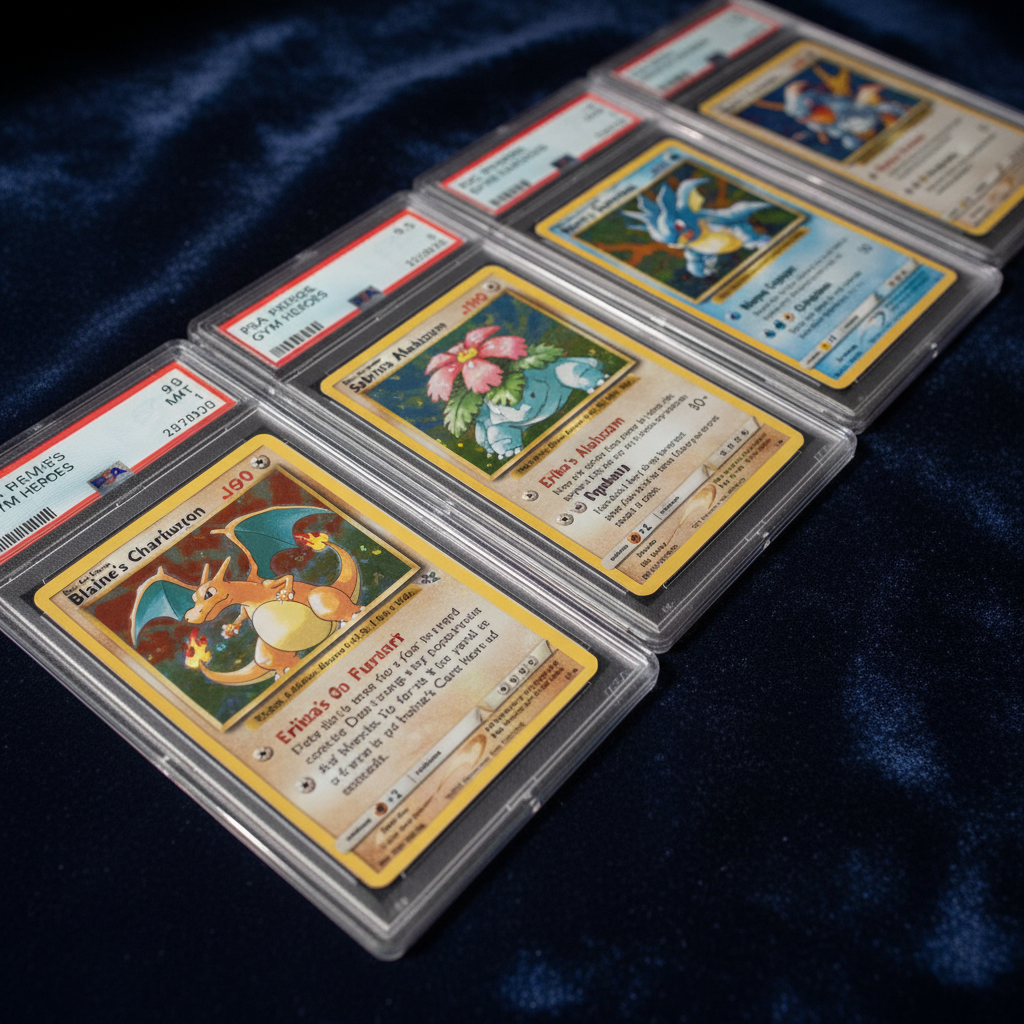
Twenty-five years after its August 2000 release, Pokémon Gym Heroes is commanding serious collector attention — and serious money. The set, catalogued as G1 in most set registries, was a structural departure from everything that came before it. Base Set, Jungle, and Fossil were built around biological species. Gym Heroes pivoted to something more narrative: Owner's Pokémon, cards tied directly to the rosters of Kanto's Gym Leaders. Brock's Onix. Misty's Tentacruel. Erika's Dragonair. The concept aged extraordinarily well.
What's driving renewed market heat isn't nostalgia alone — it's scarcity at the top of the grading curve. Gym Heroes was printed in an era when pack-fresh condition was the exception, not the rule. Centering issues, print lines, and surface wear plague the set at a population level, which means PSA 10 copies of the key cards are genuinely rare. That scarcity is now being priced accordingly.
The Cards Moving Real Money
The five heaviest hitters in the current Gym Heroes market break down across a surprisingly diverse range of reasons — banned status, artwork prestige, competitive legacy, and raw scarcity all factor in depending on the card.
Sabrina's Gengar sits at the top of the conversation for reasons that go beyond gameplay. The card was pulled from tournament-legal status due to its attack mechanic, which created confusion around rule enforcement — a distinction that makes it a genuine curiosity piece for both competitive historians and set completionists. Banned cards with legitimate tournament histories carry a premium that purely cosmetic cards can't replicate. PSA 10 copies have cleared well above the $1,000 threshold in recent Heritage and Goldin auction cycles, with population counts thin enough to keep supply pressure elevated.
Blaine's Moltres brings a different kind of energy. The Holo artwork is among the most visually dynamic in the entire set — fire-type cards from this era aged better aesthetically than most — and the card's Fire-type synergy made it a genuine competitive consideration in early format play. High-grade copies have been trading in the $400–$700 range depending on centering and surface quality, with BGS 9.5 Black Labels essentially non-existent in the population.
Erika's Dragonair is the aesthetic argument. The artwork — a serpentine Dragon-type rendered in soft pastels against a watercolor background — is routinely cited as one of the most beautiful cards in the entire Gym series. It's the kind of card that crosses over from the graded slab market into display collecting, which broadens the buyer pool considerably. That crossover demand is a legitimate price multiplier.
Rocket's Scyther earns its place on pure competitive pedigree. The card was meta-relevant in early Pokémon TCG tournament formats, which gives it staying power among players-turned-collectors who remember the card as a functional piece rather than just a collectible. That player-collector crossover segment has been one of the most active buying demographics in the vintage Pokémon market over the past three years.
The fifth major hitter — rounding out the set's top tier — reinforces a pattern that runs through Gym Heroes broadly: cards that combine artwork quality, gameplay relevance, or narrative significance with genuine PSA 10 scarcity are the ones sustaining price floors, not just hitting one-off auction peaks.
Why Gym Heroes Keeps Outperforming Expectations
The broader vintage Pokémon market has seen volatility since the 2020–2021 peak, but Gym Heroes has held up better than many of its contemporaries. The reason is structural. The set's Owner's Pokémon concept created a layer of character-driven collecting that Base Set never had — you're not just chasing Charizard, you're building Misty's roster or Brock's roster. That thematic completionism drives sustained demand even when speculative froth cools off.
The print run dynamics also work in the set's favor. Gym Heroes was produced at a moment when Wizards of the Coast was still calibrating its North American print volumes, and the set didn't receive the same mass-market saturation as Base Set Unlimited. Finding raw copies in genuinely submittable condition has become harder over time, not easier, as the available pool of ungraded copies gets absorbed into slabs.
At current population levels, a PSA 10 Sabrina's Gengar represents a legitimately scarce asset. The same is true for the other top-tier holos. Collectors who dismissed Gym Heroes as a secondary set during the 2020 boom may find themselves paying a premium to correct that oversight now.