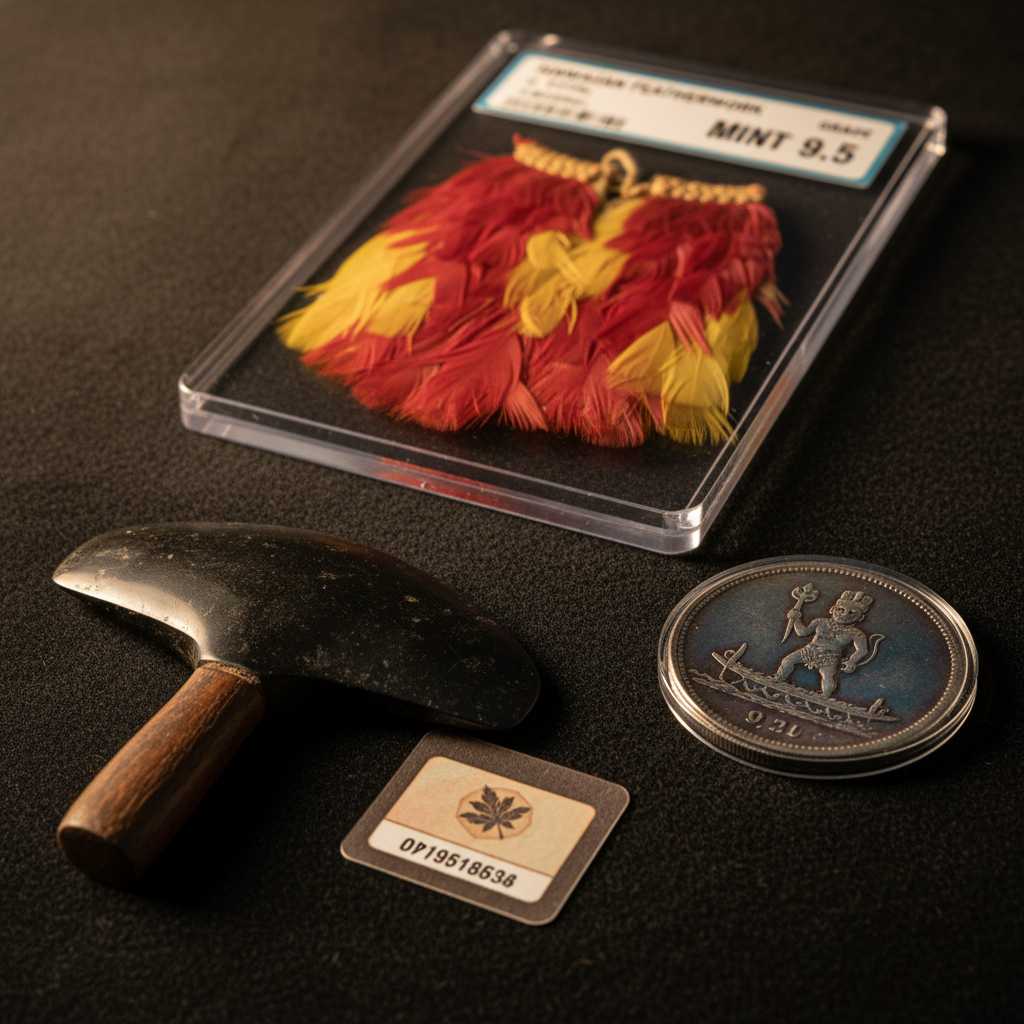
Before Hawaii was a state, before it was a territory, before American sugar barons engineered the overthrow of Queen Liliuokalani in 1893, it was a sovereign kingdom with a material culture so distinct that its artifacts occupy a category entirely their own in the American antiques market. As the United States moves toward its 250th anniversary in 2026, Hawaii's story forces collectors to reckon with something the broader Americana market rarely confronts head-on: the difference between heritage and appropriation, and what that means for the objects changing hands today.
This is not a comfortable conversation. But it is a necessary one — and increasingly, it's driving real market behavior.
The Objects That Define a Culture
Hawaiian collectibles span an extraordinary range. At the apex sit the featherwork pieces — kāhili (royal feather standards), cloaks, and helmets — that represent some of the most technically demanding craft traditions in the Pacific. A museum-quality ʻahuʻula (feather cloak) hasn't appeared at major auction in years, and when such pieces do surface, they tend to move through private treaty rather than public sale, with values that specialists estimate north of $500,000 for documented examples. The Bishop Museum in Honolulu holds the world's most significant collection, and its stewardship has effectively removed the finest pieces from circulation entirely.
Below that rarefied tier, the market is active and surprisingly accessible. Vintage koa wood bowls — hand-turned from the native Hawaiian acacia — regularly appear at Heritage Auctions and regional Hawaiian auction houses like Kaminski's Honolulu sales. A well-figured, pre-1950s koa bowl in good condition typically fetches between $800 and $4,500 depending on provenance, form, and patina. The best examples, with documented lineage to specific craftsmen or ali'i (chiefly) households, can push considerably higher.
Surfboard collecting is its own submarket. Pre-war Hawaiian boards — the long, solid olo and alaia styles predating the balsa-and-fiberglass revolution — are genuine museum pieces. A documented pre-1940 solid koa surfboard sold through a California estate auction in 2021 for $68,000, a figure that would have seemed absurd to the surf memorabilia market a decade earlier. Condition is brutal on these objects; the ones that survived did so largely because they ended up in institutional collections or dry storage far from the ocean.
Provenance, Repatriation, and the Market's Blind Spot
The Native American Graves Protection and Repatriation Act of 1990 (NAGPRA) applies to federally recognized tribes and Native Hawaiian organizations, which means a meaningful portion of Hawaiian cultural material carries legal complexity that general Americana does not. Collectors and dealers who treat Hawaiian sacred objects — akua figures, burial-associated items, ceremonial implements — as straightforward antiques are operating on increasingly thin ice, both legally and reputationally.
This isn't abstract. In 2023, updated NAGPRA regulations significantly tightened requirements around the transfer of Native Hawaiian objects, and several prominent auction houses have quietly tightened their consignment review processes for Pacific material as a result. The practical effect: genuinely sacred or funerary objects have become nearly untouchable in the commercial market, while secular material — furniture, textiles, tourism-era crafts, vintage photography — has seen increased collector interest as buyers seek culturally significant pieces with cleaner provenance chains.
Vintage Hawaiian quilts, for instance, have appreciated steadily. The distinctive kapa lau appliqué style, with its bold symmetrical patterns derived from natural forms, commands strong prices from both textile collectors and Hawaiian cultural institutions. A documented 19th-century example in good condition is a five-figure purchase at minimum. 20th-century examples from known quilters can reach similar territory when the maker's identity is established.
The Aloha Spirit as Collectible Narrative
There's a broader Americana angle here that the 250th anniversary context makes impossible to ignore. The standard narrative of American collectibles — colonial silver, Federal furniture, Declaration-era ephemera, Civil War material — reflects a particular, East Coast-centric vision of national identity. Hawaiian material culture represents something genuinely different: a non-European tradition absorbed into the American story through annexation rather than settlement, carrying a living Indigenous community that never stopped practicing its traditions.
That living continuity matters to the market in ways that, say, Shaker furniture does not have to contend with. Contemporary Hawaiian craftspeople working in traditional forms — lauhala weavers, koa woodworkers, featherwork artists — exist alongside the antique market, and the best of them command serious prices. A contemporary koa bowl by a recognized Hawaiian master can sell for more than a comparable 19th-century piece, because the maker is known, the cultural context is documented, and the object carries no repatriation risk.
For collectors approaching Hawaiian material as part of a broader American history collection, the 250th anniversary moment is genuinely clarifying. The objects that tell Hawaii's story most powerfully are not the tourist-trade aloha shirts and mid-century tiki ephemera — though that market has its own devoted following and legitimate cultural interest. They are the objects made by Hawaiian hands, for Hawaiian purposes, in a tradition that predates American sovereignty by centuries. Collecting them responsibly means understanding that history, not just the auction record.
The United States turns 250 in a country that includes a place where the American story is, at best, one chapter among many. The collectibles market is slowly catching up to that complexity.