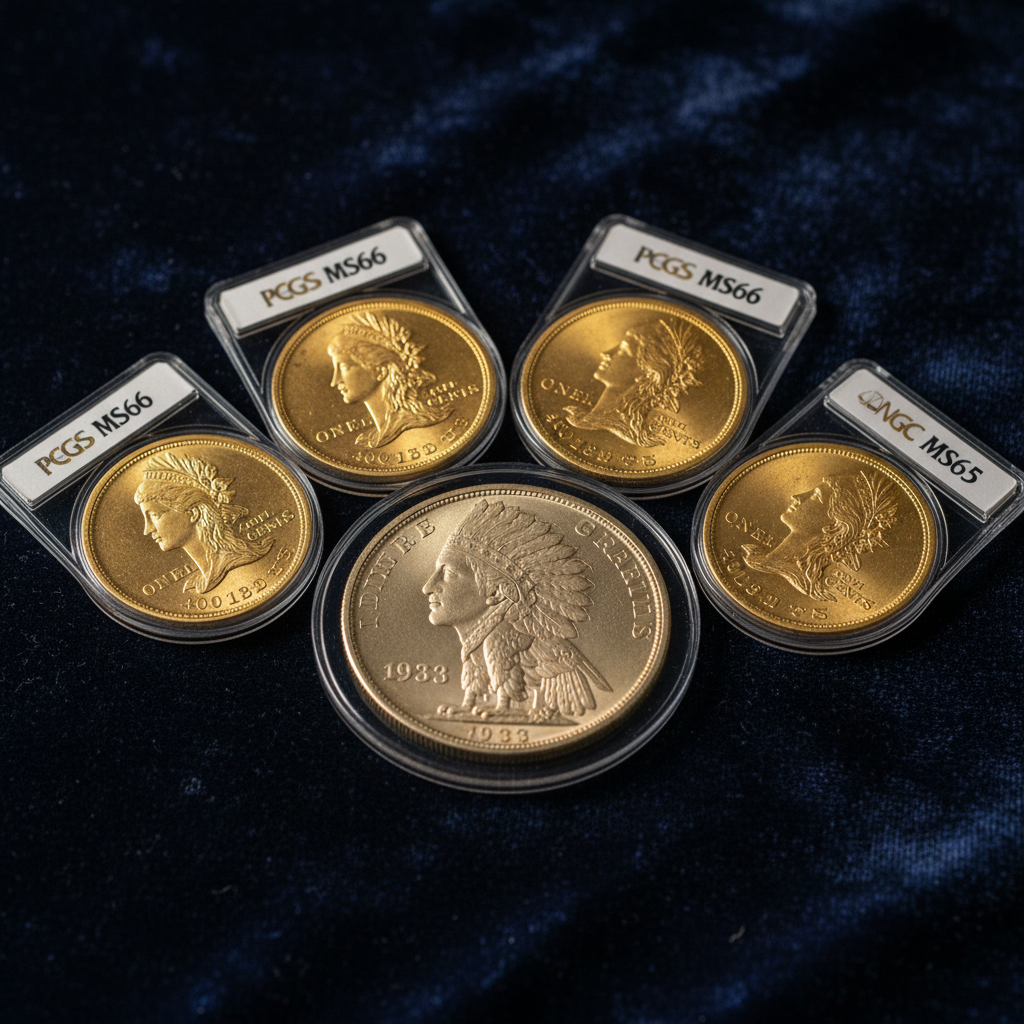
All four gold stella issues from The Presidio Collection, Part II. A fresh-to-market 1933 Indian Head Eagle. Registry-level coins across the board. Heritage Auctions' April 29–May 2, 2026, CSNS U.S. Coins Signature® Auction isn't just a major sale — it's a credentialing moment for the spring numismatic calendar.
The Central States Numismatic Society convention has long served as one of the hobby's premier gathering points, and Heritage has consistently used the platform to move serious metal. This year's lineup suggests they intend to make a statement.
The Stellas: A Complete Set, Rarely Assembled
The gold stella is one of American numismatics' great white whales. Struck in 1879 and 1880 as pattern coins to explore a potential international currency standard, they were never released for circulation — which means every example in existence today is a survivor of political failure and collector fortune. The four major varieties — the 1879 Flowing Hair, 1879 Coiled Hair, 1880 Flowing Hair, and 1880 Coiled Hair — represent the complete stella universe, and assembling all four in a single collection is a feat that demands both capital and patience.
The Presidio Collection, Part II brings all four to auction simultaneously. That's significant. Collectors chasing a complete stella set typically spend years hunting individual pieces across multiple platforms, paying whatever the market demands at each turn. Seeing the complete run surface in one sale compresses that chase into a single bidding window — and tends to attract the kind of competitive energy that pushes realized prices well above pre-sale estimates.
Mintage context matters here. The 1879 Coiled Hair and 1880 Coiled Hair varieties are among the rarest U.S. pattern coins with any collector following, with surviving populations in the dozens rather than hundreds. When high-grade examples of either appear at auction, they routinely generate seven-figure conversations. The 1880 Coiled Hair in particular has seen fewer than a handful of major auction appearances in the past decade.
The 1933 Indian Eagle: Fresh Paper, Maximum Premium
If the stellas are the centerpiece, the 1933 Indian Head $10 Eagle is the headline. The 1933 date carries enormous weight in American gold coinage — not because of its technical rarity alone, but because of what it represents: the last gasp of circulating U.S. gold before FDR's executive order effectively ended the era. Most 1933-dated gold was melted. The pieces that survived did so through a combination of circumstance, collector intervention, and legal complexity that took decades to untangle.
The 1933 Saint-Gaudens Double Eagle dominates headlines — the Weitzman example sold for $18.9 million at Sotheby's in 2021 — but the 1933 Indian Eagle occupies its own distinct category. It's legal to own, less publicized, and consequently underappreciated relative to its historical significance. Auction records for top-grade examples have pushed well past the $1.5 million threshold, and fresh-to-market coins — pieces that haven't circulated through the major auction ecosystem recently — carry a premium that seasoned bidders understand intuitively.
Fresh to market is doing real work in this sale's marketing, and it should. A coin that hasn't appeared at a major auction in years arrives without a public price history that anchors bidder expectations downward. That's a structural advantage for the consignor and a genuine opportunity for collectors who believe the market has moved since the coin's last public appearance.
Registry Competition and the Broader Catalog
Beyond the marquee lots, Heritage is positioning this as a deep registry-quality sale — meaning coins graded and certified at the top of their respective population reports, the kind of material that moves needle scores in PCGS Set Registry and NGC Registry competition.
Registry collecting has reshaped the high-end coin market over the past two decades. When a collector needs a specific coin in a specific grade to hold or improve a registry ranking, they don't negotiate — they compete. That dynamic inflates realized prices on coins that might otherwise trade at modest premiums, and it creates a reliable buyer pool for sellers consigning top-pop or condition-census material.
The April–May window is well-timed. Spring auction season traditionally sees strong buyer participation as collectors emerge from the slower winter months with fresh capital and renewed focus. The CSNS convention floor provides Heritage with a captive audience of serious numismatists, many of whom will preview lots in person before the auction closes online.
For anyone tracking the upper tier of U.S. coin values in 2026, this sale is required viewing. The stella set alone would anchor most major spring auctions. Paired with a fresh 1933 Indian Eagle and a deep registry catalog, Heritage has assembled something that doesn't come together often — and the realized prices will tell us exactly where the market stands on American gold's most storied survivors.