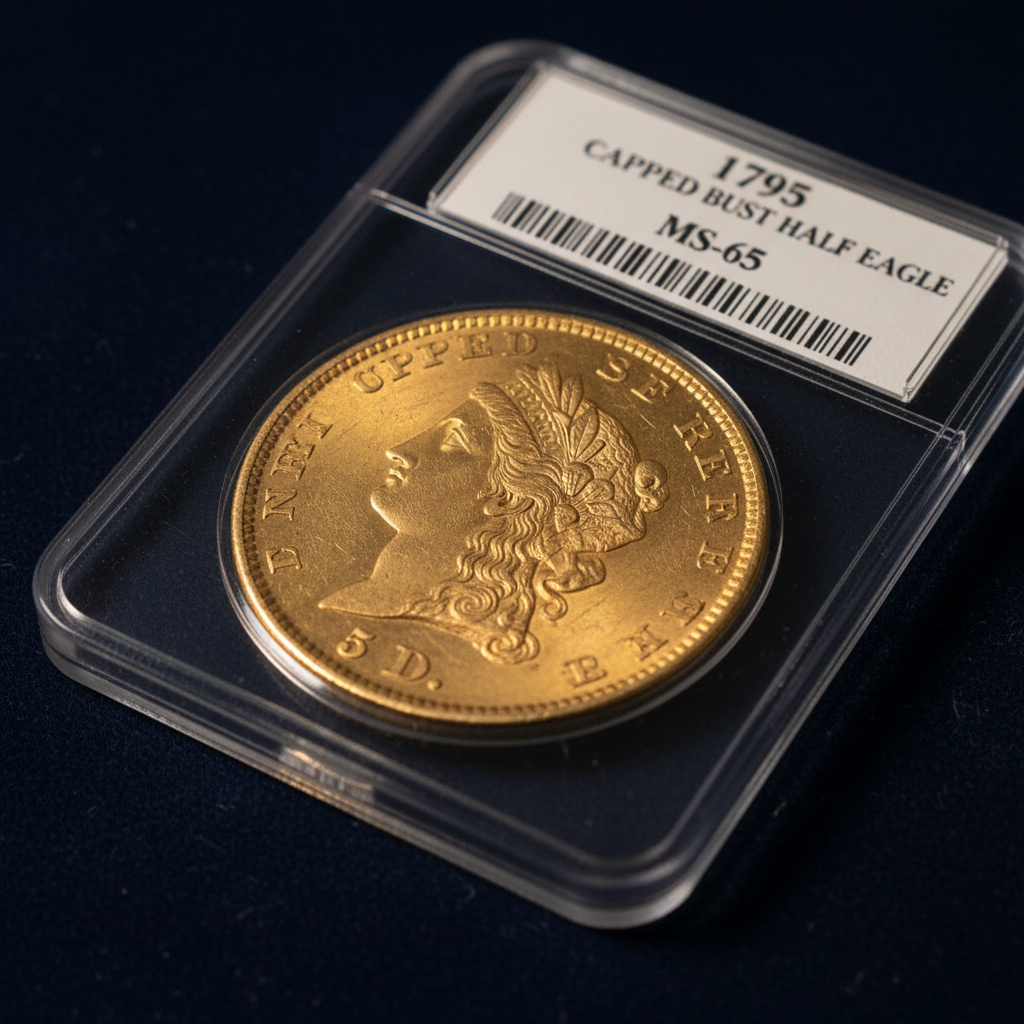
Heritage Auctions closed its March 26–28, 2026 U.S. Coins Signature® Auction at $11,948,630 in total realized sales — a result that would be impressive in any environment, but lands with particular weight given the current headwinds facing discretionary collectibles markets. Early American gold carried the session, and one coin above all others defined the sale.
The 1796/5 Half Eagle — the finest known example of one of the most historically loaded early U.S. gold issues — crossed the block to become the auction's marquee lot. The coin's overdate designation, struck when dies from 1795 were re-engraved for use in 1796, places it at a singular moment in American monetary history: the young republic still figuring out how to mint its own money. That the finest surviving specimen surfaced here, at Heritage, in a single-session sale rather than a dedicated rarities event, says something about where serious numismatic capital is sitting right now.
Early Gold and the Rarity Premium
Early U.S. gold has been one of the most durable segments of the coin market over the past decade, largely immune to the volatility that has rattled modern issues and bullion-adjacent material. The 1796/5 Half Eagle sits at the apex of that category. Half Eagles from this era — $5 gold pieces produced at the Philadelphia Mint in the first years of federal coinage — are scarce in any grade. An overdate variety in the finest certified condition is, by definition, a once-in-a-generation opportunity.
Heritage described this example as the finest ever offered at public auction. Population data for early U.S. gold at the top of the grading scale is thin by nature — these coins weren't preserved with future collectors in mind, they circulated in a cash-strapped economy — which means when a condition rarity appears, the bidding dynamic shifts from price discovery to controlled competition among a very small group of advanced collectors.
Beyond the headline lot, the sale's broader early gold category delivered consistently. That pattern — strong results distributed across a category rather than concentrated in a single trophy lot — is the hallmark of genuine collector demand rather than speculative heat. It's a meaningful distinction.
Stellas, Shipwrecks, and the Supporting Cast
Two other collecting categories added texture and depth to the $11.9 million total: Stella pattern coins and shipwreck bullion ingots.
Stellas — the $4 gold pattern coins proposed in 1879 and 1880 as a potential international trade currency — occupy a peculiar and beloved niche in American numismatics. They were never adopted for circulation, which makes every surviving example a proof-only rarity. The Flowing Hair and Coiled Hair varieties from those two years consistently draw aggressive bidding from type collectors and specialists alike, and their presence in a sale of this profile is a reliable indicator of consignor confidence in the room.
The shipwreck ingots represent a different kind of appeal entirely. Historic bullion recovered from sunken vessels carries provenance that no mint-state coin can replicate — tangible connection to a specific moment of loss, recovery, and history. Collectors who pursue this material aren't buying metal; they're buying narrative. That Heritage included this category alongside classic numismatic rarities reflects a broadening of what serious coin buyers consider portfolio-worthy.
- Total Realized: $11,948,630
- Auction Dates: March 26–28, 2026
- Auction House: Heritage Auctions, Dallas
- Headline Lot: 1796/5 Half Eagle — finest known example
- Supporting Categories: Stella pattern coins, shipwreck bullion ingots
What $11.9 Million Actually Means Right Now
Context matters here. Heritage regularly runs nine-figure auction totals across its broader collectibles platform, so $11.9 million for a single coin session isn't a record-breaker in isolation. What it signals is sustained institutional-level demand for top-tier numismatic material at a moment when many adjacent collectibles categories are experiencing price compression and buyer hesitation.
The coin market's upper tier — pre-federal and early federal gold, key-date rarities, condition census examples — has historically been the last to soften and the first to recover. This sale fits that pattern. The buyers who compete for a finest-known 1796/5 Half Eagle are not the same buyers who drove modern raw coin prices to unsustainable levels during the 2020–2021 boom. They're a smaller, more deliberate cohort, and they showed up.
For dealers and collectors watching from the sidelines, the March result is a data point worth taking seriously. The market for genuinely rare early American coinage isn't waiting for conditions to improve. It's operating as though conditions are already fine — because at that level, they largely are.